
Strawberry Fields REIT Bets on Healthcare Assets to Fuel Lean Growth
The REIT leverages its specialized healthcare property portfolio and operational model to achieve profit growth, while managing regulatory and legal complexities.
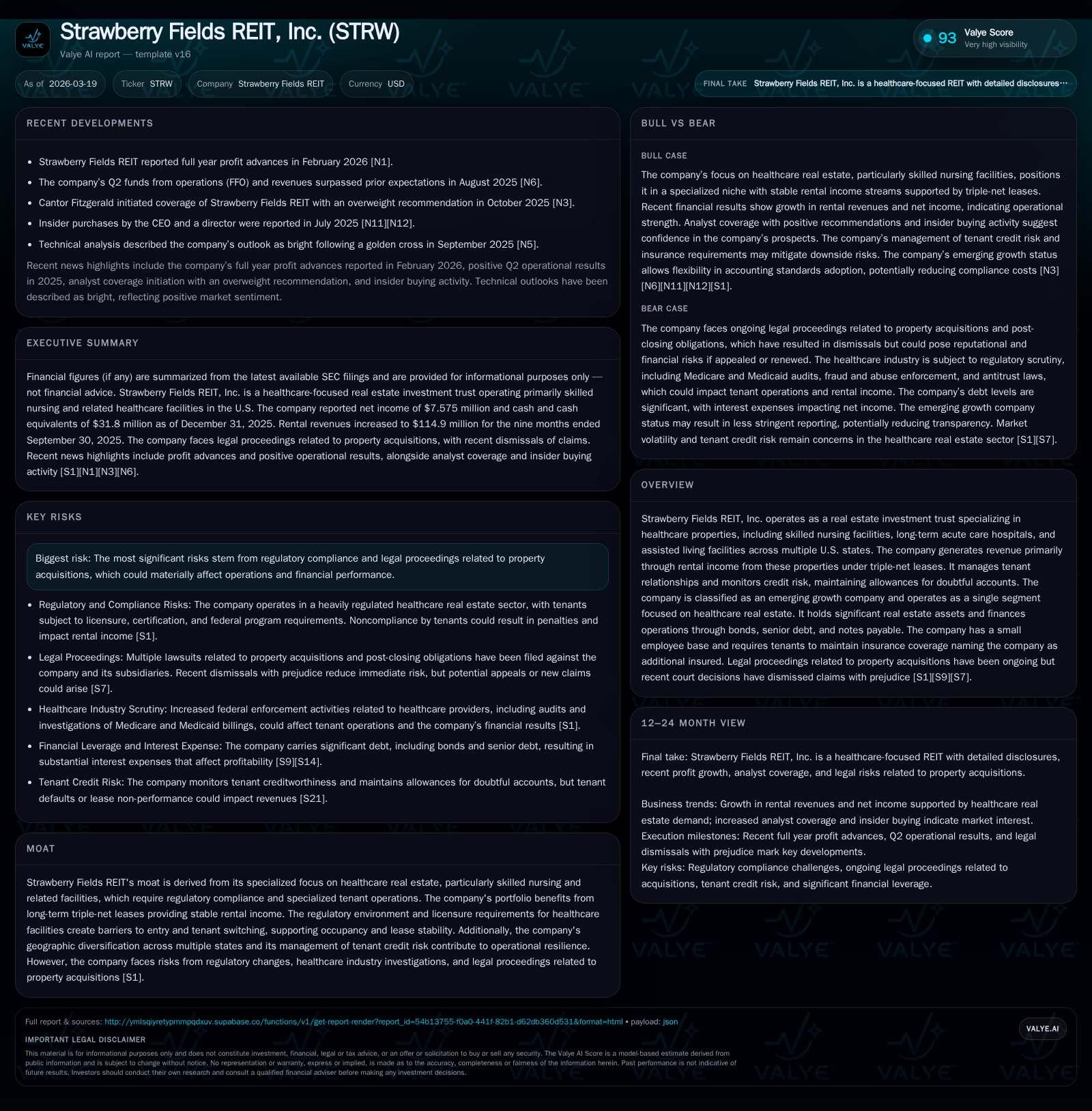
Strawberry Fields REIT, Inc. has recorded robust growth in operating income and net income, supported by its focus on triple-net leased skilled nursing and healthcare facilities across multiple states. This niche specialization underpins stable rental revenues amid a complex regulatory landscape. The company’s capital structure features a diversified bond and senior debt mix with prudent liquidity management. Dividend payments align with cash flow strength, while share repurchases remain modest. Future growth depends on tenant credit quality, geographic expansion, and regulatory developments impacting lease renewals and acquisition strategies.
Profit Momentum Fueled by Niche Portfolio Expansion
Strawberry Fields REIT has achieved significant profit momentum through its focused portfolio of healthcare properties primarily consisting of skilled nursing facilities, long-term acute care hospitals, and assisted living centers. The company's strategic use of triple-net leases—where tenants bear responsibility for property taxes, insurance, and maintenance expenses—has created a reliable revenue stream anchored by long-term contracts [S1][F1]. This setup minimizes operating cost volatility for Strawberry Fields while transferring much of the operational complexity to experienced tenant operators.
Operating income surged from approximately $61.3 million in FY2024 to $84.3 million in FY2025, representing a robust 37.5% year-over-year increase [F1]. This reflects both organic rent escalations inherent in triple-net agreements as well as portfolio expansions through acquisitions completed over recent years [S1]. Stability in rental collections is bolstered by the regulatory licenses required for healthcare operations, which act as barriers against tenant turnover given the onerous licensure transfers under federal programs such as Medicare.
Net income more than doubled relative to the prior year—from $4.1 million to $7.6 million—driven by top-line gains alongside disciplined cost controls [F1]. Effective monitoring of tenant credit risk safeguards earnings quality amidst sector-specific risks [S1].
Regulatory and Legal Challenges Loom Over Growth Outlook
Despite positive financial trends, Strawberry Fields faces uncertainties from a complex regulatory environment governing skilled nursing facilities and healthcare real estate ownership [S1][S8]. Tenants operate under stringent federal and state licensing regimes with notification requirements upon ownership or operational changes critical for continued Medicare/Medicaid reimbursements [S1]. Failures here can lead to penalties or operational disruptions.
Ongoing legal disputes linked to past acquisitions in Arkansas, Kentucky, and Massachusetts have largely been dismissed or resolved without material financial impact beyond insurance coverage [S1]. However, these matters introduce potential distractions.
Heightened antitrust enforcement targeting anti-competitive behaviors within healthcare markets also poses indirect risks to tenants’ businesses affecting lease stability [S8].
These factors necessitate diligent compliance monitoring by Strawberry Fields and its tenants, potentially constraining future growth despite current profitability.
Key Performance Metrics: Historical Trends
Historical performance (annual)
| FY | Net ($mm) | CFO ($mm) | OpInc ($mm) | Net YoY |
|---|---|---|---|---|
| 2025 | 8 | 90 | 84 | +85.0% |
| 2024 | 4 | 59 | 61 | +64.1% |
| 2023 | 2 | 55 | 47 | +34.8% |
| 2022 | 2 | 51 | 50 |
Source: SEC companyfacts cache [F1].
Capital returns and efficiency (annual)
| FY | Buybacks ($mm) | ROE% |
|---|---|---|
| 2025 | 1 | 62.6 |
| 2024 | 2 | 22.5 |
| 2023 | 33.2 | |
| 2022 | 23.8 |
Source: SEC companyfacts cache [F1].
Note: Buybacks data pertains only when reported; equity fluctuations reflect capital raises or repayments [F1].
The steep rise in operating income reflects portfolio growth via acquisitions mainly executed between FY2023–FY2025 and enhanced rent realization embedded within triple-net leases [F1][S1]. Net income outpaced revenue increases due to improved margin management including tighter recovery on tenant delinquencies aligned with credit risk allowances [S1]. Operating cash flow grew faster than net income indicating strong underlying cash generation fueling liquidity.
Equity declined in FY2025 relative to FY2024 likely reflecting share repurchases offsetting some capital inflows amid stable retained earnings; buybacks reduced markedly signaling cautious capital deployment post-earnings acceleration [F1].
Capital Structure: Debt Profile and Funding Strategy
The REIT utilizes a layered debt structure comprising multiple bond series alongside senior loans supporting real estate purchases and refinancing activities . Deferred issuance costs are amortized using the interest method consistent with industry best practices minimizing earnings volatility from financing fees [S6][S23].
As of Q3/2025 end notes indicate holdings include Series A-D bonds backed by pledged assets mainly healthcare facilities across ten U.S states. Senior debt balances decreased modestly reflecting scheduled repayments partially offset by new issuances totaling around $86 million during the year [S4][S5][S15].
Tenant payments include escrowed reserves earmarked for property tax payments and insurance premiums reducing timing mismatches between cash inflows/outflows for these variable expenses [S6][S7][S22], mitigating landlord exposure while maintaining liquidity buffers.
Market concentration risk is material given nearly half of licensed beds reside within Illinois (27%) and Indiana (22%)—states whose Medicaid/Medicare reimbursement rates or regulatory changes could disproportionately impact revenues if unfavorable revisions occur abruptly [S6].
Dividend Policy and Share Repurchase Activity Reflect Earnings Strength
Dividend distributions mirror growing cash flow capacity amidst prudent capital management policies [N1][S3][F1]. The Board declared a quarterly dividend of $0.16 per common share early in calendar year 2026 following sustained operating cash flow gains totaling about $90 million for FY2025—a rise over half from prior levels highlighting solid payout coverage consistent with healthcare REIT standards [N1][F1].
Share repurchases were modest relative to prior years' activity ($652k vs $2.47 million), suggesting management prioritizes balance sheet strength or acquisitions over aggressive buybacks amid external uncertainties from regulation or litigation risks [F1].
Outlook: Navigating Healthcare Real Estate Risks Amid Growth Opportunities
While explicit forward guidance is not provided publicly by Strawberry Fields REIT’s disclosures or news releases,[N1] future growth appears tied closely to enhancing tenant relationships through credit risk frameworks ensuring timely lease receivables despite challenges posed by shifting Medicare/Medicaid reimbursement policies [S1][N1][S29].
Geographic diversification mitigates single-state shocks; however concentrated exposure requires vigilance around state-level policy decisions affecting facility viability.
Legal matters related to historical litigations are mostly dormant post-dismissals or covered by insurance but remain relevant for reputational risk assessment among investors.
Monitoring lease renewal rates influenced by operator financial health will be key milestones shaping portfolio value sustainability versus erosion risks from adverse regulatory changes or competitive pressures.
What Investors Should Monitor Next
Investors should watch upcoming SEC filings for updates on legal proceedings tied to past acquisitions.
Sector-wide Medicaid/Medicare reimbursement policies warrant close attention given their impact on tenant cash flows critical under triple-net leasing structures.
Occupancy rates at specialized facilities alongside delinquency trends offer signals on operational risks affecting stakeholder confidence.
Debt refinancing needs as bonds mature could affect liquidity cushions depending on capital market conditions.
Overall vigilance balancing commendable earnings momentum against entrenched regulatory/legal headwinds encapsulates the nuanced investment narrative around this focused healthcare real estate trust.
This analysis was prepared based solely on publicly available information as of March 19th, 2026 including SEC filings ([S#]), financial fact snapshots ([F1]), and relevant news items ([N#]). It is intended for informational purposes without conveying investment advice or recommendations.
Disclaimer: This is research-only, informational analysis and not investment advice. It may include AI-generated interpretation and general industry context. Always verify important details using primary sources.

Comments