
Starz Entertainment’s Post-Separation Growth and Liquidity Constraints Shape Near-Term Outlook
Following its spin-off from Lionsgate in May 2025, Starz faces subscriber pressures and content cost challenges amid substantial leverage.
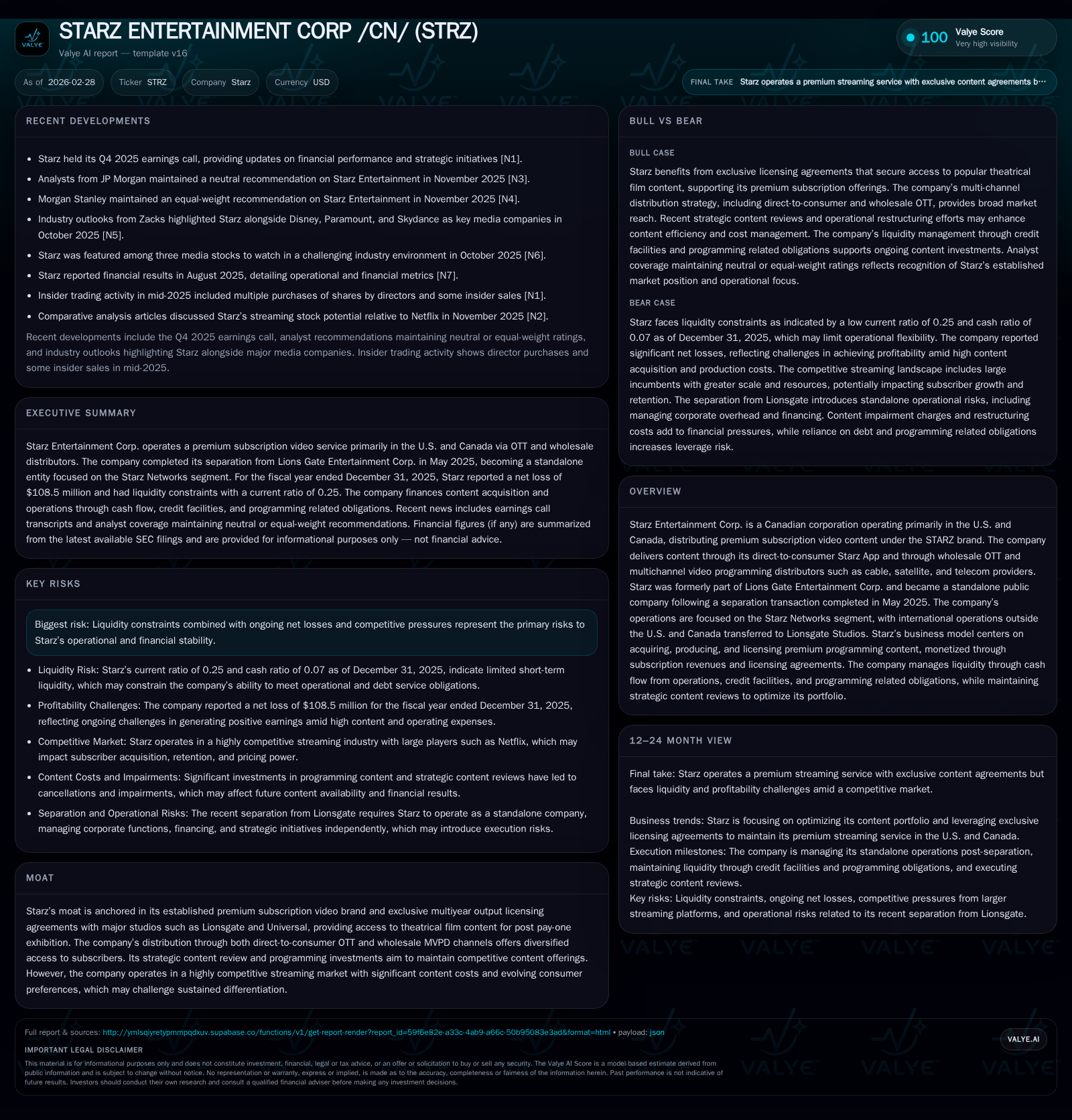
Starz Entertainment Corp. emerged as a standalone entity in mid-2025, inheriting a strong premium content brand but navigating declining subscribers and lower revenues. The company’s revenues contracted year-over-year due to subscriber attrition partly offset by reduced programming amortization and tighter marketing spending. While adjusted OIBDA showed improvement compared to pre-spin-off losses, free cash flow remains modest and leverage is significant with debt maturities concentrated in the next three years. Starz’s exclusive licensing agreements underpin content exclusivity but carry substantial financial commitments. Future growth will hinge on content strategy, subscriber stabilization, and managing capital structure amidst liquidity risks.
Company Background and Historical Performance
Starz Entertainment Corp. completed its separation from Lions Gate Entertainment Corp. in May 2025 [N1], becoming a publicly traded Canadian corporation with primary operations in the U.S. and Canada. Post-spin-off, Starz focuses on distributing premium subscription video programming under the STARZ brand through multiple channels: direct-to-consumer (the Starz App) and wholesale OTT via cable, satellite, and telecom providers .
Financially, Starz has experienced variability accentuated by the spin-off effects and restructuring. Historical revenue peaked around fiscal year (FY) 2017 at approximately $1.256 billion before declining to about $1.04 billion by FY2018 [F1]. More recently, revenue decreased further by roughly 17% year-over-year heading into FY 2025 amid subscriber contractions stemming from fewer original series premieres [S2].
Operating income reflects this volatility dramatically; after profitable results in FY2022 ($9 million operating income), operating losses ballooned during FYs 2023-2024 with figures exceeding $900 million negative largely associated with restructuring, content investments, and loss carryovers linked to legacy costs prior to spin-off [F1],[S2]. The standalone FY 2025 operating loss improved to $66.4 million but remains reflective of sizeable cost burdens [F1]. Net income mirrored this trend with a sharp reduction in losses in FY 2025 (-$108.5 million) compared to previous years [F1].
Historical performance (annual)
| FY | Net ($bn) | CFO ($mm) | OpInc ($mm) | Capex ($mm) | Net YoY |
|---|---|---|---|---|---|
| 2025 | -0.1 | 18 | -66 | 17 | +90.2% |
| 2024 | -1.1 | 397 | -939 | 35 | +45.1% |
| 2023 | -2.0 | -114 | -1858 | 49 | -968.1% |
| 2022 | -0.2 | -661 | 9 | 33 |
Source: SEC companyfacts cache [F1].
Capital returns and efficiency (annual)
| FY | Buybacks | FCF ($mm) | ROE% |
|---|---|---|---|
| 2025 | 1 | -16.8 | |
| 2024 | 362 | 352.7 | |
| 2023 | 0 | -163 | -256.2 |
| 2022 | 0 | -694 | -7.0 |
Source: SEC companyfacts cache [F1].
*FY24 and FY25 reflect calendar-year aligned figures post separation transition.
Revenue Composition Drivers
Declines in subscriber counts directly impacted subscription revenues during FY25 as noted by management [S2]. The diminished presence of original series releases early or within the period led not only to softer revenue but also materially decreased programming amortization expenses (down approximately $6 million), as fewer new series required less immediate capital charge recognition [S2]. Moreover, marketing expenditures were pared back reflecting efficiency drives alongside the scaled-back original productions budget [S2]. These factors collectively constrained top-line revenue but provided partial mitigation at adjusted OIBDA level.
Adjusted Operating Profitability
Adjusted Operating Income Before Depreciation & Amortization (OIBDA) for the six months ended September 30, 2025 was reported as $55.2 million versus $83.5 million same period prior year—signaling narrowing profitability albeit under pressure from revenue softness [S2]. This adjusted metric excludes share-based compensation, restructuring charges totaling approximately $11 million, which included expenses for transitioning operations post spin-off [S2].
Liquidity Profile and Capital Structure
Handling significant liquidity challenges is imperative given continuing operating losses combined with large contractual content commitments. As per latest disclosures:
- Cash and equivalents totaled $37 million as of December 31, 2025 [F1], up moderately from earlier quarters (e.g., $17.8 million at March 31, 2025) [S2].
- The balance sheet carries over $600 million of net debt comprising a senior secured Term Loan A facility of $300 million due December 1, 2028 plus unsecured 5.5% Senior Notes totaling roughly $325 million maturing April 15, 2029 [S4][F1].
- Programming-related obligations — including production loans and unsecured programming notes — adds material near-term cash outflows exceeding $100 million payable mostly within the next twelve months [S6][S16][S28].
- A revolving credit facility of up to $150 million remains undrawn as of September 30, 2025, providing an additional liquidity buffer though borrowing is considered only if needed based on operating cash requirements [S6][S7].
Starz’s credit agreements include customary covenants requiring maintenance of leverage ratios (net total leverage ratio capped progressively down from <=4.50x starting June 30, 2025 to <=3.50x by March 31, 2028), interest coverage ratios no lower than 2.50x and limitations on incurring liens or additional debt [S10][S15]. Early covenant compliance has been reported.
The company also uses an accounts receivable monetization program whereby trade receivables are transferred/sold to third parties for immediate cash inflows subject to ongoing servicing obligations; this mechanism yielded over $130 million proceeds for transferred receivables during recent quarters albeit typically at some loss expense recognized separately [S7][S14][S20].
Capital expenditures averaged ~$16 million in FY25 down nearly half relative to FY24 reflecting measured investment pacing aligned with cautious growth plans [F1]. Starz displays a minimal dividend policy currently given ongoing reinvestment focus and lack of distributable earnings since becoming public.
Competitive Position and Moat Analysis
Starz retains a defensible niche anchored by exclusive multiyear output licensing agreements with major Hollywood studios including Lionsgate (its former parent) and Universal Pictures — providing first pay-one window post-theatrical rights particularly for U.S.-theatrical live-action films under these studio labels beginning January 1, 2022/23 depending on label [S28][N1]. This grants early access for premium content reflected through subscription-friendly offerings.
The company operates a hybrid distribution approach combining direct-to-consumer OTT streaming via its Starz App alongside wholesale OTT via cable/satellite/telecom operators—facilitating diversified subscriber access amidst evolving viewing habits.
However, the broader premium SVOD landscape continues to experience intense competition from deep-pocketed global streamers investing heavily in content library expansion — pressuring pricing power and necessitating strategic agility in content acquisition/production choices.
Risks and Financial Stability Concerns
Liquidity constraints are prominent risks as outlined by management given sizable contractual commitments for licensed/produced content that must be funded upfront while revenue realization accrues over time windows post-release [S6][S24]. Market disruptions such as inflationary cost pressures or capital markets volatility affecting refinancing capacity pose incremental challenges.
Net operating losses since spin-off emphasize execution risks against competing streaming giants; profitability hinges partly upon subscriber retention/recovery amid selective original content investment balancing cost control.
The substantial near-term scheduled debt repayments necessitate prudent liquidity management; failure to generate sufficient operating cash or secure incremental financing could restrict operational flexibility.
Furthermore, periodic impairment charges related to underperforming or strategically deprioritized content may impact earnings variability going forward [S6].
Future Growth Prospects and Milestones to Monitor
While explicit long-term guidance was not provided publicly so far post-separation beyond general operational focuses, key growth catalysts identified internally include:
- Stabilizing or growing Starz App direct subscribers via curated exclusive original productions,
- Capitalizing on output licensing agreements ensuring premium film supply post theatrical window,
- Enhancing marketing efficiency leveraging data-driven targeting,
- Expanding distribution partnerships among MVPDs,
- Robustly managing programming costs through strategic reviews ongoing since separation [N1][S6].
Watchpoints involve subscriber count metrics post renewed content launches; margin evolution given programming amortization alignment; adherence to credit covenants amid deleveraging plans; execution on international restructuring completed recently transferring territories outside U.S./Canada operations back to Lionsgate Studios business segment [N1][S3].
Returns & Capital Allocation Summary
Starz exhibits low returns currently with approximate negative ROE near -16.8% calculated using latest annual net loss ($108m) relative to ending equity ($646m) as of December 31, 2025 [F1]. Free cash flow modulation has improved considerably reaching nearly break-even ($1.3m FCF defined as CFO minus capex in FY25), marking progress from deeply negative flows pre-spin-off when capital deployment was heavier into scaling operations [F1].
No dividends have been paid subsequent to becoming public reflecting priority toward maintaining liquidity given leverage profile; share buybacks have been negligible recently as well due to limited discretionary cash after programming spending commitments.
Capital allocation priorities appear focused on funding attractive original programming pipeline balanced against debt servicing demands while preserving financial flexibility via revolving credit availability.
Conclusion
Starz Entertainment Corp.’s independence following separation presents both an opportunity anchored by valuable licensed content tied exclusively through key studio agreements—and significant near-term challenges mainly driven by subscriber dynamics impacting revenues alongside heavy debt loads constraining cash flow flexibility. Prudent capital stewardship involving program investment discipline, marketing efficiency improvements, and careful liquidity management remain pivotal pillars supporting potential recovery trajectories amid streaming industry headwinds.
Investors should monitor quarterly subscriber trends closely along with adjusted profitability margins as they offer leading indications of operational momentum post-spin-off transformation.
This analysis is based solely on publicly available SEC filings up through February 28, 2026, recent earnings call transcripts dated February 27–28, 2026,[N1] company facts snapshots,[F1] and related disclosures.[S#] No forward-looking investment advice is provided herein.
Disclaimer: This is research-only, informational analysis and not investment advice. It may include AI-generated interpretation and general industry context. Always verify important details using primary sources.

Comments