
AT&T’s strategic fiber expansion and innovation fortify its telecom moat amid macroeconomic headwinds
AT&T leverages its scale and infrastructure investments to navigate inflationary and competitive pressures while innovating consumer offerings.
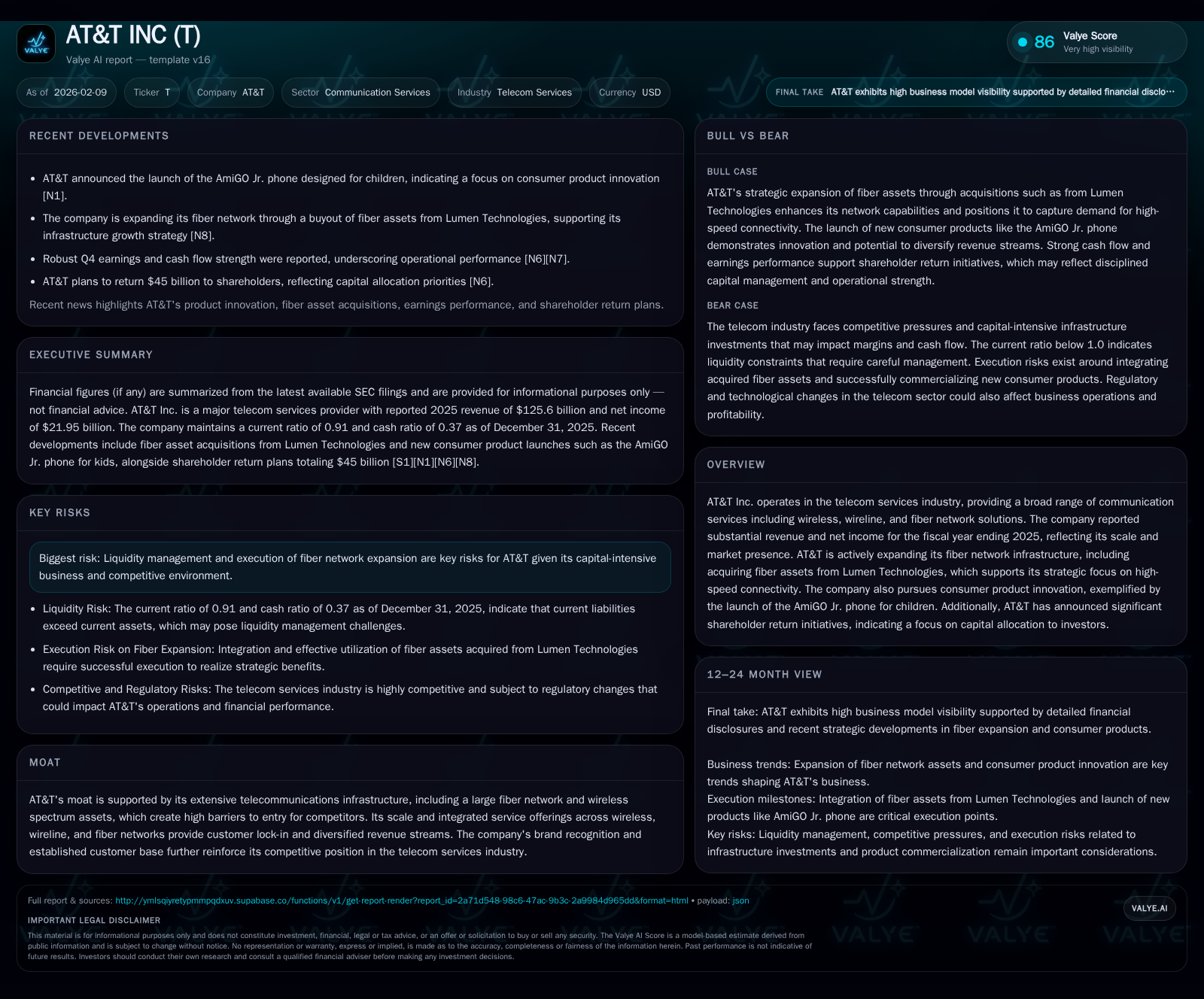
AT&T reported solid fiscal 2025 results underscoring its financial scale and operational resilience. Its acquisition of fiber assets from Lumen Technologies marks a pivotal shift toward enhancing high-speed connectivity as a growth engine. Meanwhile, innovations like the AmiGO Jr. phone signal a broader product diversification strategy, aimed at capitalizing on niche markets. However, macroeconomic inflation, supply chain volatility, and the capital-intensive nature of network expansion introduce execution and liquidity risks that management must carefully balance.
AT&T’s Financial Backbone: Scale Meets Stability
AT&T Inc., operating at the forefront of telecom services, concluded fiscal year 2025 with revenue totaling approximately $125.6 billion and net income near $21.95 billion [F1]. These figures not only underscore the company’s massive scale but also highlight stable profitability amidst an industry characterized by heavy capital intensity and evolving competition. A current ratio hovering close to 0.91 reflects manageable liquidity levels given the company’s working capital profile [F1]. Recent earnings commentary affirmed a robust cash flow foundation, vital for supporting both ongoing operations and ambitious expansion plans [N8][N5]. This profitable footing provides AT&T with financial flexibility as it ventures deeper into extensive fiber network builds—a move poised to define its competitive posture over the coming years.
Mapping the Fiber Frontier: Lumen Acquisition and Network Expansion
In a decisive strategic maneuver, AT&T acquired significant fiber assets from Lumen Technologies—an acquisition that turbocharges its fiber footprint across multiple U.S. markets [N2][valye_report_excerpt]. The company's fiber expansion transcends mere infrastructure augmentation; it represents a bet on accelerating demand for ultra-high-speed broadband fueled by digital transformation trends in residential, enterprise, and government sectors. Industry observers point toward this bolt-on strategy as potentially enabling double-digit EPS growth as fiber-related revenues benefit from enhanced service quality and market penetration [N14]. Nevertheless, this opportunity is shadowed by inherent capital expenditure demands requiring meticulous execution against inflation-affected input costs and complex supply chains.
Innovation Spotlight: The AmiGO Jr. Phone as Market Differentiator
Diversifying beyond connectivity services, AT&T’s recent launch of the AmiGO Jr., a mobile device tailored for children, spotlights innovation aimed at niche demographics [N13][valye_report_excerpt]. This product caters to parents prioritizing safety and connectivity controls for younger users—a segment relatively underserved by major carriers. While nascent in scale, such innovations hint at AT&T’s broader ambition to extend brand relevance into adjacent consumer categories through targeted product development rather than generic enhancements alone. Successful market penetration here could generate incremental revenue streams while reinforcing customer loyalty early in user life cycles.
Structural Moat Analysis: Infrastructure, Spectrum, and Brand Loyalty
AT&T’s durability springs from a multifaceted moat grounded in vast telecommunications infrastructure encompassing wireless towers, expansive wireline circuits, and rapidly growing fiber networks [valye_report_excerpt]. Coupled with strategically acquired spectrum licenses—a scarce resource critical for next-generation wireless services—the company maintains formidable barriers deterring new entrants or accelerating competitor catch-up [S1]. Customer lock-in emerges through bundled offerings spanning mobile, broadband, and entertainment services that reduce churn potential. Yet these strengths exist amid an industry undergoing swift technological shifts demanding sustained capex commitments to uphold service quality and innovation pace.
Capital Allocation Strategies: Balancing Shareholder Returns with Growth
Management has publicly committed to significant shareholder return initiatives reflecting confidence in entrenched cash flows even as it devotes substantial resources to network expansion [valye_report_excerpt][N5][N6]. This balancing act between deploying capital for growth against dividends or buybacks warrants close attention; excessive emphasis on returns could starve fiber buildouts of necessary funding whereas under-delivering on returns may displease investors accustomed to steady yields. How effectively AT&T navigates competing demands will influence investor perceptions regarding sustainability of dividends alongside transformative infrastructure investments.
Navigating Inflation and Supply Chain Pressures
The company faces pronounced inflationary cost pressures affecting both device inputs sold to customers and network equipment essential for rollout activities [S1]. Labor costs are also trending upward amid broader wage inflation in technology deployment sectors. Compounding raw material price volatility is constrained supply capacity especially in semiconductors integral not only to general device manufacturing but increasingly driven by AI-related demand surges within tech ecosystems linked indirectly to telecom vendors’ supply chains. Although AT&T seeks pricing power to partially offset cost escalation through selective price hikes for services or devices, such measures risk suppressing volume or accelerating customer churn—a delicate interplay requiring nuanced pricing discipline.
Risk Review: Liquidity, Market Volatility, and Execution Hurdles
Per disclosures accompanying its latest 10-K filing [S1], AT&T acknowledges critical risks surrounding liquidity management within a rising interest rate environment that elevates borrowing costs. Broader capital markets volatility further complicates debt refinancing efforts or new issuance timing—both essential as fiber investments unfold over multiple years. Execution risk remains nontrivial given project complexity across disparate geographies coupled with vendor performance uncertainties amid strained global supply lines. Failure to meet construction cadence or cost targets could impair financial forecasts or erode competitive momentum.
Peer View: Positioning Against Verizon and Industry Dynamics
A comparative glimpse at Verizon reveals an operator currently capitalizing more heavily on wireless service momentum buoyed by 5G deployments [N3][N7][N11]. Whereas Verizon leans on aggressive wireless monetization strategies boosting near-term top-line growth, AT&T bets on a complementary yet distinct growth vector through accelerated fiber buildout designed to capture fixed broadband demand shifts catalyzed by remote work trends and streaming proliferation. Investors tracking sector dynamics observe these dual approaches offering differentiated risk-return profiles — Verizon exhibits sharper wireless agility contrasted against AT&T’s longer-term physical plant investments.
Outlook: How Fiber Could Reframe AT&T’s Earnings Trajectory
Fiber emerges as AT&T’s ‘secret weapon’ driving optimism for sustainable double-digit EPS growth in calendar year 2026 and beyond [N14][valye_report_excerpt]. Enhanced fiber infrastructure supports higher-margin business offerings ranging from symmetrical gigabit services to enterprise-grade connectivity solutions that command premium pricing relative to legacy DSL or cable alternatives. This could gradually shift overall revenue mix favorably while cementing long-term customer stickiness crucial under mounting competitive pressures. Nonetheless, realizing this promise hinges critically on deftly managing inflation exposure, securing supplier cooperation amidst ongoing semiconductor scarcity issues, maintaining sufficient liquidity buffers against funding headwinds, and delivering execution excellence at scale.
This analysis is intended solely for informational purposes regarding AT&T Inc.’s current business dynamics and industry context as of early 2026. It does not constitute investment advice or recommendations regarding any security transactions. Readers should independently assess risks before deriving conclusions about financial or investment actions.
Disclaimer: This is research-only, informational analysis and not investment advice. It may include AI-generated interpretation and general industry context. Always verify important details using primary sources.

Comments