
Tarsus Pharmaceuticals Expands Commercial Traction and Clinical Pipeline Despite Ongoing Losses
Tarsus leverages FDA-approved XDEMVY® to address Demodex blepharitis while advancing novel treatments in a competitive biopharma landscape.
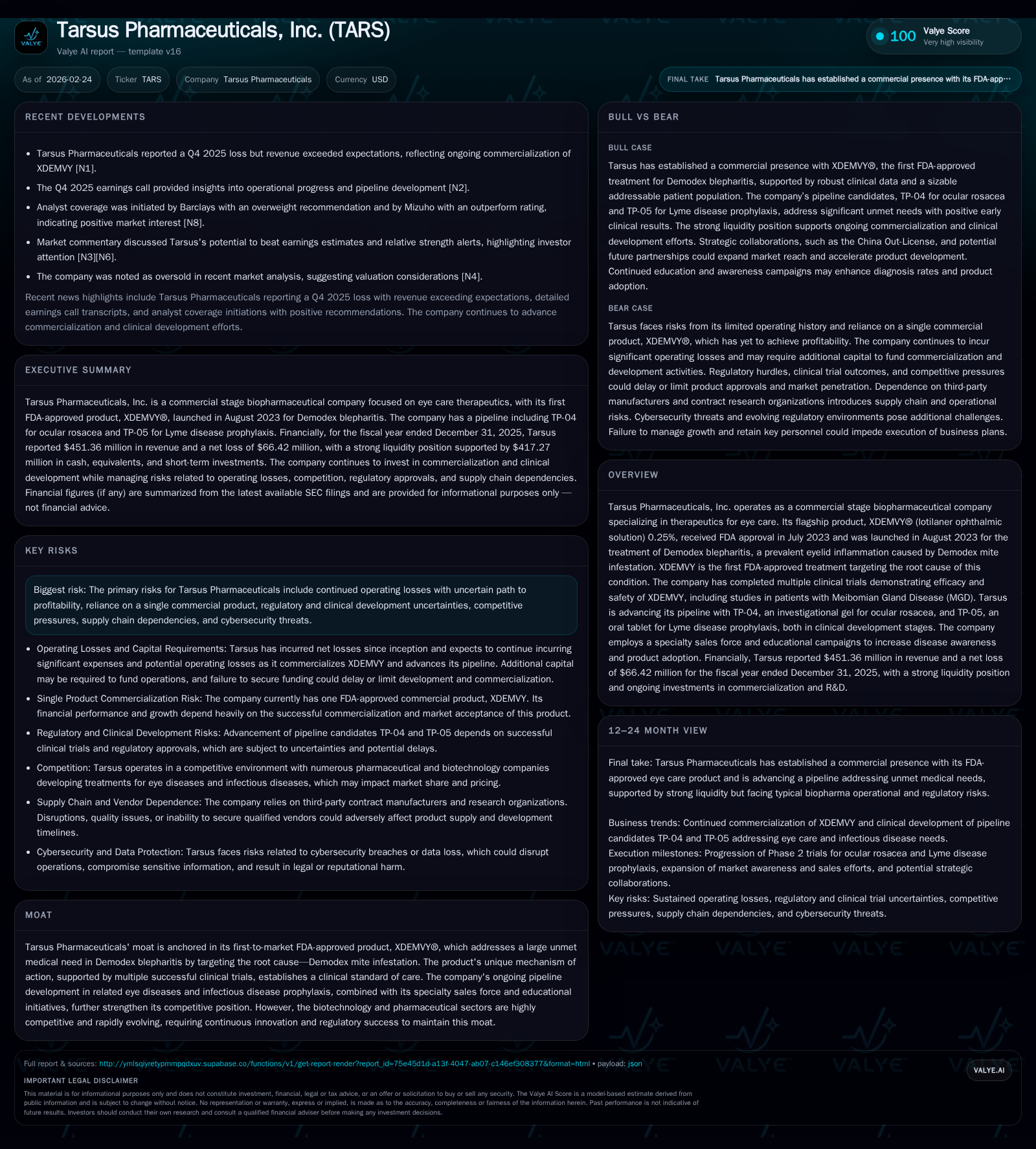
Since its FDA approval of XDEMVY® in mid-2023, Tarsus Pharmaceuticals has rapidly scaled revenue but continues to operate at a loss amid substantial investment in commercialization and clinical development. The company's flagship product addresses an unmet need by targeting Demodex mite infestation in blepharitis, positioning it uniquely in the eye care segment. Looking forward, Tarsus is developing extensions for ocular rosacea and Lyme disease prophylaxis using its lotilaner API platform. However, profitability remains elusive with challenging regulatory dynamics, reliance on a single commercial product, and ongoing R&D spending shaping near-term operational results.
Company Overview and Market Position
Tarsus Pharmaceuticals operates as a commercial-stage biopharmaceutical company centered initially on eye care therapeutics. Its lead product, XDEMVY® (lotilaner ophthalmic solution) 0.25%, secured FDA approval in July 2023 and launched promptly thereafter to treat Demodex blepharitis—a condition caused by infestation of Demodex mites leading to eyelid margin inflammation and irritation. This condition affects an estimated 25 million people in the U.S. alone, representing a sizable and previously unmet medical need [S1][N2].
XDEMVY's active ingredient lotilaner acts by paralyzing Demodex mites through parasite-specific GABA-gated chloride channel inhibition without affecting human receptors—positioning it as the first therapeutic targeting the underlying cause rather than symptoms.
Multiple clinical trials spanning Phase 1 through Phase 3 have demonstrated efficacy and safety of XDEMVY including studies addressing co-occurrence with Meibomian Gland Disease (MGD), which itself impacts up to 30–40 million Americans but currently has no FDA-approved pharmacologic treatments [S1].
Historical Financial Performance
The company’s financial trajectory captures an impressive revenue ramp following product launch but persistent operating losses reflecting heavy investments into commercialization infrastructure and pipeline development:
Historical performance (annual)
| FY | Rev ($mm) | Net ($mm) | CFO ($mm) | OpInc ($mm) | Rev YoY | Net YoY |
|---|---|---|---|---|---|---|
| 2025 | 451 | -66 | -12 | -71 | +146.7% | +42.5% |
| 2024 | 183 | -116 | -83 | -121 | +948.6% | +15.0% |
| 2023 | 17 | -136 | -117 | -143 | -32.4% | -118.9% |
| 2022 | 26 | -62 | -49 | -63 |
Note: Omitted columns lack sufficient annual XBRL coverage in the provided tags (need ≥2 annual points): Capex, Div, Buybacks. Source: SEC companyfacts cache [F1].
Capital returns and efficiency (annual)
| FY | FCF ($mm) | ROE% |
|---|---|---|
| 2025 | -22 | -19.3 |
| 2024 | -85 | -51.5 |
| 2023 | -119 | -69.0 |
| 2022 | -50 | -32.2 |
Source: SEC companyfacts cache [F1].
Note: Net income YoY growth percentages calculated for directional insight where applicable.
Key takeaways include:
- Revenue catapulted post-launch from $17M in FY23 to $451M in FY25, driven by increased disease awareness campaigns, expansion of sales personnel, and foundational uptake among eye care professionals [N1][S1].
- Despite this growth, operating losses remain considerable though improving, narrowing from -$143M in FY23 to -$71M in FY25.
- Cash flow from operations improved substantially but remained negative at about -$12M in FY25.
- Capital expenditures rose notably tied mainly to scaling production and office infrastructure.
Growth Drivers and Constraints
Potential Growth Catalysts
- Continued adoption of XDEMVY among optometrists and ophthalmologists supported by robust clinical data that demonstrate resolution of collarettes—distinct pathological markers linked specifically to Demodex infestation [S1].
- Expanding payer coverage through supplemental deals will determine broader patient access; securing reimbursement remains a pivotal hurdle [S6][N2].
- Pipeline advancement: TP-04 gel for ocular rosacea—a related inflammatory eye disorder—and TP-05 oral tablet aimed at Lyme disease prophylaxis are positioned to leverage the lotilaner platform into new indications with substantial patient populations if clinical trials remain positive [N2][S1].
- Increased telemedicine partnerships facilitate direct-to-consumer reach albeit under closer regulatory scrutiny.
Growth Limitations
- Dependency on a single commercial product exposes Tarsus to concentration risk if sales momentum slows or competitors emerge with novel approaches.
- Regulatory hurdles persist – stringent FDA expectations over marketing claims have led to industry-wide enforcement actions affecting DTC advertising strategies potentially encumbering Tarsus’s communication plans [S13][S17].
- Competitive dynamics include emerging therapies addressing blepharitis symptoms or related inflammatory eye conditions requiring continual innovation.
- The pathway to profitability remains uncertain given ongoing R&D expenditures and commercialization costs amidst volatile net losses.
Capital Structure, Liquidity, and Returns
Tarsus held cash and equivalents totaling $184 million as of year-end 2025 with current assets significantly exceeding current liabilities (current ratio ~3.85x), reflecting a comfortable liquidity buffer [F1][S4]. The company operates under a $75 million credit facility established in April 2024 providing additional financial flexibility; however, undrawn tranche availability lapsed with none drawn beyond initial funding indicating prudent capital management so far [F1][S20].
The company has no dividend payments or share repurchase programs disclosed; cumulative net losses since inception are sizeable at approximately $427 million as of Dec 31, 2025 [F1][S1]. Return on equity remains negative (~-19% based on latest fiscal metrics), underscoring ongoing investment phases rather than mature profitability.
Regulatory Environment and Risk Factors
Tarsus faces typical biopharma challenges including stringent compliance requirements around promotional materials adherence to fair balance standards by the FDA’s Office of Prescription Drug Promotion (OPDP). Recent regulatory clampdowns due to misleading claims have heightened scrutiny across direct-to-consumer TV advertising—a primary channel leveraged by Tarsus [S13][S17].
Additionally, legal risk emerges from intellectual property challenges common within biotech patents that may impose substantial defense costs or limit exclusivity windows if claims are contested unfavorably [S23][S18]. Healthcare fraud and abuse laws such as the Anti-Kickback Statute (AKS), False Claims Act (FCA), along with Medicaid rebate requirements also pose compliance burdens capable of inflicting fines or penalties if violated .
Environmental health & safety statutes govern lab operations due to hazardous materials usage; lapses could yield costly penalties or reputation damage [S7][S19]. Finally, ongoing COVID-related supply chain impacts remain relevant though not explicitly quantified here.
Operational Strategy & Commercial Execution Highlights
Since its product launch in August 2023, Tarsus has rapidly built out a specialty sales force targeting eye care providers (ECPs) supported by disease education campaigns aiming to increase diagnosis rates of Demodex blepharitis—a condition often overlooked or misdiagnosed until recently.
Clinical validation supports XDEMVY’s differentiation via mite eradication versus symptomatic treatment approaches prevalent historically such as lid scrubs or antibiotics which do not address underlying etiology.
Beyond direct sales efforts, telemedicine tie-ups enable prescription issuance remotely accelerating patient access channels although regulatory complexities surrounding telehealth prescribing require careful navigation [N2][S17].
Pipeline candidates share lotilaner as an API enabling platform versatility—TP-04 targets inflammation driven by ocular rosacea while TP-05 is being studied for oral prophylaxis preventing Lyme disease transmission—potentially allowing cross-indication leverage pending favorable trial outcomes.
Milestones To Watch And Analysis Forward-Looking
While explicit guidance is limited per available sources, investors and stakeholders should monitor:
- Quarterly revenue trends for indications of sustained XDEMVY demand beyond initial launch surge;
- Regulatory filings/approvals updates on TP-04 gel for ocular rosacea expected within coming trial phases;
- Reimbursement contracts expansion impacting net product pricing;
- Clinical data readouts particularly regarding safety/tolerability shaping label expansions or commercial appeal;
- Any shifts in regulatory environment affecting direct-to-consumer promotions;
- Debt tranche utilization decisions signaling liquidity strategy adjustments.
Summary
Tarsus Pharmaceuticals stands out as an emergent player capitalizing on first-to-market status with a uniquely targeted therapy against Demodex blepharitis—an underserved condition impacting millions—supported by robust clinical data underpinning differentiated positioning.
Financials illustrate rapid scaling but continuing high operational deficits driven by aggressive commercialization investments alongside early-stage pipeline development intended to broaden therapeutic reach through lotilaner derivatives for eye care/infectious diseases.
The company’s strong cash reserves coupled with credit facilities afford operational runway yet profitability timelines remain unclear given current burn rates amid evolving regulatory headwinds especially concerning promotional compliance.
Effective execution against commercialization goals coupled with successful pipeline milestones and payer engagement will be critical levers defining Tarsus’s medium-term outlook amidst competition within the ophthalmology biopharma space.
This analysis is informational only and does not constitute investment advice.
Disclaimer: This is research-only, informational analysis and not investment advice. It may include AI-generated interpretation and general industry context. Always verify important details using primary sources.

Comments