
TFS Financial CORP: Resilient Mortgage Growth and Proactive Risk Management in a Dynamic Credit Environment
In-depth analysis of TFS Financial CORP’s mortgage portfolio expansion, liquidity strategy, credit risk controls, and operational infrastructure investments.
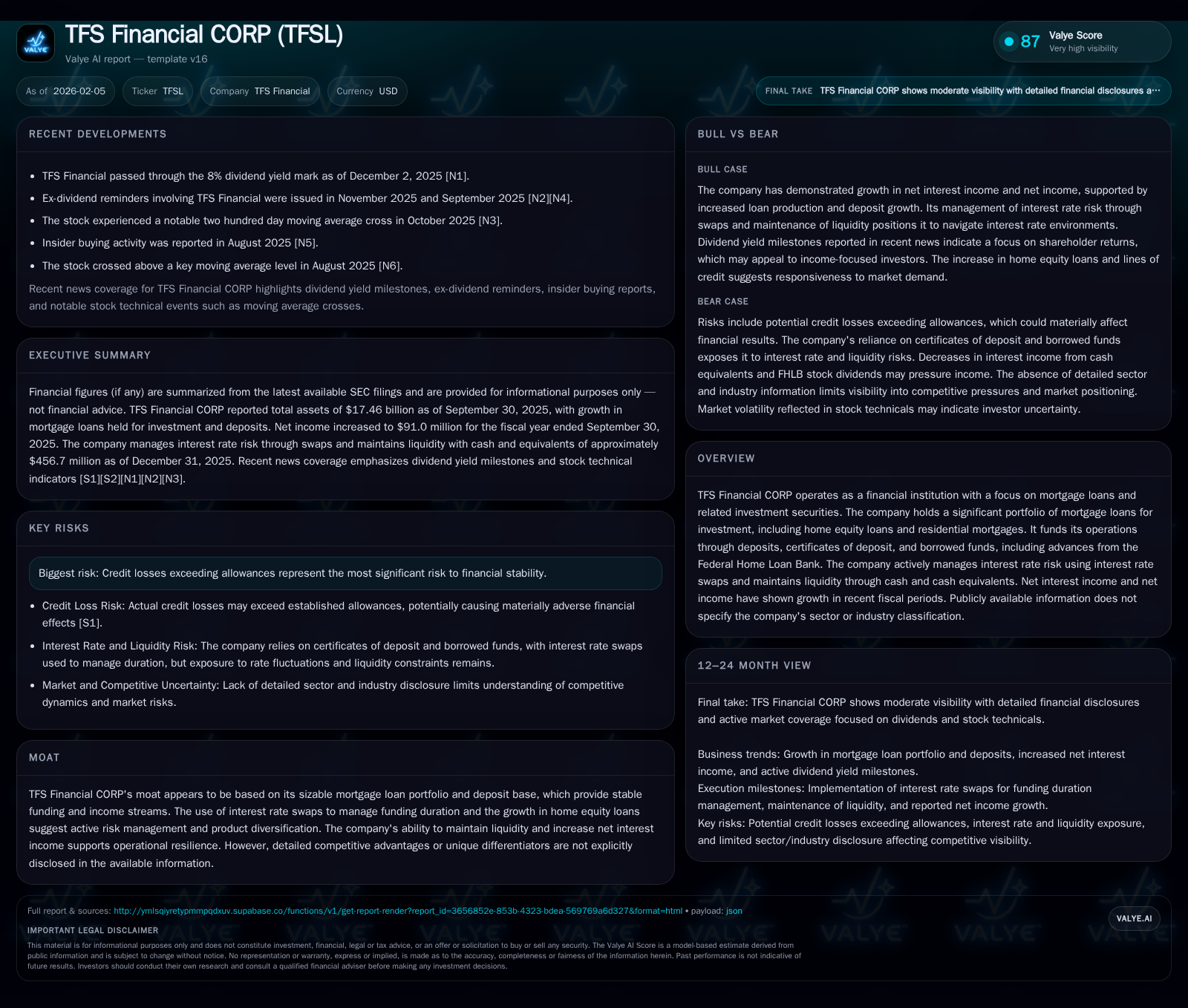
TFS Financial CORP demonstrates steady growth driven by an expanding mortgage loan portfolio, prominently in home equity products, while managing credit risk through increased allowances aligned with loan volume growth. The firm maintains stable liquidity despite asset expansion and deploys interest rate swaps to mitigate funding risks amid market uncertainties. Investments in technology point to a focus on scalability, supporting financial performance that reflects both growth and vigilance amid potential credit loss challenges.
Mortgage Portfolio Growth: The Engine Behind TFS Financial’s Expansion
Over the year ending September 30, 2025, TFS Financial CORP saw total assets increase by $365.5 million, or about 2.14%, reaching approximately $17.46 billion. This growth was largely attributable to an expanded mortgage loan portfolio held for investment, which climbed by $341.3 million (2.23%), bringing the total to roughly $15.66 billion [S1]. A deeper dive reveals that within these loans held for investment, the home equity loans and lines of credit segment notably increased by $927 million within the same period—demonstrating TFS’s strategic emphasis on diversifying its mortgage product mix.
This robust home equity loan growth effectively compensated for a $581.3 million decline in the residential core mortgage segment, highlighting evolving customer demand dynamics or perhaps shifting origination priorities. Alongside balance sheet changes, the company increased first mortgage loan originations and acquisitions significantly from $854.2 million to about $1.19 billion year over year [S1]. Importantly, nearly 90% ($1.07 billion) of these residential mortgage originations were purchase transactions rather than refinancings, an indicator consistent with underlying housing market trends favoring new homebuying activity over refinance-driven volume.
Strategic Liquidity and Capital Management in a Changing Market
Despite asset growth, cash and cash equivalents decreased by approximately $34.3 million (7.4%) to $429.4 million at fiscal year-end September 2025 from the prior year [S1]. Rather than signaling stress, this decline appears consistent with active liquidity management aimed at optimizing capital deployment amid expansionary lending activities.
Similarly, available-for-sale investment securities fell modestly by $5.6 million (1.06%) to about $520.7 million due mainly to repayments and maturities outstripping purchases during the year; no sales transactions were recorded [S1]. This disciplined approach to managing liquid securities balances underscores a focus on preserving quality while adjusting portfolio compositions to support broader business needs.
Navigating Credit Risk: The Crucial Role of Allowances and Loss Provisions
With portfolio size expanding—particularly within home equity loans whose credit risk profiles differ materially from traditional residential mortgages—the company incrementally increased its allowance for credit losses to $104.4 million or roughly 0.67% of total loans receivable as of September 30, 2025 [S1]. This compares to an allowance of $97.8 million (0.64%) a year earlier.
The rise aligns proportionally with the growing loan book size but also reflects heightened vigilance amid potential macroeconomic headwinds or borrower credit deterioration risks linked to consumer lending exposures.
TFS explicitly notes that actual credit losses could exceed recorded allowances resulting in materially adverse impacts on financial results—highlighting inherent uncertainties in credit risk estimation and reinforcing the importance of ongoing close monitoring of loss trends [S1].
Funding Structure and Interest Rate Hedging: Tools for Stability
The company’s funding base relies principally on stable sources such as customer deposits and certificates of deposit alongside borrowings including advances secured from the Federal Home Loan Bank [valye_report_excerpt]. Such diverse funding fosters operational durability.
To address risks stemming from mismatches between asset durations (loans) and liabilities (deposits/funding), TFS employs interest rate swaps actively as hedging instruments to manage interest rate sensitivity and duration gaps [valye_report_excerpt]. This tactical use of derivatives assists in stabilizing net interest margins during periods of rate volatility—a critical component given the interest-rate sensitive nature of mortgage lending.
Innovation in Infrastructure: Investing in Technology for Sustained Scalability
Reflecting an eye toward long-term operational efficiency, premises, equipment, and software assets grew by $6.8 million (20.5%) reaching a net value around $40 million by September 2025 [S1].
The majority of this increase stems from software acquisitions supporting an anticipated core processing system upgrade—elucidating management’s commitment to modernize infrastructure enabling scalable growth and potentially improved customer service capabilities.
Such investments are strategically significant given competitive pressures in financial services where technological agility increasingly underpins operational advantage.
Financial Performance Deep Dive: Trends in Income and Asset Metrics
As per the most recent quarterly filing ending December 31, 2025, net income was reported at approximately $22.27 million [F1]. This figure anchors a narrative of continued profitability concurrent with asset base expansion.
Balanced against organic loan origination increases and active expense management—including technology investments—this income level evidences the firm’s capacity to convert expanded mortgages into enhanced bottom-line contribution despite ongoing provisions for credit risks.
Assessing the Moat: Strengths, Vulnerabilities, and Competitive Positioning
TFS Financial CORP’s moat appears grounded chiefly in its sizeable mortgage loan portfolio paired with a solid deposit franchise providing relatively low-cost funding—a fundamental base offering steady income streams.
Active management via interest rate swaps mitigates funding duration mismatch risks while incremental diversification into home equity lending broadens product exposure beyond traditional residential mortgages [valye_report_excerpt]. These elements collectively create operational resilience.
However, public disclosures stop short of identifying unique competitive differentiators such as specialized underwriting expertise or exclusive distribution channels which might elevate competitive positioning amid peers.
Moreover, the company faces notable vulnerability centered on credit losses potentially exceeding its allowance coverage—a risk acknowledged explicitly by management as capable of materially affecting financial outcomes [S1]. This remains a critical area necessitating continued prudence especially given fluctuating macroeconomic environments impacting borrower repayment capacity.
The measured expansion strategy combined with sophisticated risk controls situates TFS Financial CORP well within its competitive context but also flags key areas requiring vigilance as market conditions evolve.
This analysis is provided solely for informational purposes based on publicly available information as of February 2026 and does not constitute investment advice or recommendations.
Disclaimer: This is research-only, informational analysis and not investment advice. It may include AI-generated interpretation and general industry context. Always verify important details using primary sources.

Comments