
TECOGEN’s Technology-Driven Efficiency Growth Meets Capital and Operational Pressure
The company’s patented low-emission CHP solutions power niche industrial markets amid rising costs and regulatory challenges.
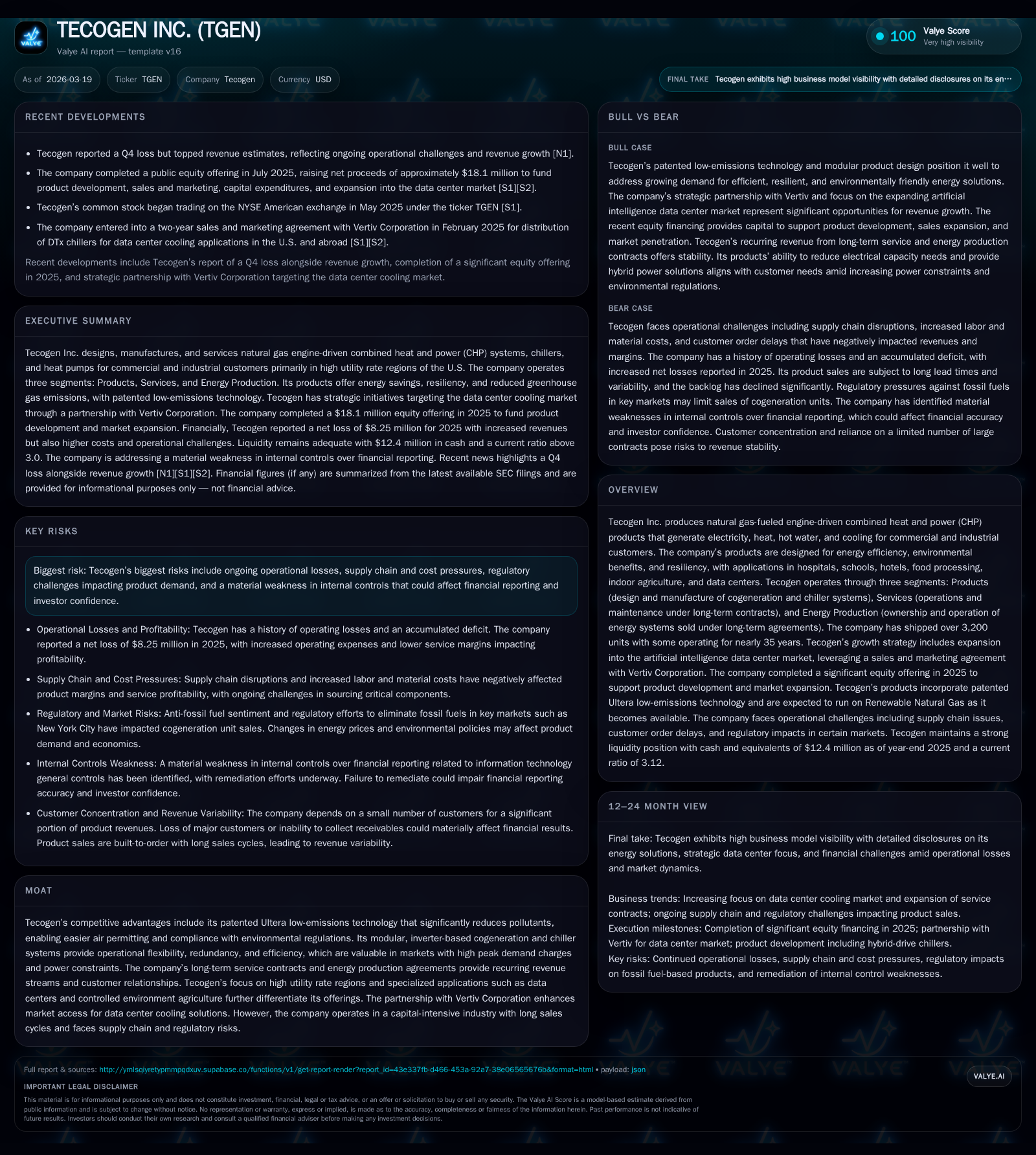
Tecogen Inc. designs and manufactures ultra-clean, natural-gas engine-driven cogeneration systems with a strong installed base exceeding 3,200 units. While its patented Ultera technology confers competitive advantages in emissions and efficiency, the company has reported widening operational losses and negative cash flow over recent years. Growth is targeted via expansion into AI data center cooling through a partnership with Vertiv, but the business faces supply chain constraints, long sales cycles, and a material weakness in internal financial controls. For 2025, revenues increased modestly but operating income worsened significantly, pressured by higher labor and material costs.
Company Overview
Tecogen Inc., incorporated in Delaware in 2020, specializes in high-efficiency natural gas-fueled combined heat and power (CHP) systems. These engine-driven cogeneration units supply electricity alongside heat recovery for applications including hospitals, schools, indoor agriculture, hotels, and food processing plants [S1][S10]. Tecogen’s product suite includes cogeneration modules such as InVerde series units, Tecopower generators, Tecochill chillers that provide simultaneous chilled water and heat, as well as refrigeration compressors via its TecoFrost line [S1][S11].
The firm's patented Ultera technology positions it distinctly by drastically reducing nitrogen oxides (NOx) and carbon monoxide (CO), facilitating stringent air-permit compliance especially across states with tight environmental regulations like California, New York, Massachusetts, and New Jersey [S1][S14]. As a result of its design efficiencies exceeding 88%, Tecogen’s systems typically halve greenhouse gas emissions relative to traditional grid electricity [S1].
Historical Performance & Growth Drivers
Over the past several years leading up to 2025, Tecogen has demonstrated modest top-line growth but persistent net losses driven by cost pressures and operational scaling challenges. The company shipped over 3,200 units cumulatively since inception of its product lines with some units running reliably for nearly 35 years—a testament to product durability [S1][S11]. Its diversified customer base spans healthcare facilities, educational institutions, multi-unit residential buildings, factories including indoor agriculture settings where power resiliency is critical [S10][S11].
Financially, Tecogen's revenue increased approximately 8.1% year-over-year (YoY) entering fiscal year end December 31, 2025 ([F1]). Despite this growth trajectory, operating income deteriorated substantially by about 81.8%, culminating in an operating loss of roughly $8.2 million ([F1]). Net losses deepened similarly to $8.25 million in 2025 from $4.76 million the prior year ([F1]). This widening loss reflects elevated labor costs and material expenses coupled with supply chain disruptions that delayed shipments and constrained capacity [S15][S16][S6].
The service segment remains a critical source of recurring revenue through hundreds of long-term maintenance contracts that also underpin predictability during seasonally higher summer demand periods for chillers [S1][S5]. At the close of 2025, Tecogen serviced approximately 244 chillers and over 760 cogeneration units under maintenance agreements [S11]. Nonetheless, margin contraction within services due to rising input costs undermined segment profitability despite revenue gains [S15][S16].
Similarly, revenues from the Energy Production segment contracted due to expiration of certain long-term energy sales agreements and temporary shutdowns for site repairs [S15]. This segment owned fourteen operational energy systems totaling more than one megawatt electrical capacity at year-end 2025 [S11]. However, sustained lower contribution margins reflected challenges restarting these assets [S20].
Historical performance (annual)
| FY | Net ($mm) | CFO ($mm) | OpInc ($mm) | Capex ($) | Net YoY |
|---|---|---|---|---|---|
| 2025 | -8 | -10 | -8 | 400781 | -73.3% |
| 2024 | -5 | 4 | -5 | 969163 | -3.5% |
| 2023 | -5 | -1 | -4 | 46851 | -87.8% |
| 2022 | -2 | -1 | -2 | 314879 |
Source: SEC companyfacts cache [F1].
Capital returns and efficiency (annual)
| FY | FCF ($mm) | ROE% |
|---|---|---|
| 2025 | -10 | -38.1 |
| 2024 | 3 | -46.5 |
| 2023 | -1 | -31.2 |
| 2022 | -2 | -12.8 |
Source: SEC companyfacts cache [F1].
Note: Exact revenues for 2024 not explicitly provided; operational excerpts emphasize growing losses despite some revenue gains ([F1],[S1],[S15]).
Strategic Initiatives & Future Growth Prospects
Tecogen pursues growth by expanding its footprint in niche high-rate utility regions primarily across California, the Northeast U.S., Midwest, Mid-Atlantic states including Florida as well as Canadian markets [S4][S11]. Furthermore, the burgeoning artificial intelligence (AI) data center market represents a compelling opportunity due to high power density demands accompanied by thermal management challenges [S11]. Through a notable sales and marketing agreement signed with Vertiv Corporation in early 2025, Tecogen aims to commercialize its DTx chillers specifically designed for data center cooling applications nationally and internationally outside the U.S., positioning itself strategically within this fast-growing vertical [S2][N1].
The mounting pressures from increasing utility rates—ranging from $0.15 to over $0.30 per kWh—create economic incentives encouraging customers to adopt CHP solutions that both offer operational savings approaching up to 60% on energy expenditure as well as grid resilience benefits amidst increasing congestion [S1][S4][S5]. Additionally, federal tax credits introduced under the Inflation Reduction Act boost feasibility particularly for non-profit institutions such as hospitals and universities who historically could not capitalize on such incentives due to tax-exempt status [S19].
Nevertheless, potential growth ceilings exist due to lengthy sales cycles frequently extending six months or longer attributed to complex project specifications customized per client engineering needs as well as dependence on third-party suppliers for key components like engines and compressors—whose availability remains subject to global industry supply constraints causing shipment delays or cost increases [S1][S7].
Forecasts & Key Milestones
Management disclosed plans leveraging latest equity proceeds raised mid-2025 aimed at accelerating product development—especially hybrid-drive air-cooled chillers—and scaling sales/marketing efforts targeting AI data centers alongside general working capital enhancement [S2][S21]. The Vertiv agreement spans two years with performance-based earning provisions granting exclusivity dependent on achieved sales levels underscoring emphasis on commercial scale-up [S2].
Given historically volatile quarterly performance aggravated by customer order postponements or facility shutdowns related to macro disruptions including pandemic-related closures tapering off gradually through late-2025 [N1][N3], monitoring backlog trends (which notably shrank materially by roughly $10 million from end-2024 to end-2025 due partly to fulfillment of large chiller orders early last year) will be critical near term indicators of demand sustainability [S18]. Furthermore, restoration of energy production contract renewals will influence recurring revenue stability.
Returns & Capital Allocation Analysis
While current profitability metrics remain negative reflecting extensive reinvestment phases typical within industrial equipment manufacturing scaling cycles ([F1]), return on equity is estimated at -38% calculated from reported net loss relative to shareholder equity (~$21.6 million at end-2025) ([F1]). Operating cash flows turned sharply negative in 2025 (-$9.9 million), contrasted with positive cash generation in prior year attributable largely to working capital fluctuations linked to timing of shipments ([F1]). Concurrent capital expenditures were scaled back nearly by half year-over-year yet remain focused primarily on new facility improvements supporting manufacturing modernization based out of North Billerica headquarters [S18][F1].
The company completed an equity raise generating net proceeds above $18 million during mid-2025 enabling repayment of related party promissory notes along with funding research initiatives plus corporate overhead expansion necessary for geographic diversification ambitions including personnel growth tied to AI data center pursuits [S2][S21]. No dividend payments or share buybacks are reported given ongoing deficit conditions.
Competitive Position & Risks Summary
Tecogen’s combination of proprietary Ultera emissions control technology along with modular inverter-based CHP systems enable differentiated ease in meeting environmental regulations while offering flexible scalability tailored for sites requiring multiple distributed units addressing dynamic load requirements—a factor that enhances appeal when contending against conventional reciprocating engine competitors or renewable sources constrained by intermittency or storage issues ([S14]). Also distinguishing is its integrated service model providing O&M contracts which yield recurring revenue streams buffering cyclical equipment sales volatility.
However considerable risks persist including:
- Persistently incurred net losses questioning pathway to sustainable profitability amidst intensifying competition,
- Supply chain vulnerabilities concerning key external suppliers impacting fulfillment timelines,
- Regulatory fluctuations possibly altering incentive landscapes or permitting burdens,
- A noted material weakness in internal financial controls identified in recent quarters potentially undermining confidence among investors or lenders,
- Dependence on a few customers who sometimes represent over ten percent of annual revenues raising concentration risks,
- Long lead times inherent in built-to-order customized product configurations stretching cash conversion cycles.
Conclusion
Tecogen’s specialized CHP technologies cater effectively to sectors demanding efficient on-site electric generation combined with heat recovery amid regulatory frameworks tightening emissions thresholds nationwide. Expansion into AI-powered data centers could unlock significant incremental growth avenues given documented demand-supply imbalances stressing existing electric grids coupled with escalating cooling requirements. Nevertheless capital-intensive operations coupled with operational hazards embodied by supply chain fragility plus underlying accounting control deficiencies temper immediate prospects for earnings stability or free cash flow positive outcomes absent successful scale-up execution. Investors should continue assessing backlog evolution post-pandemic normalization alongside technical progress validating promised lifecycle enhancements envisaged under ongoing R&D programs.
This report is prepared solely for informational purposes based on publicly available disclosures as of March 19, 2026. It does not constitute investment advice or an endorsement of any kind.
Disclaimer: This is research-only, informational analysis and not investment advice. It may include AI-generated interpretation and general industry context. Always verify important details using primary sources.

Comments