
Tejon Ranch Expands Industrial Footprint with Multifamily Ventures and Strategic Land Use
Tejon Ranch’s sprawling land assets underpin a transition towards mixed-use development, balancing industrial strength with emerging multifamily ventures amid financial headwinds.
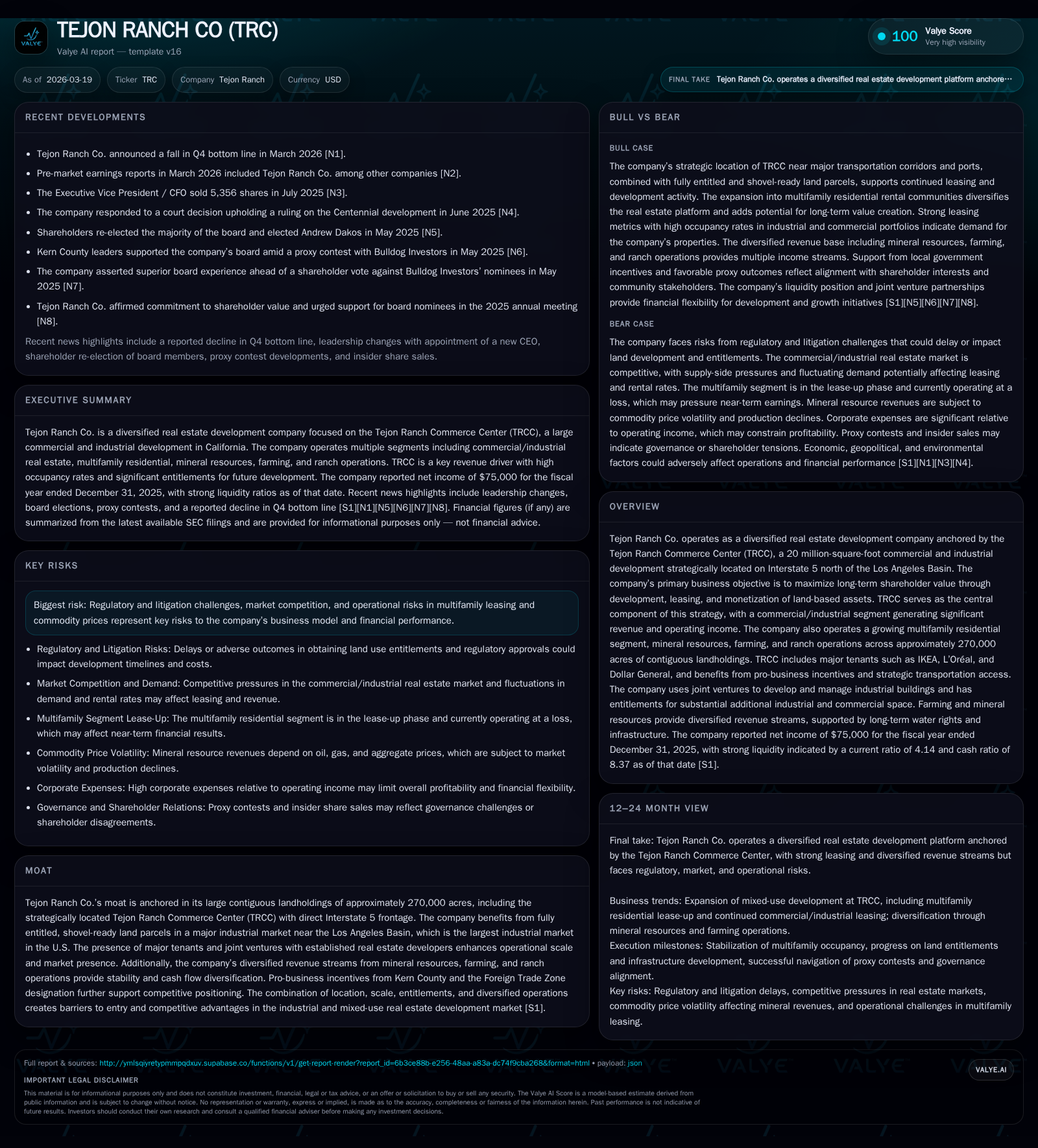
Tejon Ranch Co. operates a uniquely large contiguous landholding anchored by the Tejon Ranch Commerce Center (TRCC), a major commercial-industrial hub north of Los Angeles. While historically supported by diversified land-based revenues, recent years have seen revenue contraction and operating losses linked to rising development expenditures. The company now strategically extends into multifamily residential leasing with its Terra Vista project, integrating broader mixed-use concepts. Competitive advantages include direct Interstate 5 access, prime location in the Southern California logistics corridor, and pro-business county incentives. However, regulatory challenges and market shifts moderate near-term prospects. Capital allocation currently prioritizes developmental capex over shareholder returns as the company pursues long-term value creation.
Historic Growth Trajectory Underpinned by Strategic Land Holdings
Tejon Ranch Co.’s historical growth is anchored by its expansive contiguous land portfolio of approximately 270,000 acres stretching along Interstate 5 between the Los Angeles Basin and Bakersfield. This vast holding forms the foundation for diversified business lines including commercial/industrial leasing at TRCC, mineral rights royalties, farming operations, ranching activities, and resort/residential land entitlements [S4][S5][S9].
The centerpiece is the Tejon Ranch Commerce Center (TRCC), a 20 million-square-foot master-planned site positioned as one of California’s largest industrial parks. As of year-end 2025, TRCC comprised roughly 3.4 million square feet of gross leasable area (GLA) under the company's direct control and was substantially fully leased to marquee tenants such as IKEA, L’Oréal, Dollar General, Caterpillar, and Nestlé [S5][S7]. These anchor tenants reflect TRCC's ability to attract high-quality occupants suitable for distribution and logistics operations serving the broader Southern California market.
Beyond industrial leasing revenues which generated $15.0 million in 2025, Tejon Ranch benefits from recurring income streams tied to mineral resources—primarily oil and gas royalties—and income from farming activities including almond and pistachio orchards on San Joaquin Valley floor properties [S9][S14]. These non-real estate streams provide cash flow diversification stabilizing overall revenue generation.
Shifts in Financial Performance: Revenue Decline Amid Rising Expenses
Financial performance in recent years has seen notable shifts. Consolidated revenue decreased sharply by an estimated 23.6% from the prior year [F1], largely driven by slower commercial/industrial leasing growth coinciding with elevated development outlays. Operating income remained negative at approximately -$7.95 million in fiscal 2025 but reflected a modest improvement versus -$9.2 million in fiscal 2024 suggesting some stabilization efforts taking hold [F1].
Net income dropped dramatically by over 97% year-over-year to near break-even levels ($75 thousand) as escalating costs associated with infrastructure buildout—particularly at TRCC—and the initial lease-up phase of the multifamily segment impacted margins [F1][N2]. Notably, capital expenditures surged by more than 168%, reaching $57 million in 2025 relative to prior periods as investments ramped up toward supporting both commercial expansion and new residential projects [F1][S13].
Operating cash flow declined substantially by over half (57%) to around $6.1 million reflecting timing mismatches between revenue inflows and heavy developmental spending [F1]. Despite this pressure on cash flows, the company maintained strong liquidity reserves with cash & equivalents totaling approximately $9.5 million and a current ratio above 4 [F1][S6], indicative of conservative working capital management amid expansion.
Mixed-Use Development: Broadening Beyond Industrial Spaces
In a strategic evolution beyond its core commercial-industrial base, Tejon Ranch launched its Multifamily real estate segment in 2025 centered on Terra Vista at Tejon—a residential rental community integrated within TRCC [S5][S18]. This introduces vertical diversification with an asset class that promises recurring rental income streams aligned closely with employment hubs generated by logistics and distribution centers onsite.
Terra Vista is currently progressing through the lease-up phase characterized by sub-stabilized occupancy typical for newly delivered apartment communities requiring time to optimize rental rates and tenant retention [S18]. The Bakersfield regional housing market is relatively affordable compared to coastal metros supporting demand; however multifamily operations remain subject to local economic factors influencing absorption velocity.
This shift toward a master-planned mixed-use environment highlights management’s intent to reduce concentration risk inherent in pure industrial leasing by capturing value across complementary real estate categories while addressing workforce housing shortages proximate to employment centers [S5][S18].
Competitive Positioning in the Southern California Logistics Corridor
TRCC enjoys competitive advantages due to its strategic location on Interstate 5 featuring about sixteen miles of freeway frontage facilitating efficient goods movement up and down California’s primary north-south trade route [S4][S28]. Although situated farther inland than prime port-adjacent markets like Inland Empire West, this geographic position has become less of a competitive handicap given eastward expansion trends pushing industrial development further inland beyond Riverside/San Bernardino into Perris and Moreno Valley areas [S4][S8].
Moreover, TRCC benefits from Kern County’s pro-business incentive programs such as AdvanceKern which offer state tax assistance, infrastructure support funding via joint powers authorities like TRPFFA bonds, and workforce development initiatives promoting tenant attraction [S7][S13]. The designation of approximately 1,094 acres within TRCC as a Foreign Trade Zone further enhances cost efficiency for import/export activities enabling streamlined customs processes typically coveted by distribution operators [S7][S10].
Despite competitive pressures from Inland Empire’s cooling rent environment—evidenced by increasing vacancy rates rising from ~5% to ~7.6% over one year—TRCC maintains tight industrial vacancy averaging below 4%, supported by fully leased industrial spaces on company landholdings [S8][S16]. Lease expirations are mostly staggered beyond near-term horizons with concentrations peaking around 2030 indicating stable tenancy profiles but also underscoring future importance of lease-up velocity for new buildings under construction or planned expansions [S16][S29].
Future Growth Catalysts and Regulatory Headwinds
Looking forward, Tejon Ranch plans substantial entitlement advancement targeting over 35,000 housing units across three large-scale master-planned communities: Mountain Village, Grapevine (12k+ units approved), and Centennial — the latter undergoing re-entitlement following litigation-driven rescissions of prior approvals [S24][S26].
This regulatory backdrop adds complexity as legal processes create timing uncertainty delaying commencement of certain residential developments while requiring renewed planning submissions resembling earlier approvals [N2][S26].
Nonetheless, significant investment continues at TRCC where entitlements enabling more than 11 million square feet of additional industrial space remain available for development offering future upside should market conditions improve [S10][S14]. Prioritization will hinge on navigating entitlement risks judiciously while leveraging infrastructure buildout aligned to risk-adjusted return objectives set forth by management and board oversight [S5].
Capital Deployment Strategies and Returns to Shareholders
Capital allocation emphasis clearly skews toward development expenditure acceleration as evidenced by capex jumping more than twofold year-over-year reaching $57 million mainly funneled into real estate infrastructure at TRCC plus multifamily construction costs [F1][S13].
The company's capital structure remains sound with no borrowing concerns highlighted in latest liquidity disclosures; robust current assets exceed liabilities giving comfort about short-term liquidity despite negative free cash flows (-$51 million) stemming from capex outlays surpassing operational cash inflows [F1][S6].
Shareholder returns currently do not include dividends or share repurchases reflecting prudent conservation of resources during this buildout phase while return on equity approximates zero due to near break-even net income after operating losses incurred during transition years [F1]. Interest rate swap terminations generated one-time cash inflows but do not impact core operating results significantly [S1].
Overall capital discipline aims at balancing long-term land value appreciation potential through phased investments rather than near-term distributions.
Key Metrics: What Investors Should Monitor Next
Historical performance (annual)
| FY | Net ($mm) | CFO ($mm) | OpInc ($mm) | Capex ($mm) | Net YoY |
|---|---|---|---|---|---|
| 2025 | 0 | 6 | -8 | -97.2% | |
| 2024 | 3 | 14 | -9 | 57 | -17.6% |
| 2023 | 3 | 14 | -4 | 21 | -79.3% |
| 2022 | 16 | 9 | 14 | 23 |
Source: SEC companyfacts cache [F1].
Capital returns and efficiency (annual)
| FY | FCF ($mm) | ROE% |
|---|---|---|
| 2025 | 0.0 | |
| 2024 | -43 | 0.6 |
| 2023 | -8 | 0.7 |
| 2022 | -14 | 3.4 |
Source: SEC companyfacts cache [F1]. *Figures approximate based on available SEC filing data; capex reflects combined real estate investments.
Key metrics warrant close attention going forward including lease expirations concentrated around calendar years 2026 through 2030 that may influence renewal or re-tenanting risk profiles; ongoing absorption rates at Terra Vista multifamily which will determine stability of recurring rental income; capital availability trends particularly how efficiently new infrastructure milestones align with entitlement progress; plus legal/regulatory outcomes related to Centennial re-entitlement proceedings.
Disclosure: This analysis is based solely on information extracted from publicly available SEC filings and news sources provided herein up to March 19, 2026 without any speculative forecasts or price opinions.
Disclaimer: This is research-only, informational analysis and not investment advice. It may include AI-generated interpretation and general industry context. Always verify important details using primary sources.

Comments