
Navigating Catastrophic Tides: Travelers Companies' Underwriting and Capital Strategies Amid Elevated Risk
Travelers Companies, Inc. leverages underwriting expertise and capital discipline to manage volatile catastrophe exposures in a shifting climate landscape.
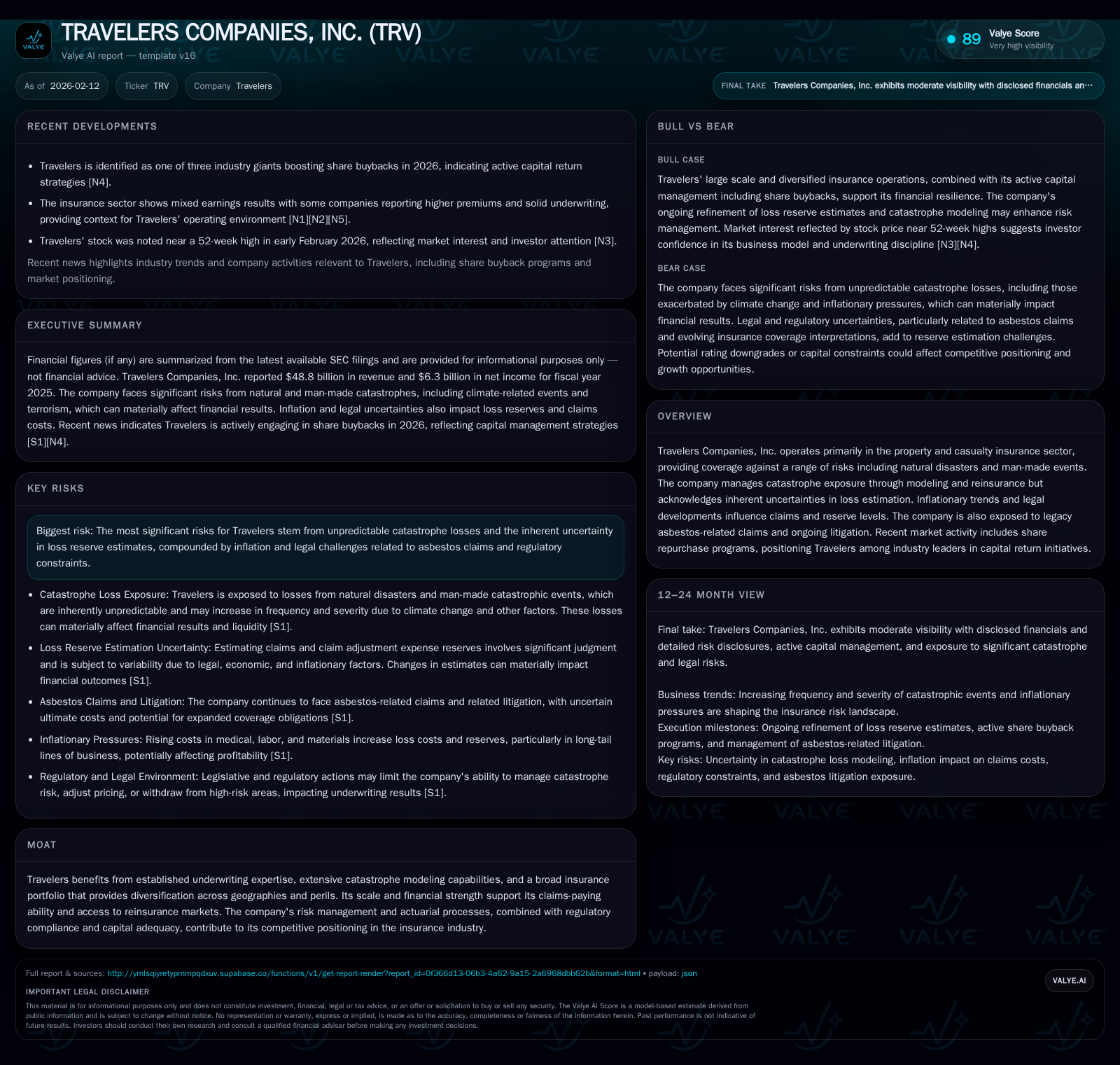
Travelers Companies stands at the nexus of rising catastrophe risks and evolving market dynamics, employing robust underwriting proficiency combined with aggressive capital deployment. The firm faces ongoing headwinds from inflationary pressures, asbestos-related claims, and legal challenges that inject reserve uncertainty. While catastrophe modeling remains an indispensable but imperfect tool, Travelers' scale, diversified portfolio, and prudent risk management underpin its resilience amid sectorwide volatility.
Underwriting Expertise in the Eye of the Catastrophe
The capricious nature of catastrophic events often evokes chaotic imagery—roaring hurricanes tearing through coastal towns, wildfires consuming vast swaths of land with ravenous unpredictability. For Travelers Companies, Inc., such volatility is not merely portraiture but the core crucible shaping its underwriting métier. Anchored by an extensive property and casualty portfolio that spans multiple geographies and peril types, Travelers’ underwriting approach navigates this complexity with deliberate precision.
In its recently filed 10-K (2026), Travelers acknowledges the kaleidoscopic array of natural disasters it insures against—hurricanes, tornadoes, hail storms, earthquakes—and extends coverage to encompass man-made risks such as cyber events and civil unrest [S1]. This breadth affords Travelers a diversified exposure that tempers concentrated losses arising from single catastrophic occurrences. Their underwriting expertise is not a blunt instrument but a finely calibrated blend of actuarial rigor, historical loss analysis, and real-time exposure management.
Such diversification mitigates the impact of unpredictable catastrophe frequency or severity spikes intensified by climate trends—an accelerating concern as government studies increasingly document heightened incidence of extreme weather phenomena [S1]. Against this backdrop, Travelers reported revenues just under $49 billion with net income exceeding $6.2 billion for fiscal year 2025, figures underscoring operational scale capable of absorbing episodic shocks while sustaining profitability [F1].
Capital Management & Shareholder Returns: Buybacks as a Strategic Signal
Amidst the storm of external uncertainties stands Travelers’ resolute capital strategy. The company has recently embarked on significant share repurchase programs—indicative of both capital discipline and management’s confidence in intrinsic value amid prevailing market headwinds [N14]. Buybacks serve dual purposes here: they return capital efficiently to shareholders while signaling that current valuations do not fully reflect underlying financial strength.
This approach is grounded in a balance sheet fortified by robust underwriting profits complemented by reinsurance protections that buffer against outsized losses [S1]. Net income performance at over $6 billion buttresses the capacity to execute these buybacks without compromising strategic flexibility [F1]. Furthermore, regulatory compliance measures and strong ratings sustain access to capital markets on favorable terms—a crucial lever when catastrophe exposures spike unpredictably.
This assertive deployment contrasts favorably with some peers facing elevated claim costs or reserving pressures who may adopt more conservative capital returns [N3][N5][N6]. The buyback momentum thus emerges as a nuanced investor signal: confidence amid caution.
Decoding Reserve Uncertainty: Inflation, Asbestos Legacy, and Legal Headwinds
Behind Travelers’ sturdy facade lies an undercurrent of complex reserve uncertainties. Inflationary pressures weave a subtle yet potent influence on claims cost inflation; post-event demand surges elevate labor and material expenses beyond baseline projections [S1]. This dynamic complicates loss reserves estimation as replacement costs climb unexpectedly.
Adding layers to this calculus are legacy asbestos-related claims—a specter common in long-standing insurers—which continue to demand prudent reserve allocations given ongoing litigation [S1]. These enduring liabilities disrupt clarity around future cash outflows despite efforts toward mitigation. Legal developments accentuate unpredictability further.
Financial disclosures hint at sizeable reserve levels accommodating these risks; however, the indeterminate timing and magnitude prescribe caution in interpreting reserve adequacy solely through headline metrics [F1]. Here Travelers underscores the inherent challenge in actuarial assumptions translating emerging exposures into quantifiable liabilities.
Catastrophe Modeling: Between Science and Assumption
At the heart of insurer risk navigation is catastrophe modeling—a realm where science contends with inherent guesswork. Travelers relies heavily on sophisticated models to estimate potential losses across peril zones. Yet their own filings candidly recognize that all such tools embed significant assumptions prone to error [S1].
Especially with emergent coverages like cyber insurance—where historical loss data remain sparse—the frontier of modeling is foggy. Potentially systemic cyber events could cascade across large customer bases linked to shared technology platforms, rendering standard probabilistic approaches less reliable.
This admission tempers expectations; disaster modeling provides directional guidance rather than definitive forecasts. Such humility validates management’s tactical emphasis on diversification, conservative reserving buffers, and reinsurance layering as complementary defenses.
Peer Benchmarks: How Travelers Stacks Up Against Industry Players
Placing Travelers within the competitive tableau uncovers a nuanced picture of relative strength. Its $48.8 billion revenue base eclipses many mid-size players while aligning well with top-tier insurers like Chubb or Progressive who similarly posted solid fourth-quarter performances marked by resilient premium growth and underwriting discipline [N3][N9][F1].
However, margin pressures visible among some peers due to persistent inflation or reinsurance cost hikes underscore vulnerabilities everyone faces [N1][N5]. Selective Insurance and HIG reported beats largely attributed to solid pricing actions offsetting higher claims costs [N5][N6], echoing sectors trends that likely influence Travelers’ strategic calibrations.
This comparative lens highlights how Travelers’ scale combined with diversified lines affords operational flexibility that smaller or more narrowly focused competitors might lack.
Market Signals: Stock Trajectory and Investor Sentiment
Investors have taken note—Travelers’ shares crest near 52-week highs, embodying tempered optimism bolstered by recent earnings solidity alongside robust buyback activity [N11][N12]. Yet ETF outflow reports signal prudence persists amid broader market rotations or tactical reallocations [N13].
This juxtaposition captures classic investor psychology dynamics where appreciation in share price coexists with profit-taking or repositioning within portfolios. It suggests confidence tempered by awareness of ongoing catastrophe risk variability.
Analyst commentaries echo this duality; they celebrate underwriting execution while flagging reserve complexities tied to inflationary forces and litigation outcomes. Such balanced perspectives invigorate discourse without tipping into complacency or alarmism.
Risk Oversight in an Era of Climate Flux and Man-Made Threats
The expanding canvas of climate change alters risk contours constantly—from rising sea levels exacerbating flood exposures to intensifying wildfire seasons reshaping vulnerability profiles [S1]. Concurrently, new peril dimensions arise via cyber threats increasingly entwined with geopolitical instability or technological evolution.
Travelers explicitly integrates these factors within its risk governance framework—a necessity as reliance on historical patterns become less predictive amid rapid environmental transformation.
Their proactive stance involves continuous updates to exposure models coupled with scenario analyses incorporating non-linear climate trajectories alongside man-made event simulations. This dynamic oversight aims to safeguard solvency and competitive positioning during unfolding disruptions.
Diversification Across Geographies & Coverage Lines: A Buffer Against Volatility
A core tenet animating Travelers’ resilience is geographic spread paired with broad coverage lines spanning personal property through commercial casualty products [S1]. This stratification dilutes concentrated loss potential where one region’s disaster might be offset partially by relative calm elsewhere.
Moreover, spanning products from traditional property damage policies into burgeoning cyber insurance lines creates revenue placidity balanced against idiosyncratic risks specific to each domain. Such breadth complements capital strategies ensuring no single shock overwhelms enterprise stability.
The strength reflected in consistent multi-billion-dollar revenue inflows alongside meaningful net income attests to this layered buffering mechanism effectively at work [F1].
This analysis synthesizes publicly available regulatory filings alongside recent market news to present a comprehensive perspective on Travelers Companies’ operational landscape without offering investment advice or recommendations. Readers should consider company disclosures as the primary source alongside professional counsel for decision-making purposes.
Disclaimer: This is research-only, informational analysis and not investment advice. It may include AI-generated interpretation and general industry context. Always verify important details using primary sources.

Comments