
Texas Ventures Acquisition III Corp’s Strategic Moves Signal Next Phase Transition
Recent executive appointments and quarterly disclosures underscore Texas Ventures Acquisition III Corp's critical stage as it pursues its inaugural business combination.
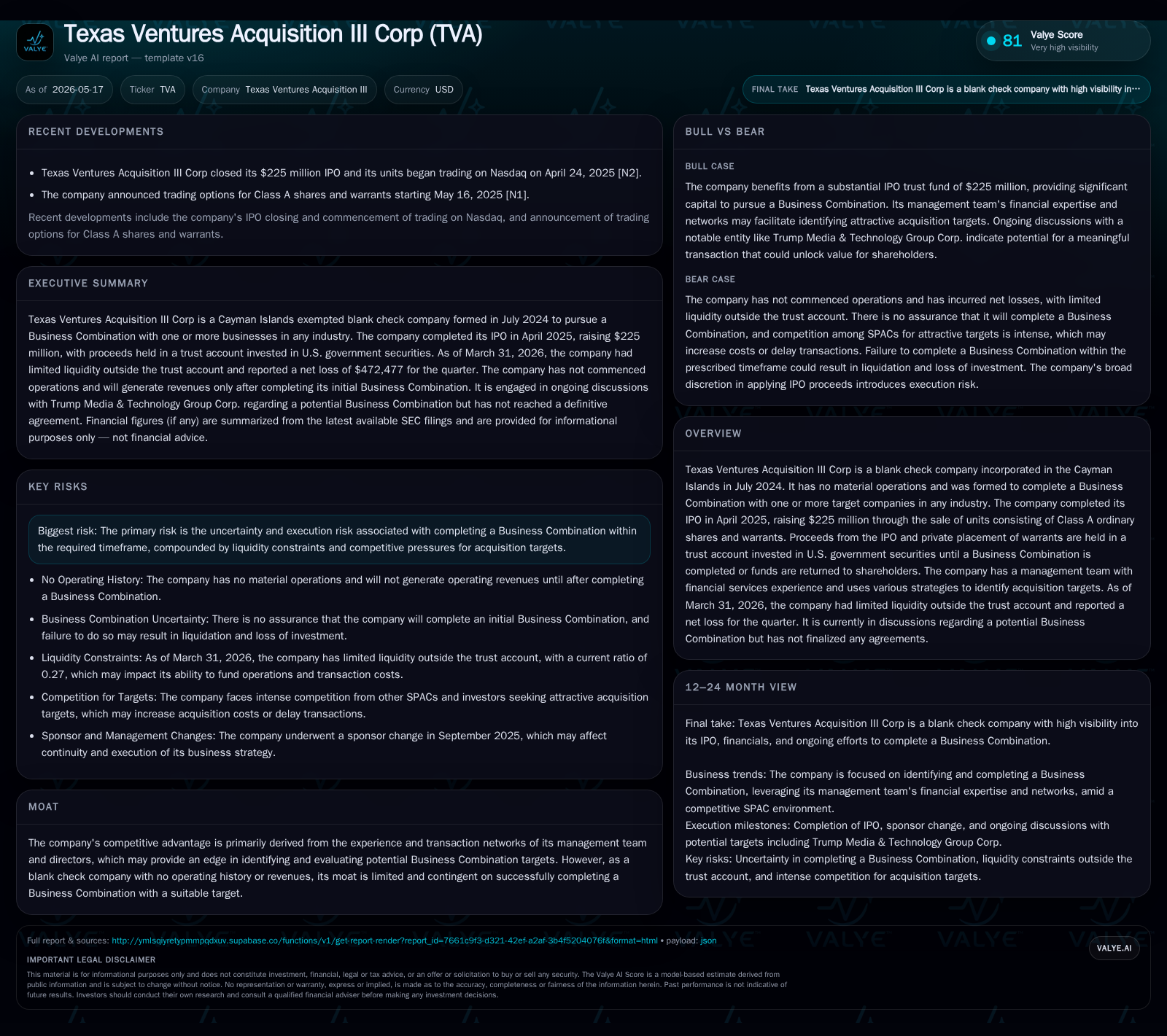
Texas Ventures Acquisition III Corp’s latest quarterly filing reveals operational challenges typical for a blank check company nearing its business combination deadline, including potential trust account indemnity risks and limited liquidity outside the trust. The appointment of Troy Rillo as CEO, alongside his continuing CFO role, marks a governance strengthening amid a competitive SPAC environment. The firm’s business model remains focused solely on completing an initial business combination within Nasdaq’s 36-month framework, with growth contingent on executing this transaction. Execution risks, liquidity constraints, and timing pressures remain paramount considerations for stakeholders in this next phase.
Recent Quarterly Developments Shape Near-Term Execution Risk
Texas Ventures Acquisition III Corp’s Q1 2026 Form 10-Q [S2] casts sharp focus on critical execution risks inherent to blank check companies approaching their business combination deadlines. The filing highlights that indemnity obligations could materially reduce the funds held in the Trust Account below the standard redemption value of $10.05 per Public Share if third-party claims are successful against those funds. This scenario implies a potential shortfall that might imperil the company’s ability to complete its initial Business Combination within Nasdaq’s prescribed 36-month timeframe.
Moreover, the company reports no outstanding working capital loans as of March 31, 2026, but liquidity external to the Trust Account remains constrained [S2], consistent with typical SPAC structures where operational cash reserves are minimal pre-transaction. The net working capital deficiency reported amplifies concerns regarding financial runway for deal-related expenses.
A noteworthy governance development disclosed in proximate filings shows a reduction in Sponsor alignment through forfeiture of Founder Shares after underwriter overallotment selections were not fully exercised [S2]. This dilutes sponsor-held incentives and could influence deal-making motivations going forward.
Business Model and Operating Framework: A Pure-Play Blank Check Entity
As detailed in the company’s April 2026 annual filing [S1], Texas Ventures Acquisition III Corp operates exclusively as a Special Purpose Acquisition Company (SPAC). Incorporated in July 2024 in the Cayman Islands with no operating subsidiaries or revenues, its core activity revolves around raising IPO proceeds—in this case $225 million from April 2025—and holding these funds in a U.S. government securities trust account pending a qualifying business combination.
Revenue generation pre-Business Combination is limited strictly to interest income earned on the trust assets [S1]. The capital structure features Class A ordinary shares aligned with Public Shares and Founder (Class B) shares held by Sponsors, subject to conversion upon consummation of an acquisition [S1][S2]. Warrants tied to the IPO units add complexity to capital structure but typically accrete value contingent on share price post-transaction announcement.
This pure-play blank check entity model inherently lacks diversification or ongoing operational earnings until completion of a Business Combination, posing structural dependency on successful deal execution.
Management Expertise and Target Identification Strategy
On April 22, 2026, Texas Ventures welcomed Troy Rillo as Chief Executive Officer while maintaining his role as Chief Financial Officer [S3]. Mr. Rillo brings deep experience from Yorkville Advisors since 2004 where he has driven firm growth and strategic investments. His dual role consolidates executive oversight during what is arguably the most pivotal phase for a SPAC: consummating its target acquisition.
His background as an attorney specializing in corporate finance and securities law enhances governance rigor amid complex transaction structuring [S3]. This leadership change reflects an intentional pivot toward enhanced discipline and leveraging established sector networks for target sourcing.
Management employs diverse deal origination avenues including investment bank outreach, professional networks, inbound inquiries from private companies seeking access to public markets, and internal director affiliations [S1][S18]. This multi-pronged approach aims to surface high-quality acquisition candidates capable of satisfying regulatory requirements and shareholder expectations.
Industry Context: SPAC Market Mechanics and Competitive Dynamics
Texas Ventures confronts intensive competitive pressures characteristic of the broader SPAC market landscape. Regulated by Nasdaq listing standards requiring completion of an initial Business Combination within 36 months or face trading suspension and delisting [S1], the entity operates under stringent timing constraints.
Extended transition periods offered to emerging growth companies provide some accounting flexibility but not relief from market timing imperatives [S2][S19]. The company also contends with challenging investor dynamics where public shareholders maintain redemption rights at fixed per-share valuations which can complicate financing negotiations with potential targets due to uncertain cash inflows post-combination.
Furthermore, the limited pool of viable targets that can meet auditing standards (PCAOB or IFRS compliant historical financials) narrows acquisition candidates—heightening deal competition within management’s transaction pipeline [S13][S18].
Sponsor networks serve as crucial differentiators; Texas Ventures' board possesses transaction experience seeking to capitalize on relationships across financial intermediaries yet faces elevated valuation scrutiny amidst abundant SPAC capital chasing fewer attractive deals.
Growth Drivers: Unlocking Value Through Business Combination Execution
Growth for Texas Ventures is structurally binary: either deliver value-accretive returns through successfully closing an initial Business Combination or face inevitable capital return under liquidation protocols dictated by public shareholder redemptions [S1][S2].
Upon announcing a definitive agreement, share price typically becomes more sensitive to market perceptions around target quality, deal financing structure (cash versus stock mix), and potential PIPE participation that can supplement liquidity but cause dilution [S1][S2]. Interest income earned on trust funds stiffens financial footing modestly during runway but is secondary relative to transaction success.
The Company's strategic flexibility includes pursuing combinations via cash offers drawn from trust account proceeds supplemented potentially by debt or equity issuances post-business combination [S1]. Effective deployment hinges heavily on sponsor diligence capabilities plus adept negotiation acumen amid increasingly scrutinized regulatory environments.
Risks and Constraints: Liquidity, Timing Pressures, and Sponsor Obligations
Execution risk dominates Texas Ventures’ landscape. The company faces substantial uncertainty about consummating an acquisition prior to mandatory deadline expiry enforced by Nasdaq rules [S1]. Failure to do so likely triggers liquidation with proceeds returned pro-rata minus transaction costs.
Liquidity outside the Trust Account remains minimal—with cash at $473K contrasted against over $2.4 million in current liabilities reported as of March 31, 2026—yielding a constrained current ratio around 0.27 indicative of tight short-term funding capacity for acquisition-related expenses [F1][S15]. While Working Capital Loans remain unused currently [S2], reliance on sponsor advances or credit lines increases counterparty exposure risk.
Additionally, indemnity claims levied against Trust Account funds could reduce available balances below redemptive thresholds further constraining operational flexibility for approvals or negotiations [S2][S16]. Public shareholder redemptions prior to combination exert downward pressure on capitalization potentially impairing perceived deal value [S1].
Sponsor interests are aligned through Founder Shares convertibility; however recent forfeiture episodes indicate shifts in alignment dynamics that merit scrutiny ahead of final transaction structures [S2] suggesting governance may evolve with stakeholder incentives recalibrated.
Key Upcoming Milestones and Investor Watchpoints
Investors should closely monitor SEC filings regarding any proposals requiring public shareholder votes such as requests for extensions beyond Nasdaq-mandated deadlines or approval of definitive Business Combination terms [S2][S3]. Timely disclosures around potential target engagements or Letter-of-Intent signings will signal acceleration toward transaction closure.
Insider activity—including founder share conversions or secondary transactions involving sponsors—will provide valuable insights into management confidence levels given direct economic exposure implications [S2][S3].
Lastly, macro regulatory developments around SPAC listing rules or accounting standard transitions applicable upon losing emerging growth company status warrant monitoring given their potential downstream impact on reporting complexity and compliance costs post-business combination [S19].
Disclaimer: This analysis is prepared solely for informational purposes without providing investment advice or recommendations. It synthesizes publicly filed documents as of May 17, 2026; readers should consider all disclosures directly from regulatory filings before drawing conclusions.
Disclaimer: This is research-only, informational analysis and not investment advice. It may include AI-generated interpretation and general industry context. Always verify important details using primary sources.

Comments