
Tigo Energy Expands Geographic Footprint and Innovates in Solar Hardware and SaaS
Tigo Energy leverages product innovation and global market expansion to bolster its solar energy hardware and software portfolio while managing operational and tariff-related challenges.
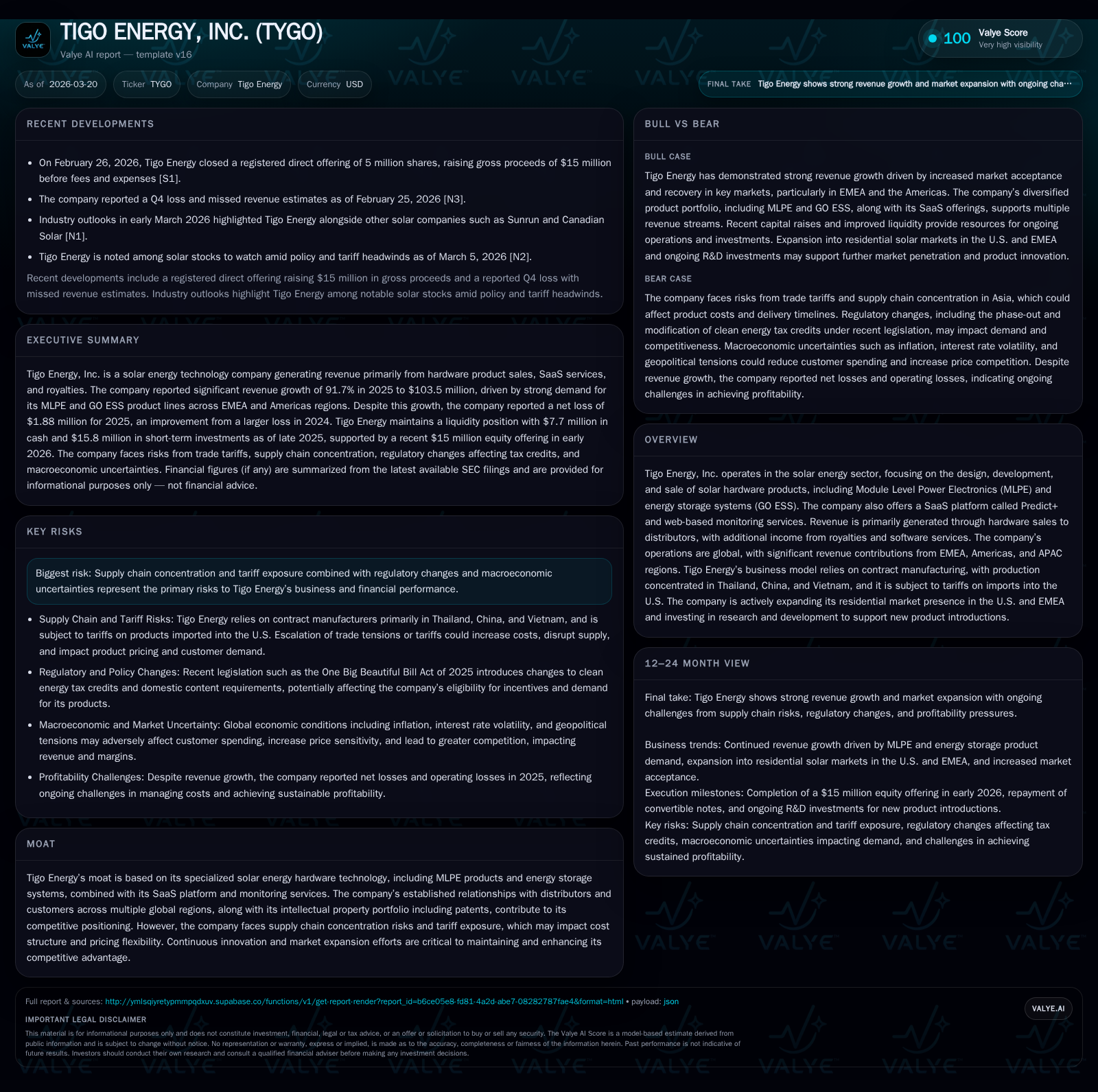
Tigo Energy, Inc. executed a notable financial rebound in 2025 with revenue nearly doubling to $103.5 million from the prior year’s $54.0 million, marking a sharp recovery from steep losses experienced in 2024. This upswing was driven by strong demand for its Module Level Power Electronics (MLPE) and energy storage systems across diverse geographies, notably EMEA and the Americas. The company’s contract manufacturing model and focus on R&D underpin ongoing innovation in both hardware and SaaS offerings such as Predict+. While improving operational efficiency narrowed its operating loss considerably, tariff exposure and concentrated supply chains remain key risks. Future growth depends on continued geographic expansion, new product introductions, and navigating regulatory headwinds.
A Sharp Reversal: From Deep Losses to Revenue Acceleration
Tigo Energy closed fiscal 2025 with a striking financial turnaround after struggling through intense losses in prior years. Revenue nearly doubled to $103.5 million, growing by 91.7% compared to $54.0 million in 2024 [F1]. This rebound of approximately $49.5 million was powered primarily by heightened sales volume across its core product lines: MLPE hardware rose by about 87%, while GO ESS energy storage revenues expanded over 178%, underpinned by solar repowering trends [S21]. Operating loss narrowed sharply to -$4.5 million from a staggering -$52.0 million the previous year—a sign of substantial improvement in operational leverage [F1][S4]. Similarly, net loss improved drastically to -$1.9 million from -$62.7 million in 2024 [F1].
This progress partly stems from a reduction in excess inventory writedowns that weighed heavily in 2024 ($23.5 million reserve charge). In contrast, the sale of reserved GO ESS inventory contributed positively to gross profit in 2025 [S12][S13]. Despite cost of revenue rising slightly by $1 million due primarily to increased warranty expenses linked to volume growth plus tariff-related customs fees ($1.5 million), gross profit surged over twelvefold, delivering a healthy gross margin of 42.8% versus a negative margin prior year [F1][S4][S13]. These shifts reflect improved unit economics including scale efficiencies alongside more optimized pricing.
Global Sales Dynamics: Growing Presence Across EMEA, Americas, and APAC
Geographic diversification bolstered Tigo’s resilience throughout the recovery period [S6][S7]. The EMEA region became the largest revenue contributor at approximately $69.5 million for 2025—more than doubling the prior year’s $32.6 million share—and benefited from strong demand particularly in Germany (15.5% of total revenue), Czech Republic (15.2%), United Kingdom (15.1%), and Italy (10.3%) [S6][S9]. Americas revenue also showed robust growth reaching $26.5 million or nearly twice the amount from $13.1 million previously; notably, U.S. revenues comprised roughly 23.3% of total sales despite ongoing tariff pressures on imported MLPE products manufactured primarily in Thailand [F1][S25]. To address tariff exposure on ESS products previously made in China for the U.S., the company shifted production to Vietnam starting October 2025—a strategic realignment aimed at mitigating trade risks [S25].
APAC revenue contracted slightly by about 9%, totaling $7.5 million mainly due to softening markets like Australia and Southeast Asia [S15]. Overall the broad geographic footprint supports customer diversification but underscores dependence on Southeast Asian manufacturing hubs which pose supply chain concentration hazards.
Product Portfolio Overview: Hardware, Energy Storage & SaaS Innovation
Tigo’s differentiated value proposition centers on high-efficiency Module Level Power Electronics (MLPE), complemented by its energy storage solutions branded as GO ESS along with the Predict+ SaaS monitoring platform [S1][N2]. The contract manufacturing model outsourced to third-party manufacturers across Thailand, China, and Vietnam keeps fixed asset intensity low while leveraging specialized production capabilities—a hallmark approach common among capital-light solar hardware providers [S1][S12].
Research and development investments remained sizeable at $9.2 million (about 8.9% of revenue), reflecting deliberate focus on product enhancements that reduce costs per unit through design innovation while improving reliability and feature sets [S8][S14]. The company emphasizes continuous upgrades both on hardware efficiency fronts as well as expanding Predict+ functionalities enhancing customers’ system visibility.
Such R&D spend contrasts against an industry backdrop where scaling efficiencies often dictate survival; Tigo appears committed to balancing prudent cost control with technological advancement support critical to sustaining competitive pricing power long term.
Operating Margins and Pricing Drivers: Cost Structure Under the Microscope
The marked swing from negative gross margin (-7.7%) in 2024 to a solid positive margin (+42.8%) in 2025 highlights key operational improvements [F1][S4]. Gross profit benefits arose chiefly from drastic declines (88%) in inventory reserve charges coupled with favorable sales mix weighted towards higher-margin reserved GO ESS units sold post-2024 provisioning [S12]. Yet elevated warranty costs tracked volume expansion closely—underlining an intrinsic tradeoff between accelerated unit sales growth and associated future service delivery costs [S4][S13].
Pricing negotiations occur quarterly with distributors allowing incremental agility amid freight cost volatility driven by logistic channel complexity spanning U.S., European, Chinese third-party distribution centers [S4]. Tariffs levied on imports into the U.S.—particularly MLPE components made in Thailand—introduce about $1.5 million of additional customs expense affecting unit economics even as part production shifts intend to lessen this impact going forward [S25][N3]. Maintaining continuous margin optimization will require navigating these headwinds alongside competitive pricing pressures inherent to solar hardware markets.
Practitioners would note Tigo’s margin dynamics exemplify classical unit economics tension where volume ramp is paired with deleterious warranty expense trends warranting vigilant cost management strategies.
Capital Allocation and Liquidity: Evaluating Cash Flow, Equity Raise, and ROE
Reflective of improved earnings quality, operating cash flow turned positive at approximately $10.3 million for fiscal 2025 against an outflow exceeding $12 million just one year earlier—a near $22 million cash flow swing underscoring operational stabilization [F1][S23]. Capital expenditures remained modest at just under $0.65 million aligning with contract manufacturer reliance that limits fixed asset needs while fostering free cash flow creation estimated near $9.7 million after capex deduction [F1].
Balance sheet fortification accelerated via an equity offering completed February 2026 which raised gross proceeds of $15 million fueling liquidity enhancement subsequent to December’s extinguishment of convertible promissory notes at a cash payment of roughly $51 million including accrued interest that triggered a one-time loss on extinguishment near $1.1 million recorded for fiscal year end [S1][S16][S17].
The current ratio stood around a healthy 1.5 indicating adequate short-term liquidity coverage measured against liabilities [F1]. Total equity recovered markedly to above $27 million compared with prior depressed levels given losses absorbed through recent years’ transition phases [F1]. Returns remain negative; calculated ROE approximates -6.8% reflecting residual net losses but also signaling material improvement versus prior periods marked by far deeper deficits [F1].
No dividends have been declared consistent with reinvestment focus supporting growth initiatives rather than shareholder distributions currently [S1].
Future Outlook: Growth Catalysts and Potential Regulatory & Tariff Risks
While optimism surrounds expanding penetration within residential markets across U.S., Germany, Italy and broader EMEA—where emerging demand complements existing commercial installations—risks persist predominantly tied to supply chain concentration in Southeast Asia coupled with evolving trade policies placing tariffs on imports into the U.S., which compose nearly a quarter of revenue [S25][N3]. Ongoing geopolitical tensions could further disrupt sourcing flexibility or raise component prices elevating cost structures.
On the upside, royalties embedded within recent patent sale agreements present contingent income potential up to $5 million attractively supplementing traditional hardware/software revenues if milestones materialize fully [S1]. The company continues investing heavily into R&D pipelines directed at new product introductions along with marketing efforts aimed at expanding customer base breadth geographically—critical moves supporting longer-term sustainable growth trajectories.
Overall outlook factors balance measured optimism tempered by external macro uncertainties including interest rate fluctuations affecting installer financing capacity plus competitive pricing environment dynamics impacting profitability margins.
What to Watch Next: Milestones in Product Development and Market Expansion
Future performance hinges not only on topline metrics but also execution pace regarding:
- Introduction and scaling of next-generation MLPE products improving installation ease or system output,
- Expansion success within residential solar segments particularly in North America and select EMEA markets,
- Impact assessments related to tariff policy adjustments or supply chain diversifications mitigating concentrated country risk,
- Realization timeline of contingent patent royalties enhancing non-hardware operating margins,
- R&D expenditure patterns observable through forthcoming quarterly disclosures providing insight into innovation pipeline vitality.
Investors tracking these indicators will gain early insights into Tigo’s ability to translate operational improvements into sustained profitable growth.
Historical Financial Summary FY2022-FY2025
Historical performance (annual)
| FY | Rev ($mm) | Net ($mm) | CFO ($mm) | OpInc ($mm) | Rev YoY | Net YoY |
|---|---|---|---|---|---|---|
| 2025 | 104 | -2 | 10 | -4 | +91.7% | +97.0% |
| 2024 | 54 | -63 | -12 | -52 | -62.8% | -6276.6% |
| 2023 | 145 | -1 | -37 | -8 | -452.1% | |
| 2022 | 0 | -1 | -1 |
Source: SEC companyfacts cache [F1].
Capital returns and efficiency (annual)
| FY | FCF ($mm) | ROE% |
|---|---|---|
| 2025 | 10 | -6.8 |
| 2024 | -14 | -748.3 |
| 2023 | -39 | -1.6 |
| 2022 | 53.6 |
Source: SEC companyfacts cache [F1]. Note: Operating Income (OpInc), Net Income (Net), Cash Flow from Operations (CFO), Capital Expenditures (Capex) are USD values per fiscal year.
Disclosure: This report is for informational purposes only without any investment advice or recommendations.
Disclaimer: This is research-only, informational analysis and not investment advice. It may include AI-generated interpretation and general industry context. Always verify important details using primary sources.

Comments