
Automotive Sector Fuels Universal Logistics Amid Profitability Challenges
ULH’s multi-segment platform drives significant revenue gains, but goodwill impairments and operational costs pressure earnings.
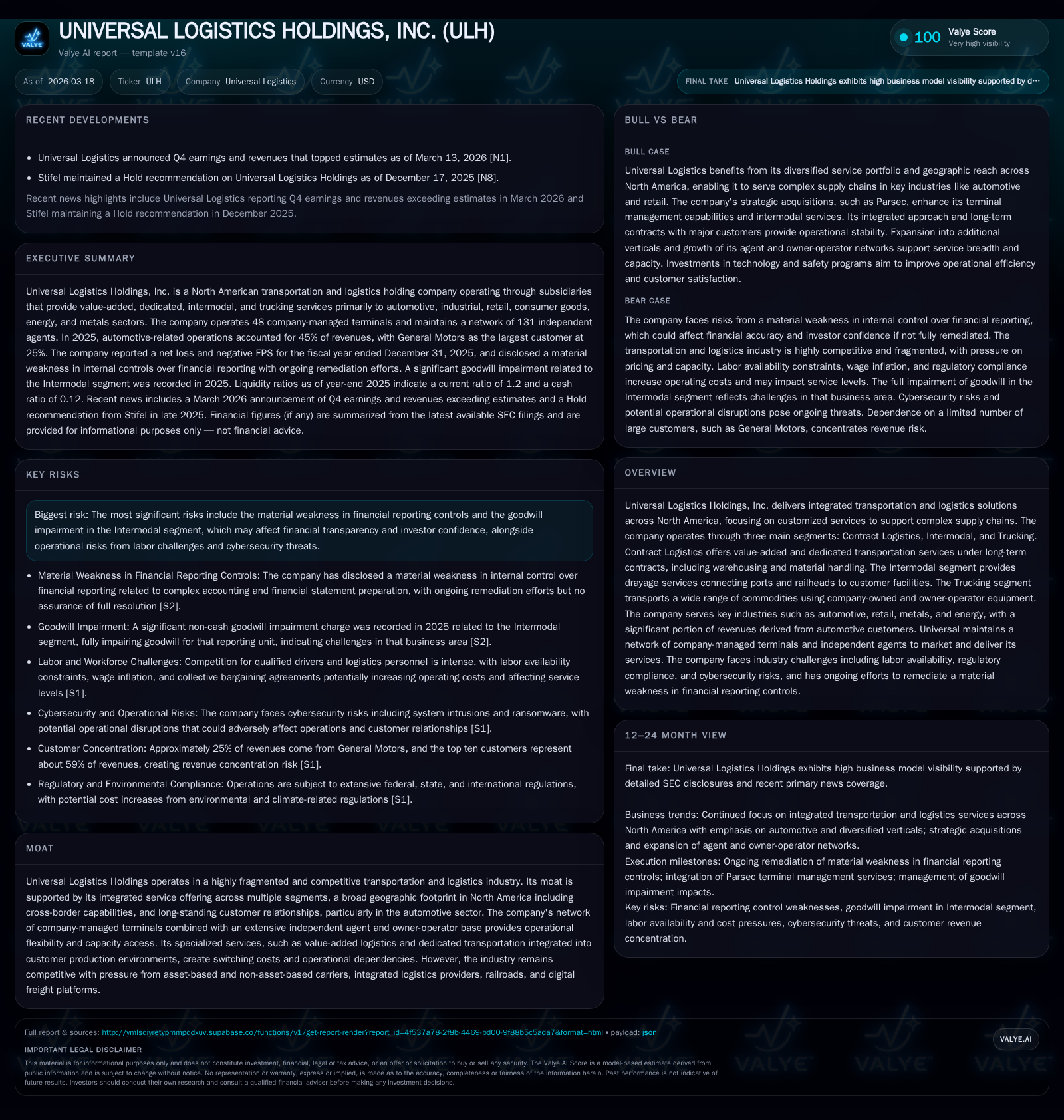
Universal Logistics Holdings, Inc. reported robust revenue growth driven primarily by its automotive-focused segments, reflecting increased outsourcing and complex supply chain integrations. However, the company faced significant operating losses influenced by a non-cash goodwill impairment in its Intermodal segment and elevated capital expenditures that strained free cash flow. Despite these challenges, ULH sustains stable dividend payouts and continues to expand through acquisitions and network growth within a fragmented North American logistics industry.
Revenues Expand but Profitability Falters: Recent Financial Performance
Universal Logistics Holdings experienced substantial top-line expansion in fiscal year 2025, with revenues ascending by approximately 23% to an estimated $386 million [F1]. This surge was principally fueled by increased activity within its core sectors, notably automotive logistics. However, beneath this revenue ascension lies a stark divergence marked by operating income retreating sharply from profitability—registering a loss of around $64 million compared with a prior profit exceeding $200 million the year before [F1]. The net income echoed this distressing pattern, plunging nearly 177% year-over-year into a negative territory nearing $100 million for FY2025 [F1].
This sharp earnings contraction contrasts with robust operating cash flows (CFO), which grew more than 60% year-over-year to approximately $183 million [F1], illustrating strong underlying liquidity from core operations. Nevertheless, heavy capital investments totaling over $224 million strained internal resources yielding a negative free cash flow position estimated at minus $41 million for the period [F1]. Such outlays underscore ongoing commitments towards equipment procurement and facility enhancements pivotal for sustaining operational capacity.
Historical performance (annual)
| FY | Net ($mm) | CFO ($mm) | OpInc ($mm) | Capex ($mm) | Net YoY |
|---|---|---|---|---|---|
| 2025 | -100 | 183 | -64 | 224 | -176.9% |
| 2024 | 130 | 112 | 203 | 252 | +39.8% |
| 2023 | 93 | 210 | 145 | 241 | -44.9% |
| 2022 | 169 | 213 | 240 | 117 |
Source: SEC companyfacts cache [F1].
Capital returns and efficiency (annual)
| FY | Div ($mm) | Buybacks ($mm) | FCF ($mm) |
|---|---|---|---|
| 2025 | 11 | 0 | -41 |
| 2024 | 11 | 0 | -139 |
| 2023 | 11 | 0 | -30 |
| 2022 | 14 | 14 | 96 |
Source: SEC companyfacts cache [F1].
The pronounced swing into operating losses largely stems from non-operational factors such as impairment charges detailed below.
Segment Contributions: Contract Logistics, Intermodal, and Trucking Dynamics
ULH's three reportable segments distinctly shape its integrated logistics offer:
Contract Logistics: Focuses on value-added services including warehousing, material handling, kitting, sequencing, repacking, cross-docking, and dedicated transportation solutions. These are delivered under longer-term contracts typically exceeding one year. Dedicated transportation components involve short-haul or round-trip operations executed by a blend of unionized employees, owner-operators, and contracted drivers seamlessly embedded within customer production environments. This integration elevates switching costs and deepens client dependence on ULH’s tailored logistics capabilities [S4],[S5],[S6].
Intermodal: Provides critical drayage services linking international ports and railheads with customer facilities using company-managed terminals. Operations utilize both company-owned equipment and owner-operators complemented by third-party capacity providers. The segment’s complexity is underscored by delivering steamship-truck and rail-truck moves designed for containerized freight transport. However, it recently suffered goodwill impairments indicating pressure points related to asset utilization or market headwinds [S4],[S7].
Trucking: Encompasses dry van, flatbed, heavy-haul, and refrigerated hauling across diversified commodities ranging from automotive parts to steel products. A hybrid model orchestrates freight through both agents and terminals leveraging owner-operator fleets alongside managed assets. The expansive geographic coverage across the U.S., Canada, and Mexico enhances cross-border trade facilitation essential for automotive supply chains among others [S4],[S6].
This multi-pronged approach retains flexibility yet demands constant coordination amid tight margin conditions common in intermodal drayage services.
Core Market Focus: Automotive and Diversification into Emerging Verticals
Approximately 45% of ULH’s revenues emanate from automotive customers—highlighted by General Motors accounting for about one quarter of total sales—reflecting deep ties within the sector's increasingly outsourced logistics functions [S6]. Such concentration affirms reliance on OEM production schedules driving seasonal demand patterns but also embeds ULH firmly within complex customer-integrated logistics workflows that reinforce switching costs.
Efforts to mitigate cyclical volatility include diversifying into aerospace, energy, healthcare, retail sectors, leveraging modular process design elements enabling rapid logistical rollouts tailored to distinctive industry needs [S6],[S7]. This strategic balancing aims to harness varying sectoral tailwinds while maintaining core contractual relationships.
Challenges from Goodwill Impairment and Financial Reporting Controls
During Q3 FY2025, ULH recorded a significant non-cash goodwill impairment related to its Intermodal reporting unit—initially disclosed as material but subsequently revised following identification of an error concerning deferred tax liabilities included improperly in carrying value calculations. After correction via restatement filings pending completion at fiscal year-end reporting, the entire goodwill associated with Intermodal was fully impaired totaling approximately $43.2 million on top of previous charges [S2],[S24].
This accounting episode coincides with disclosures surrounding material weaknesses in internal controls over financial reporting potentially undermining investor confidence. Moreover, the company's use of non-GAAP financial metrics has attracted cautionary commentary emphasizing potential investor misinterpretation risks amid heightened regulatory scrutiny [S2],[S8],[S14]. These developments add layers of complexity impacting reported profitability separate from operational fundamentals.
Capital Allocation Scrutiny: Cash Flows, Dividends, and Investment Profile
Despite operating losses in FY2025 compounded by high capex demand resulting in negative free cash flow near $41 million [F1], ULH maintained shareholder dividends consistently at just over $11 million annually—a notable commitment amid profit erosion [F1],[S3]. Conversely, share repurchases have been negligible suggesting conservative liquidity deployment reflective of balance sheet prudence.
With equity standing around $540 million at fiscal year-end against reported net losses generating an approximate negative ROE of -18.5% for the period [F1], capital returns remain challenged. High reinvestment needs tied to fleet modernization plus terminal infrastructure upkeep underscore prioritization tension between growth funding versus shareholder distributions.
Outlook on Industry Fragmentation and Strategic Acquisitions
The North American transportation logistics arena is highly fragmented featuring competition among asset-based carriers like ULH itself; non-asset brokers; integrated third-party logistics providers; Class I railroads; and emerging digital freight platforms offering transactional efficiency gains at scale [S6],[S7]. ULH aims to consolidate advantages via selective acquisitions enhancing niche capabilities—the September 2024 acquisition of Parsec LLC exemplifies this strategy adding terminal management expertise strengthening Intermodal complementarities while preserving specialized relationships within rail yard networks [S7].
Continued investment targeting cross-border service enhancements aligns with increasing supply chain globalization trends—supporting utility among automotive customers requiring seamless U.S.-Mexico-Canada logistics solutions.
Labor Relations and Workforce Dynamics in Operations
At December-end FY2025 ULH employed roughly 10,525 individuals supported further by contract workers—with about 37% union representation under collective bargaining agreements defining wage structures and work terms that impose cost considerations but promote labor stability crucial for operational continuity [S6],[S11].
The company actively addresses competitive recruitment challenges pervasive across trucking and logistics sectors through enhanced compensation packages alongside comprehensive onboarding and safety training programs addressing the safety-sensitive environment demanded by many customer contracts. Safety culture initiatives remain central given operational risks inherent in freight movement coupled with compliance requirements across multiple regulatory regimes.
Key Milestones to Monitor in Fiscal 2026 and Beyond
Explicit guidance remains limited thus forward-looking evaluation must focus on observable milestones including:
- Progress on financial reporting controls remediation with potential reductions in risks related to restatements or disclosures bestowing transparency improvements;
- Operating margin stabilization or improvement driven by Parsec integration efficiencies alongside broader cost management measures;
- Expansion velocity within independent agent and owner-operator networks accelerating transactional transportation volumes;
- Sustained dividend declarations reflecting board confidence despite earnings compression [N1],[S3],[S7].
These benchmarks will collectively indicate trajectory toward reestablishing profitability aligned with robust revenue streams predominantly anchored in automotive logistics outsourcing growth.
Disclaimer: This report is prepared solely for informational purposes based on data extracted from public filings as of March 18th, 2026. It does not constitute investment advice or recommendations regarding securities of Universal Logistics Holdings or any other entity.
Disclaimer: This is research-only, informational analysis and not investment advice. It may include AI-generated interpretation and general industry context. Always verify important details using primary sources.

Comments