Unitil Corp: Navigating Regulated Utility Dynamics Across New England
Unitil Corporation operates as a regional utility holding company providing essential electric and natural gas distribution services in New England, leveraging a regulated framework and infrastructure investments.
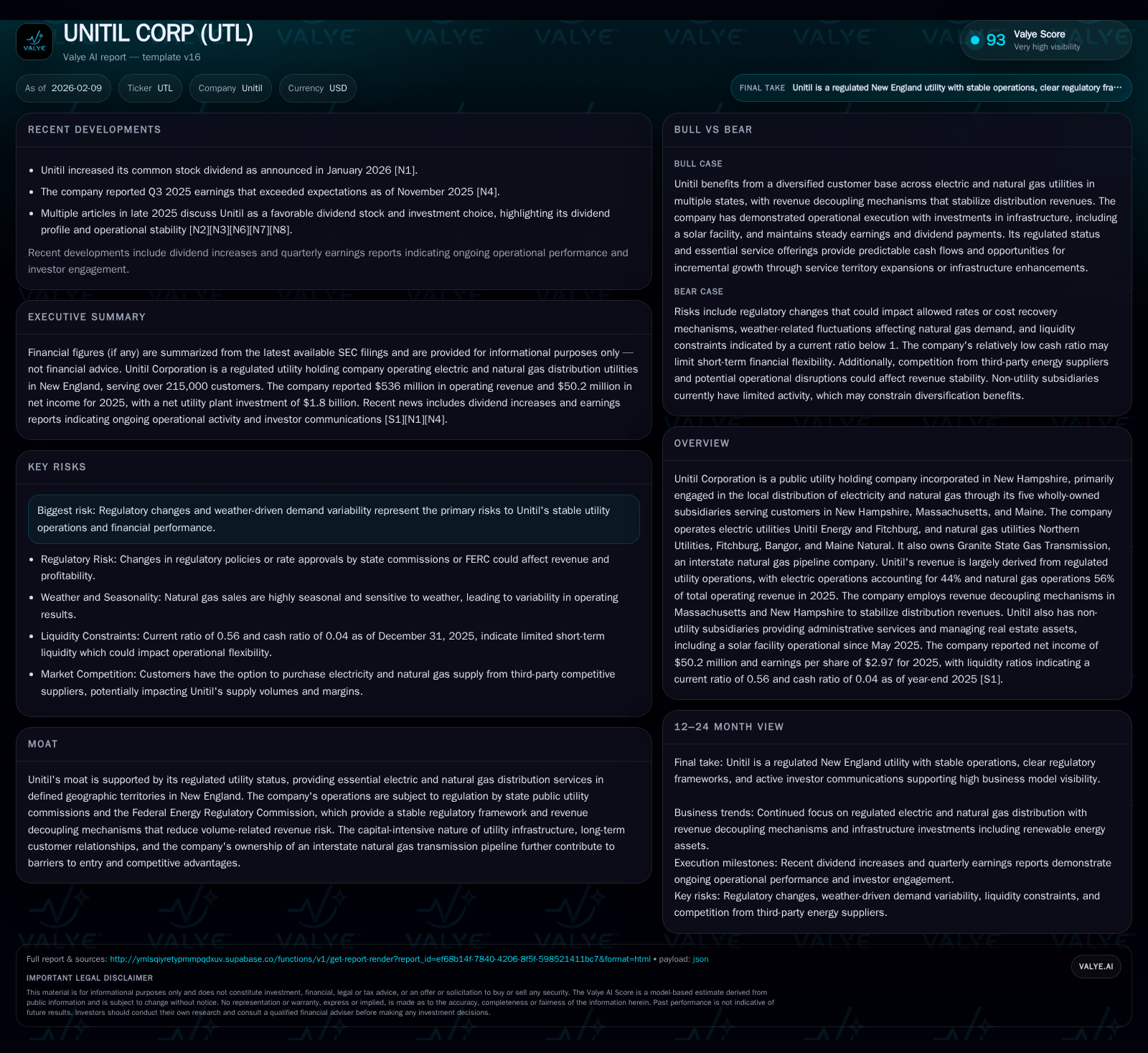
Unitil Corporation is a New Hampshire-incorporated utility holding company delivering electricity and natural gas through five subsidiaries covering regions of New Hampshire, Massachusetts, and Maine. Its revenue predominantly arises from regulated electric and natural gas distribution coupled with interstate natural gas pipeline operations. The company's moat is fortified by regulatory protections, capital-intensive infrastructure, and long-standing customer bases while facing risks from regulatory shifts and demand variability driven by weather. Recent developments include dividend increases and improved full-year financial performance as of early 2026.
Company Overview
Founded in 1984 and headquartered in New Hampshire, Unitil Corporation is an established regional utility holding company serving parts of the northeastern U.S., specifically New Hampshire, Massachusetts, and Maine. The company’s primary focus revolves around the local delivery of essential energy services — electricity and natural gas — managed through its five wholly owned subsidiaries. These comprise Unitil Energy Systems (electric in NH), Fitchburg Gas & Electric Light Company (electric and gas in Massachusetts), Northern Utilities (natural gas in NH and ME), Bangor Natural Gas Company (natural gas in central Maine), and Maine Natural Gas Corporation (natural gas in southern/central Maine).
Additionally, Unitil owns Granite State Gas Transmission which functions on the interstate level transporting natural gas to Northern Utilities' service territory. This structure evidences an integrated approach to supply chain management across production, transmission, and local distribution.
Revenue Mix & Operations
In 2025, regulatory operations yielded revenues evenly split yet slightly weighted toward natural gas services: approximately 44% from electric operations versus about 56% from natural gas activities. The company’s business model benefits heavily from state-sanctioned monopoly territories and rate-setting regimes anchored by public utility commissions complemented by Federal Energy Regulatory Commission oversight on interstate matters.
Both Massachusetts and New Hampshire utilize revenue decoupling mechanisms allowing Unitil to mitigate volume risk inherent in fluctuating customer consumption levels. This regulatory feature ensures more predictable fixed-cost recovery independent of short-term consumption shifts.
Subsidiaries & Service Footprint
- Unitil Energy Systems: Providing electric service primarily concentrated in southeastern seacoast NH including Concord.
- Fitchburg Gas & Electric: Dual-electric/gas provider serving north-central Massachusetts.
- Northern Utilities: Natural gas distributor encompassing southeastern NH as well as southern to central Maine regions including Portland.
- Bangor Natural Gas: Serving central Maine’s Bangor area with natural gas.
- Maine Natural Gas: Covering southern/central Maine including Portland metropolitan area plus Augusta.
Granite State Gas Transmission significantly supports natural gas reliability offering interstate pipeline capacity that feeds Northern Utilities’ network – a strategic asset bolstering supply security amidst regional infrastructure constraints.
Regulatory Environment & Competitive Moat
The company’s protected market territories are underpinned by stable regulatory frameworks. Public utility commissions actively monitor rates ensuring justifiable returns on invested capital via structured cost-of-service models. These conditions cultivate a durable competitive advantage as barriers to entry remain high owing to capital intensity required for utility-scale infrastructure investments.
Equally important are established long-term customer relationships fostered by necessity rather than choice – electricity and natural gas remain indispensable services limiting churn.
Moreover, federal regulation via FERC governs Granite State’s interstate pipeline operations, providing standardized tariffs and reducing potential competitive threats from third-party pipelines.
Risks & Operational Challenges
Despite the strengths emerging from regulation and essential service status, Unitil faces notable risks:
- Weather Sensitivity: Variability in temperature severely influences heating demand for natural gas during winter months and cooling load for electric consumption during summer heatwaves.
- Regulatory Changes: Shifts in policy or rate-setting frameworks may impair profitability or delay infrastructure investment recovery.
- Operational Hazards: The physical nature of utility networks exposes Unitil to risks including leaks, explosions related to aging pipelines or electric systems failures. Mitigating these events involves ongoing maintenance but cannot fully eliminate unexpected costs or operational disruptions.
- Technological Vulnerabilities: Evolving IT systems for metering and billing pose cybersecurity risks alongside challenges integrating newer technologies reliably.
- Financial Liquidity: With reported data indicating current liabilities (
$426 million) exceeding current assets ($240 million) as of December 2025 resulting in a current ratio near 0.56 [F1], short-term liquidity management remains critical.
Recent Developments
Early 2026 news highlights positive financial momentum with Unitil reporting an annual bottom line increase [N1]. Additionally, management has announced enhancements to their common stock dividend signaling confidence in steady cash flow generation supported by their regulated utility base [N2].
This payout growth suggests management’s commitment to rewarding shareholders amid stable business fundamentals despite macro uncertainties affecting the energy sector broadly.
Industry Context & Strategic Considerations (Analysis)
The New England utility landscape continues evolving under pressures from decarbonization policies including increased electrification mandates targeting carbon emissions reduction. While this creates growth opportunities for electric utilities like Unitil Energy through potential load increases from electric vehicle charging or heating electrification initiatives, it accentuates the need to modernize grid infrastructure concurrently balancing legacy natural gas assets amid shifting fuel preferences.
Investment cycles for upgrading aging pipelines intersect with regulatory deliberations over safety standards post various industry incidents nationwide heightened scrutiny on pipeline integrity will obligate sustained capital expenditures while regulators weigh rate impacts on consumers already facing inflationary pressures.
FERC's ongoing reforms concerning pipeline certification processes may affect Granite State's future capacity expansions or operations cost structures indirectly influencing Unitil's transmission revenues.
Unitil's strategy must thus strike a balance between reinforcing critical baseline service reliability through prudent infrastructure investments while exploring complementary non-regulated ventures via subsidiaries such as Unitil Resources aiming to diversify earnings streams beyond traditional regulated frameworks.
Financial Review Highlights [F1]
Prefacing the most recent fiscal year ending December 31, 2025:
- Net income stood at approximately $50.2 million — reflecting operational stability within regulated parameters.
- Cash reserves were modest at $15.6 million indicating tight working capital conditions necessitating effective liquidity management against sizable current liabilities nearing $426 million.
- The low current ratio underscores dependence on efficient asset-liability turnover cycles typically seen in utilities managing large receivables/payables tied to regulated billing cycles rather than outright liquidity concerns unless unexpected disruptions occur.
Future financial performance will be sensitive to any irregular demand patterns due to extreme weather events impacting consumption volumes despite revenue decoupling mechanisms cushioning revenue impacts somewhat but not entirely against all volume-linked cost variations.
Conclusion
Unitil Corporation exemplifies a classic vertically integrated regional utility with enduring competitive advantages rooted in regulatory protections combined with critical energy delivery infrastructure across New England states. Its balanced exposure between electricity and natural gas markets affords diversified revenue streams albeit within an overall low-growth utility industry backdrop increasingly complicated by evolving environmental regulations and technological change demands.
Monitoring regulatory developments closely alongside continued operational risk mitigation remains pivotal for sustaining financial health and service reliability. Recent dividend progress hints at confident stewardship navigating these complexities effectively while maintaining investor engagement amidst broader sector transitions towards clean energy futures.
This analysis is intended solely to provide an informed overview based on available public information without offering investment advice or recommendations. Readers should perform further due diligence tailored to their specific requirements before forming opinions or making decisions related to Unitil Corporation securities or its industry context.
Disclaimer: This is research-only, informational analysis and not investment advice. It may include AI-generated interpretation and general industry context. Always verify important details using primary sources.

Comments