
Assessing Viking Acquisition Corp I's Early Operational Metrics and Strategic Outlook
Viking Acquisition Corp I launched its SPAC IPO in late 2025, establishing a robust trust account and leveraging KingsRock's advisory to pursue a timely business combination.
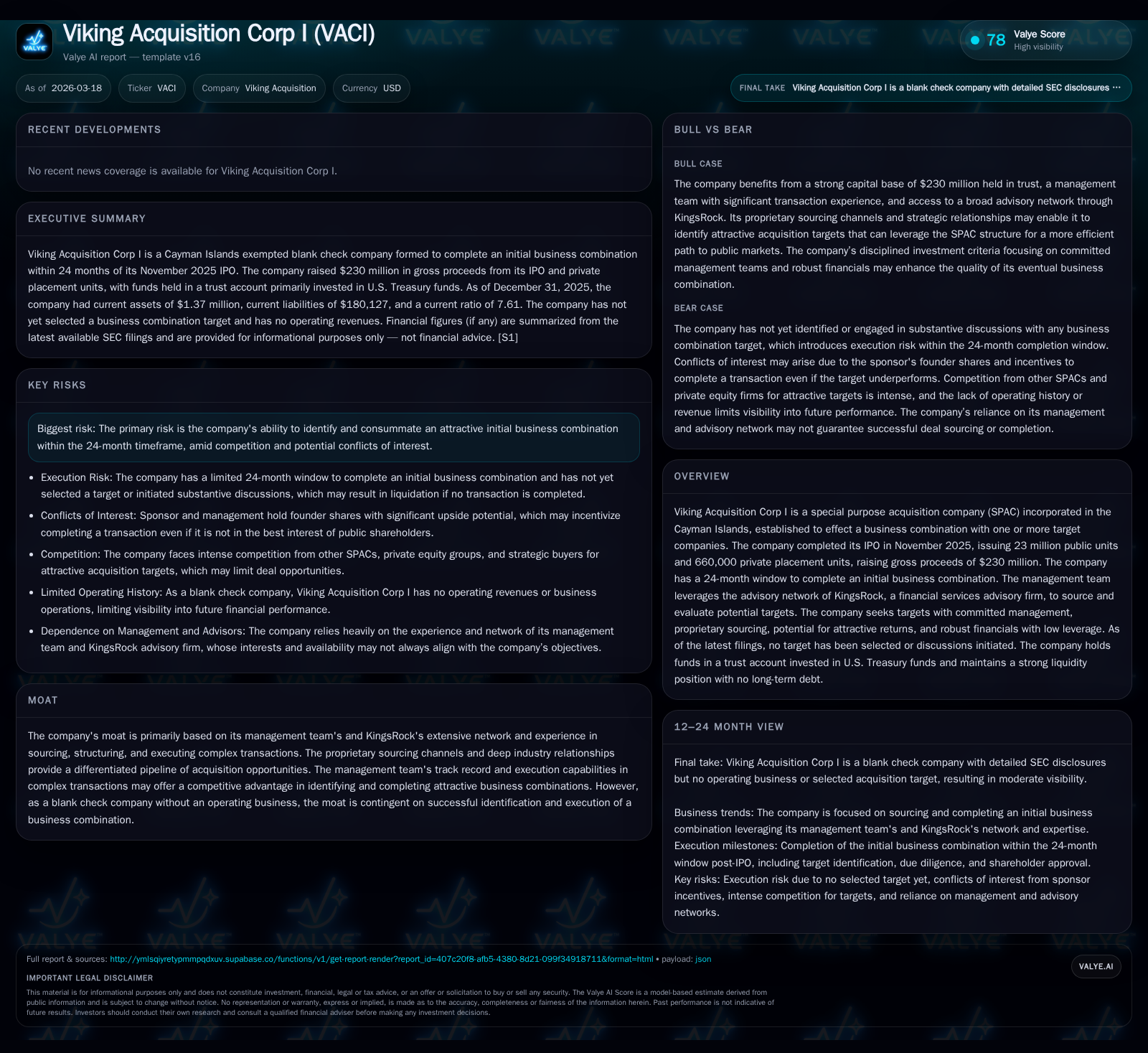
Viking Acquisition Corp I completed its IPO in November 2025, raising approximately $236.6 million inclusive of private placement proceeds. As a newly formed Cayman Islands-based blank check company, it currently holds nearly all cash proceeds in a trust account invested primarily in U.S. Treasury funds. The company has no operating revenues but generates interest income on trust assets, offset by administrative and compensation expenses related to public entity costs. Management leverages an advisory network via KingsRock to source acquisition targets; however, no formal discussions have commenced. The critical near-term milestone remains successfully identifying and closing an attractive business combination within the 24-month window, amid competitive pressures and inherent SPAC risks.
From Inception to IPO: Capital Raise and Initial Financial Footprint
Viking Acquisition Corp I was incorporated on July 24, 2025 as a Cayman Islands exempted company and executed its initial public offering (IPO) on November 3, 2025. The offering comprised 23 million public units at $10 each, generating gross proceeds of $230 million. This included full exercise of the underwriters' over-allotment option for an additional 3 million units. Concurrently, the company sold 660,000 private placement units at the same price, contributing approximately $6.6 million in gross proceeds.
Sponsor participation included the purchase of 350,000 private placement units with the remainder acquired by underwriting representatives [S1][S14]. Total funds raised amounted to roughly $236.6 million before underwriting fees and offering costs.
During its first operational period through December 31, 2025 – effectively covering inception to IPO closing – Viking I engaged solely in organizational and offering preparations with no revenue-generating operations [S1]. The company reported net income of $207,678 largely derived from interest income ($1.38 million) earned on marketable securities held within its Trust Account plus unrealized gains ($91,876), which were offset by substantial share-based compensation ($1.02 million) and administrative expenses ($236K). Operating income was negative approximately $1.26 million reflecting typical SPAC startup costs [F1].
This profile confirms Viking’s status as a classic blank check vehicle with financials dominated by capital raise proceeds secured in escrow rather than commercial operations.
Operating Structure and Financial Position After Launch
Post-IPO, Viking Acquisition Corp I established strong liquidity foundations necessary for future acquisition activities. As of December 31, 2025, cash and marketable securities held in the Trust Account totaled nearly $231.47 million with approximately $74 held as cash and the balance invested mainly in U.S. Treasury funds considered high-quality liquid assets [S8][F1]. Liquid assets outside the Trust Account stood at around $1.28 million earmarked for operating expenses such as due diligence costs.
The company's current assets were $1.37 million against current liabilities of approximately $180K resulting in a robust current ratio near 7.61—indicative of a solid liquidity buffer despite an immature operating model [F1]. No long-term debt exists; however, administrative services are provided under an agreement with KingsRock affiliates at about $30K monthly which had accrued about $60K for initial months post listing [S3].
A promissory note for bridge funding prior to IPO closure was fully repaid at close [S3][S7]. Additionally, working capital loans up to $1.5 million may be extended by the Sponsor or affiliates post-IPO strictly for transactional purposes; these advance loans are convertible into units mirroring private placement terms if made [S3][S10]. Such borrowing remains unused as of year-end.
Expenses incurred mainly relate to public company compliance alongside non-cash share-based compensation allocated to management and advisers connected to KingsRock’s ecosystem [S1][F1]. The absence of material liabilities reassures that financial risks remain principally tied to execution of the planned business combination rather than balance sheet instability.
The Challenge of Finding the Right Target: Management and Advisory Network Moat
Viking Acquisition Corp I’s competitive moat rests predominantly on its management team’s experience combined with access to KingsRock’s extensive advisory network—a global independent financial advisory platform established in 2020 [N# valye_report_excerpt]. This network is designed to deliver proprietary sourcing pipelines spanning multiple sectors and geographies that less-connected SPAC sponsors may lack.
Management prioritizes target companies led by committed leadership teams with strong financial profiles marked by low leverage and scalable growth potential [N# valye_report_excerpt]. This disciplined approach coupled with structuring expertise aims to generate attractive shareholder returns post-de-SPAC transaction.
Despite this strategic positioning advantage, as of the latest filings no target has been publicly identified nor have substantive discussions begun [S21]. Market dynamics are challenging given rising competition between numerous SPACs vying for quality targets—a point explicitly acknowledged as a notable risk factor which can dilute deal economics or delay outcomes [S20][S23].
Governance practices embedded by Viking reinforce alignment whereby sponsor founder shares convert only upon consummation of business combinations ensuring aligned incentives [S21]. However, conflicts could emerge should KingsRock affiliated entities choose alternative deals exclusive of Viking or if deal scarcity inflates valuation prerequisites.
Funding Deployment and Capital Allocation Plans Ahead of Business Combination
Viking’s capital management policy is conservative: almost all IPO gross proceeds—including interest earned post-offering—are securely held within the Trust Account pending completion of one or more business combinations valued at least at 80% of those funds per NYSE rules [S1][S28]. Interest income net of taxes may be withdrawn solely for tax obligations without eroding principal intended exclusively for merger consideration.
Funds outside the Trust Account, presently about $1.28 million, finance administrative functions such as target search activities, travel related to diligence visits, legal reviews, negotiation support and general operating requirements pre-deal close [S10][S14]. No dividends or share repurchases occur given the blank check structure remains non-operational pre-combination [S9].
Private placement warrants issued concomitant with promoter units become exercisable only after either (a) one year post-IPO or (b) thirty days following transaction closing - whichever is later - providing incremental equity upside tied directly to successful de-SPAC execution [S1][S21].
Potential use of Working Capital Loans convertible into units provides optionality should unforeseen transaction costs arise necessitating bridge financing without diluting shareholder value prematurely [S3]. Overall capital allocation maximizes protection of original public unit holders’ investment while sustaining sponsor economic interests structured around successful transaction closure.
Risks and Market Dynamics Facing VACI's Timely Transaction Completion
The foremost risk facing Viking Acquisition Corp I pertains to completing an acceptable initial business combination within a strictly imposed timeline: within 24 months from closing date (by November 2027), failing which liquidation proceedings will return pro rata funds from Trust Account less fees resulting in sponsor equity wipeout [S20][S27].
Competition among numerous SPAC vehicles intensifies challenges finding targets meeting defined financial thresholds amid evolving economic conditions and sector volatility potentially depressing valuations or curtailing promising candidates. Sponsors must guard against erosion of transactional attractiveness due to elevated redemption demands from shareholders which depletes acquisition dry powder available.
Conflicts could arise between KingsRock’s broader advisory commitments versus Viking’s exclusivity expectations limiting pipeline sharing although contractual governance provisions seek mitigation via director independence standards at NYSE compliant levels [S3][S22]. Delays could also lead to increased administrative burn rates reducing budget for due diligence efforts thereby impairing competitiveness.
While trust account protections offer downside mitigants preserving principal capital until deal closure or liquidation scenario occurs, shareholder returns depend entirely on timely successful acquisition execution obligating vigilant appraisal monitoring alongside transparent investor communications.
Key Financial Metrics and What Investors Should Monitor Next
A concise summary table below reflects Viking Acquisition Corp I’s inaugural annual financial snapshot through December 31, 2025:
Historical performance (annual)
| FY |
|---|
| 2025 |
Source: SEC companyfacts cache [F1].
Note: Revenue is absent consistent with blank check status; CFO negative due primarily to operational expenses; current ratio strong reflecting healthy liquidity buffer derived mainly from cash outside Trust Account; calculated ROE indicates startup losses not ongoing performance drivers [F1][S1].
Looking forward, quarterly SEC filings should elucidate progress toward identifying suitable targets including any signed letters of intent or definitive agreements thus enhancing visibility into anticipated timelines for shareholder votes or redemption exercises. Additional metrics such as warrant exercisability status per timing milestones will indicate dilution potential ahead post-business combination close.
Monitoring working capital loan drawdowns will also provide insights into transactional cost trajectories thereby signaling incremental financing requirements or flexibility constraints pre-closing event.
This analysis is based entirely on publicly filed financial statements extracted from Viking Acquisition Corp I's latest Forms 10-K/Q as well as internally aggregated company meta-information up to March 18th, 2026. It does not offer investment advice but aims to clarify early-stage SPAC financial characteristics alongside governance setups unique to blank check vehicles navigating competitive transactions frameworks.
Disclaimer: This is research-only, informational analysis and not investment advice. It may include AI-generated interpretation and general industry context. Always verify important details using primary sources.

Comments