
Vericel Q2 2026: Revenue Growth Supported by MACI Arthro Adoption and Burn Care Expansion
Vericel's Q2 2026 results highlight commercial progress in autologous cell therapies and burn care products alongside strong liquidity.
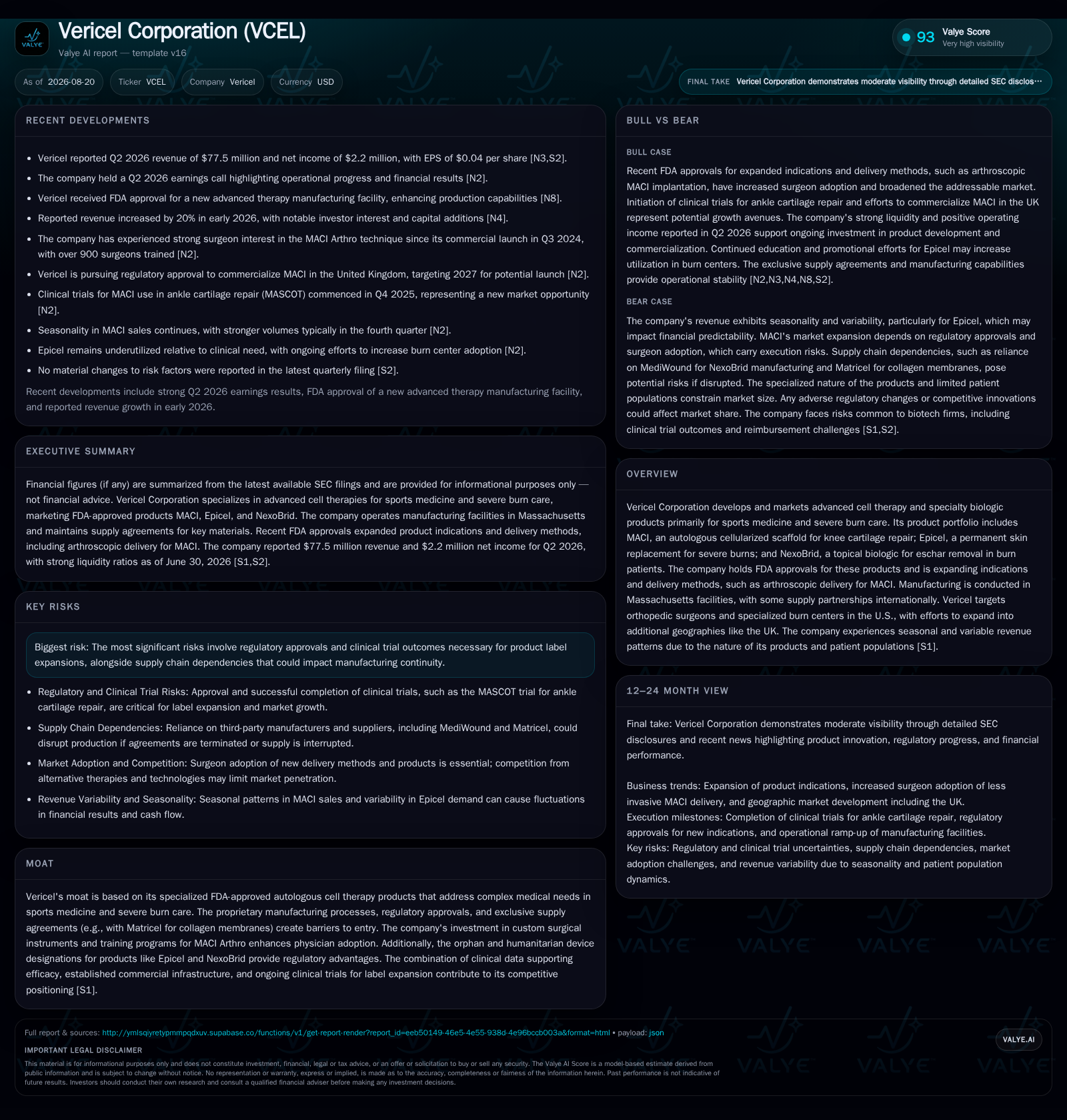
Vericel Corporation's Q2 2026 financial and operating results demonstrate continued revenue growth driven by the adoption of the MACI Arthro arthroscopic delivery system and expansion of its burn care portfolio, including Epicel and NexoBrid. Since its U.S. launch in Q3 2024, MACI Arthro has gained surgeon adoption, potentially broadening the addressable market for cartilage repair. Concurrently, growth in burn care product usage diversifies revenue streams, supported by FDA approvals and orphan designations. The company's strong liquidity position, with a current ratio of 5.04 and $125.4 million in cash and equivalents as of June 30, 2026, provides financial flexibility to fund clinical development and geographic expansion initiatives in this regulatory-driven sector.
Q2 2026 Operating Performance and Commercial Developments
Vericel Corporation's Q2 2026 results reflect meaningful progress in the commercial adoption of its autologous cell therapy products and expansion of its burn care portfolio as reported in the latest 10-Q filing [S2]. The MACI Arthro system enables less invasive delivery of the MACI implant via small incisions using custom-designed arthroscopic instruments, which may lower procedural barriers compared to traditional open surgery. This innovation potentially expands the addressable market for cartilage repair by increasing surgeon willingness to adopt the therapy.
Alongside MACI Arthro, Vericel continues to expand usage of its burn care products, Epicel and NexoBrid, in specialized burn centers. Epicel, a permanent skin replacement with a Humanitarian Use Device designation, treats patients with extensive deep-dermal or full-thickness burns. NexoBrid, licensed exclusively for North America, is an orphan-designated specialty biologic used for enzymatic eschar removal in burn patients. The growth in these products diversifies Vericel's revenue streams and leverages regulatory advantages that support commercial penetration in a niche but critical market segment [S1][S2]
Financial Position and Liquidity Analysis
As of June 30, 2026, Vericel held $125.4 million in cash and equivalents, with current assets totaling $264.7 million against current liabilities of $52.5 million, resulting in a current ratio of 5.04 [F1][S2]. This liquidity position indicates available short-term financial resources that could support ongoing operations, clinical development programs, manufacturing scale-up, and geographic expansion efforts, assuming no unforeseen cash flow constraints.
This level of liquidity may be important in the capital-intensive and regulatory-driven biotechnology sector where clinical trials, regulatory submissions, and manufacturing investments are critical to sustaining long-term growth [S2][F1]. The available financial resources could enable Vericel to pursue label expansions and international launches, such as planned MACI introduction in the United Kingdom, which might broaden the company's market reach
Business Model and Competitive Positioning
Vericel operates in the advanced cell therapy and specialty biologics market, focusing on FDA-approved autologous cell therapy products and specialty biologics for cartilage repair and severe burn care. Hospitals, specialized burn centers, and orthopedic surgeons' institutions purchase Vericel's products, with reimbursement typically provided by insurance or government payers.
Revenue is primarily generated from sales of MACI implants and the MACI Arthro surgical instruments, alongside burn care products Epicel and NexoBrid [S1][S2]. The company's competitive advantages include proprietary FDA-approved therapies, exclusive licensing agreements (notably for NexoBrid), regulatory orphan and humanitarian designations, and specialized manufacturing capabilities. The custom-designed arthroscopic instruments for MACI Arthro delivery create procedural differentiation that may enhance surgeon adoption and patient outcomes, contributing to competitive positioning.
Margins and cash conversion are influenced by manufacturing efficiency, product mix, scale, and reimbursement timing. Vericel's focus on clinical indication expansion, geographic launches, and portfolio diversification aims to drive revenue growth and improve profitability over time.
Risks and Scenario Analysis
Vericel faces several risks inherent to its specialized biotechnology sector. Regulatory delays or clinical trial failures could impede label expansions or new market approvals, limiting product adoption and revenue growth [S1][S2]. Supply chain dependencies, including reliance on third-party manufacturers, present operational risks that could disrupt product availability. Additionally, reimbursement uncertainties and competitive pressures may affect commercial performance.
Scenario analysis suggests a range of outcomes:
Bull case: Accelerated adoption of MACI Arthro combined with successful clinical label expansions and international launches could drive sustained double-digit revenue growth and margin expansion. Confirmation would come from accelerating quarterly revenue growth, positive clinical data, and new regulatory approvals.
Base case: Steady growth driven by gradual MACI Arthro adoption and burn care portfolio expansion supported by stable reimbursement and financial resources. Confirmation would include consistent revenue growth and maintained liquidity.
Bear case: Regulatory setbacks, clinical trial delays, or supply chain disruptions could result in revenue stagnation or decline and pressure on liquidity. The arthroscopic delivery innovation represents a structural growth driver by potentially increasing surgeon adoption and expanding the addressable market. The robust balance sheet provides financial flexibility to invest in clinical development, manufacturing scale, and geographic expansion critical to sustaining growth in a regulatory-driven cell therapy and biologics market.
Key watchpoints for investors include quarterly revenue trends for MACI Arthro and burn care products, progress in clinical trials and regulatory filings for label expansions, milestones in geographic launches such as the UK, and changes in liquidity and working capital. Additionally, monitoring supply chain stability and manufacturing capacity will be important to assess operational risks that could impact product availability and financial performance.
Disclaimer: This is research-only, informational analysis and not investment advice. It may include AI-generated interpretation and general industry context. Always verify important details using primary sources.

Comments