
Wingstop Q2 2026: Franchise Expansion and Digital Sales Drive Growth Amid Same-Store Sales Pressure
Wingstop's Q2 2026 results show system-wide sales growth fueled by franchise expansion and digital sales, offset by ongoing domestic same-store sales declines.
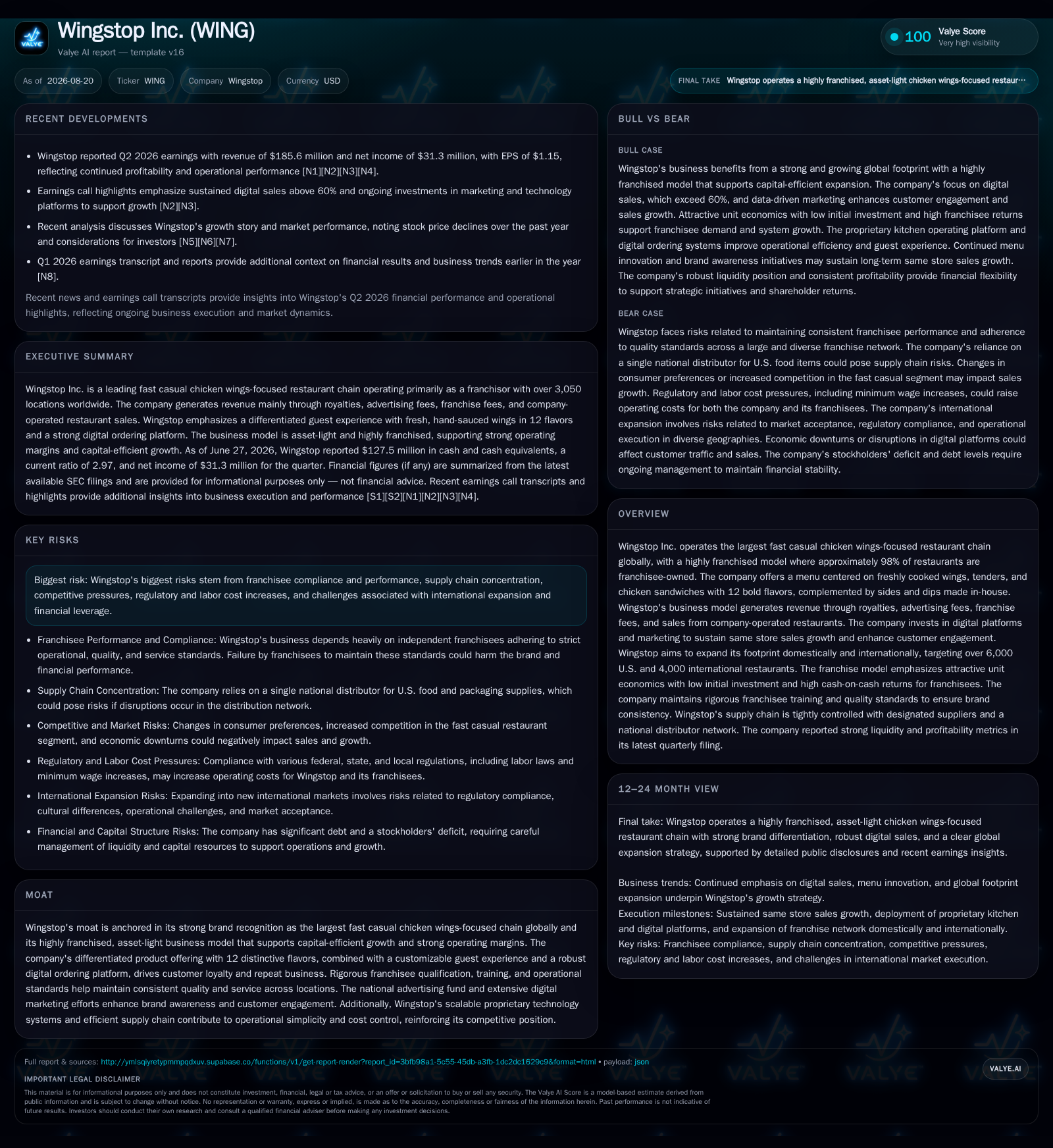
Wingstop Inc. reported continued system-wide sales growth in Q2 2026, driven primarily by net new franchise unit openings and strong digital sales penetration reaching 73.2% of system-wide sales. Despite this growth, domestic same-store sales declined by 3.3%, reflecting persistent softness in established markets. The company’s asset-light franchised business model supports capital-efficient expansion and robust liquidity, with cash and equivalents totaling $127.5 million as of June 27, 2026. Recent board expansion with the addition of an independent director enhances governance. Key investor focus remains on Wingstop’s ability to reverse same-store sales declines and accelerate international growth to achieve its Top 10 global brand ambition.
Wingstop Inc. reported a 12.1% increase in system-wide sales for Q2 2026 compared to the prior fiscal year, driven primarily by franchise expansion and increased digital sales penetration, which rose to 73.2% of system-wide sales [S2]. This growth supports Wingstop's asset-light franchised business model by boosting royalty and franchise fee revenues, enabling capital-efficient expansion. The company’s system-wide restaurant count grew to 3,056 locations worldwide, reflecting strong franchise unit openings and digital adoption.
However, domestic same-store sales declined by 3.3% during the same period, continuing a recent trend of softness in established U.S. markets [S1][S2]. Same-store sales are a critical metric in the fast casual restaurant industry as they indicate brand health and customer demand at existing locations. Prolonged declines in this area could pressure royalty revenues and franchisee profitability, potentially impacting the pace of new unit growth [S1][S2].
Franchise Model and Business Model Economics
Wingstop operates an asset-light franchised business model, with approximately 98% of its restaurants franchised and only 57 company-owned as of fiscal year-end 2025 [S1]. The company generates revenue primarily through royalties based on franchisee sales, advertising fees contributed to national marketing efforts, and franchise fees from new restaurant openings. This model supports capital-efficient growth with low capital expenditure requirements, enabling Wingstop to expand its footprint while maintaining strong operating margins [S1].
The high digital sales penetration enhances operational efficiency and customer engagement, which are important drivers of recurring royalty and advertising fee revenues [S1]. Wingstop’s focus on maintaining defined operating procedures, menu standards, and quality controls under franchise agreements aims to ensure consistent customer experience and brand reputation, which are key to sustaining long-term growth. The company’s proprietary digital platform, which supports over 70% of system-wide sales, is a competitive advantage that facilitates targeted marketing and customer relationship management, further bolstering franchisee sales performance and brand loyalty [S1].
This business model's economics are underpinned by the scalability of franchise expansion combined with the relatively low capital intensity of opening new units, as franchisees bear the majority of the investment costs. The resulting revenue streams from royalties and fees provide Wingstop with high-margin, recurring income, contributing to strong adjusted EBITDA growth and cash flow generation [S1][S2]
Liquidity and Balance Sheet Position
As of June 27, 2026, Wingstop held $127.5 million in cash and cash equivalents and reported a current ratio of 2.97, with current assets of $208.3 million against current liabilities of $70.2 million [F1]. This liquidity position provides operational flexibility and supports capital allocation for ongoing franchise expansion and other growth initiatives. The company’s asset-light model contributes to strong operating cash flow and low capital expenditure needs, reinforcing its capacity for capital-efficient growth [S2][F1].
This liquidity position could allow the company to invest in digital platform enhancements, marketing, and international expansion, potentially without significant reliance on external financing [F1][S2]
Governance Update and Strategic Implications
In August 2026, Wingstop expanded its Board of Directors from ten to eleven members with the appointment of Jay Snowden as an independent director [S3]. Mr. Snowden’s addition, including his roles on the Audit and Compensation Committees, may enhance governance oversight and risk management. Such board developments can influence investor confidence by strengthening strategic oversight during a period of both growth opportunities and operational challenges [S3].
The board expansion reflects Wingstop’s commitment to robust corporate governance and may support the company’s strategic priorities, including sustaining long-term same-store sales growth and expanding its global footprint [S3]. Enhanced oversight could be particularly important as the company navigates competitive pressures and seeks to reverse domestic same-store sales declines while pursuing international growth
Risks and Growth Scenarios
Wingstop faces the key challenge of reversing its domestic same-store sales decline to sustain long-term growth [S1][S2]. Sustained softness in same-store sales could pressure royalty revenues and franchisee economics, potentially slowing new unit openings and overall system-wide sales growth. Same-store sales declines may reflect cyclical consumer demand softness or increased competition in established markets, underscoring the need for strategic focus on brand engagement and market penetration [S1][S2].
One plausible upside scenario is that Wingstop successfully leverages its strong digital platform and brand loyalty to re-engage customers, complemented by menu innovation and marketing efforts. Accelerated international franchise expansion could also provide a significant growth runway, supporting the company’s ambition to become a Top 10 global restaurant brand [S1][S2]. Confirmation of this scenario would be indicated by positive same-store sales growth in subsequent quarters, announcements of new international franchise agreements, and stable or improving royalty revenue growth.
Conversely, the risk case scenario involves continued domestic same-store sales declines, weakening franchisee performance, and potential regulatory or operational challenges in international markets [S1][S2]. These factors could constrain Wingstop’s growth and margin expansion. Confirmation of this downside scenario would include ongoing negative same-store sales trends, increased franchisee closures or disputes, and delays or setbacks in international expansion
Despite these risks, Wingstop’s liquidity position and recent board expansion may offer a basis for pursuing growth initiatives and governance enhancements. The company’s asset-light franchised model could support capital-efficient growth even amid operational headwinds, representing a possible competitive differentiation in its business model.
Investors and observers should closely monitor quarterly domestic same-store sales trends, the rate of new franchise unit openings—particularly internationally—digital sales penetration percentages, royalty and franchise fee revenue growth, and franchisee compliance and operational performance metrics. These indicators will be critical to assessing Wingstop’s progress toward reversing same-store sales softness and achieving its long-term growth objectives.
Disclaimer: This is research-only, informational analysis and not investment advice. It may include AI-generated interpretation and general industry context. Always verify important details using primary sources.

Comments