
Navigating Tight Margins: WORLD ACCEPTANCE CORP’s Balancing Act Amid Rising Credit Losses and Regulatory Challenges
WORLD ACCEPTANCE CORP contends with mounting credit losses and regulatory uncertainties while leveraging an extensive branch footprint and sizable loan portfolio.
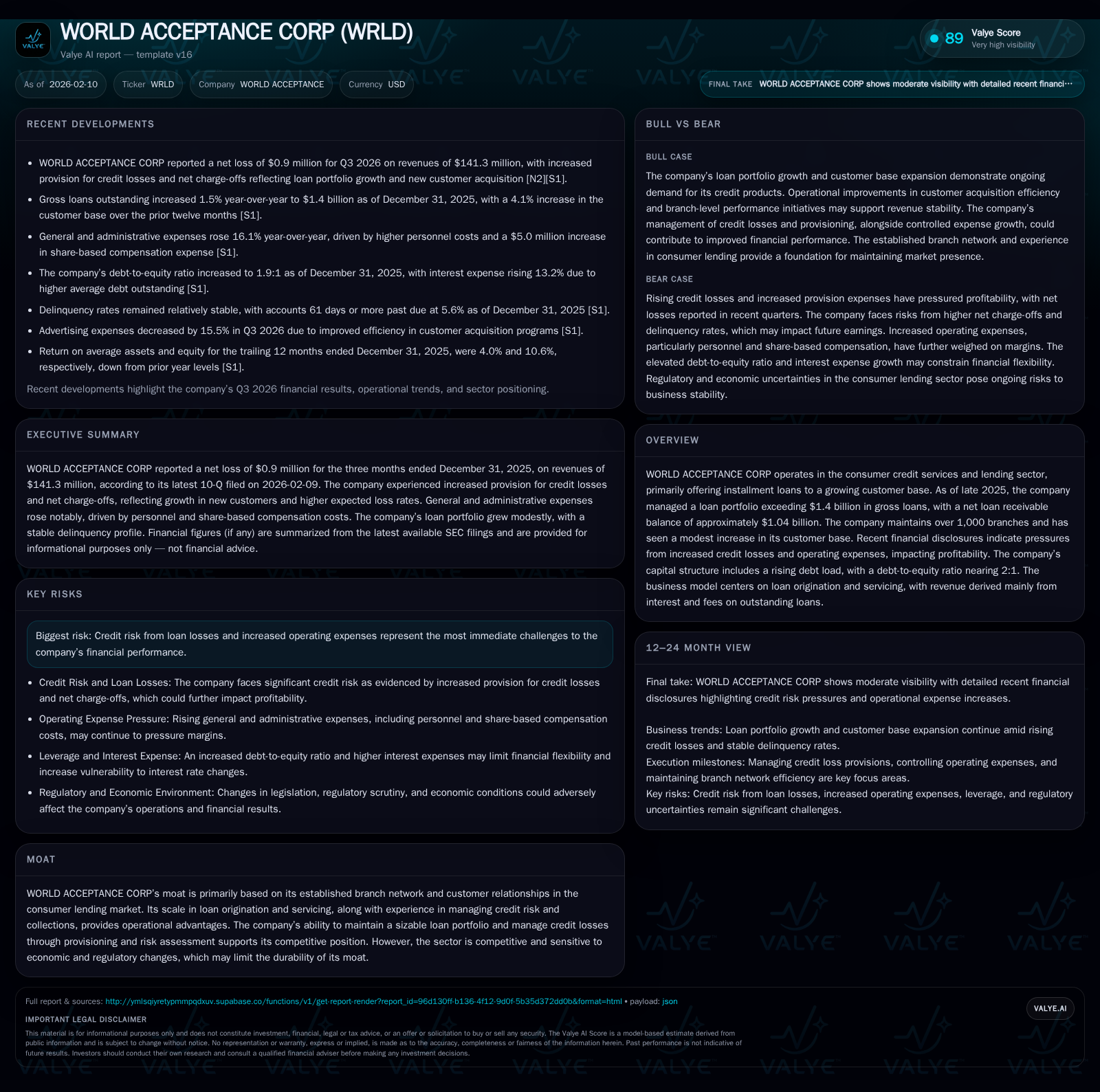
WORLD ACCEPTANCE CORP (WRLD) operates a broad consumer lending platform with over 1,000 branches and more than $1.4 billion in gross loans. Despite steady loan growth and revenue beats, rising operating expenses and credit losses have squeezed profitability, resulting in a reported net loss in Q3 2025. The company’s leverage is climbing, with its debt-to-equity ratio nearing 2:1, amplifying capital structure risks amid a challenging interest rate environment. Regulatory pressures loom large, casting uncertainty over future compliance costs and constraints. WRLD’s operational moat, rooted in scale and risk management expertise, faces tests from economic headwinds and evolving legislation.
Building Scale: The Expanding Branch Network and Loan Portfolio
At the core of WORLD ACCEPTANCE CORP's (WRLD) business model lies a vast physical footprint with more than 1,000 branches nationwide. This expansive reach supports a substantial loan portfolio—exceeding $1.4 billion in gross loans as of December 2025—with a net receivable balance around $1.04 billion [F1]. Such scale furnishes WRLD with significant market presence within the consumer installment lending segment where accessibility remains key. Modest customer base growth noted alongside this increase demonstrates ongoing demand for their credit offerings [N2]. This breadth establishes an operational platform that few competitors can replicate quickly, underpinning WRLD's advantage in loan origination density.
Revenue Engines Under Pressure: Exploring Interest Income Versus Rising Costs
Despite beating revenue estimates for Q3 2025 with total revenues touching approximately $141 million [F1][N2], WRLD reported a net loss of $0.9 million for the same period [F1]. This squeeze illustrates how rising operating expenses have begun to erode income derived predominantly from interest and fees on outstanding loans—the company's main revenue streams [S2]. As costs related to servicing, compliance, and employee remuneration increase, profit margins have tightened alarmingly. The company acknowledges these pressures candidly in filings, attributing part of the profitability drag to elevated credit losses coupled with inflation-driven expense escalation [S2].
Credit Challenges: Unpacking the Impact of Delinquencies and Provisions
Credit risk represents one of the most immediate hurdles for WRLD. The company has seen upward trends in loan delinquencies necessitating greater provisioning against potential defaults [S2]. Management commentary from their Q3 earnings call details growing delinquency ratios that exert downward pressure on earnings through increased net charge-offs [N1]. Proactive loss reserves aim to mitigate exposure but also constrain short-term financial performance given their impact on earnings volatility. The interplay between managing loan growth ambitions while controlling credit quality remains delicate—a balance crucial to sustaining long-term health amid consumer credit sensitivity to macroeconomic fluctuations.
Debt Dynamics: Understanding WRLD's Leverage and Capital Structure Risks
Compounding margin challenges is an escalating leverage profile—WRLD's debt-to-equity ratio approaching approximately 2:1 [F1]. This increasing reliance on borrowed funds raises questions about financial flexibility amidst a tightening interest rate environment [S2]. Higher debt servicing costs could exacerbate profit compression if top-line growth falters or credit issues deepen. Additionally, contingent liabilities stemming from regulatory or litigation matters potentially strain liquidity under less favorable economic climates. The firm's dependence on debt financing underscores the need for vigilant capital management strategies going forward.
Regulatory Fog: How Compliance and Legal Uncertainties Cloud the Outlook
Operating under heightened scrutiny from regulators like the Consumer Financial Protection Bureau (CFPB) generates significant uncertainty for WRLD’s business model [S2]. Recent legislative developments coupled with proactive regulatory oversight impose compliance demands that may translate into increased operational complexity and cost burdens. The company’s most recent SEC filings caution investors about unpredictable regulatory actions which could materially impact financial condition or results [S2]. These include possible shifting standards around interest rates, lending disclosures, or enforcement actions that collectively frame a murky operating environment.
Moat in Question: Can Operational Expertise Sustain a Competitive Edge?
WRLD’s competitive moat rests heavily on its entrenched branch network and experienced credit risk management—a combination fostering scale efficiencies not easily replicated by new entrants [valye_report_excerpt][S2]. Yet this advantage is arguably tenuous given intensifying sector competition and sensitivity to economic cycles affecting borrower repayment capacity. Operational resilience demonstrated historically faces new tests amidst tightening regulations and emerging digital competitors encroaching on traditional installment lending domains. Maintaining relevancy will require continued evolution beyond physical presence toward enhanced risk analytics and customer engagement strategies.
Forward Looking: Management’s View and Market Sentiment in Q3 2025 Results
Management’s tone during the January 2026 earnings call reflected cautious realism intertwined with measured optimism [N1]. While acknowledging persistent headwinds—especially related to credit quality deterioration—they emphasized focus areas including expense control initiatives and disciplined underwriting enhancements intended to stabilize performance [N1]. Market reaction post-earnings appeared mixed; revenue outperformance tempered by earnings losses underlining investor sensitivity toward margin sustainability amid macroeconomic uncertainties [N2]. Forward-looking statements underscore inherent unpredictability surrounding economic conditions, regulation evolution, and competitive dynamics influencing near-term execution [S2].
Macro Tailwinds and Headwinds: Sector-Wide Trends Influencing WRLD’s Future
Wrapping the company-specific analysis into broader context reveals sector-wide forces at play. Inflation persists as a double-edged sword—potentially pushing up interest revenues but simultaneously increasing default risks as consumer debt servicing strains budgets [S2][N3]. Rising benchmark rates may raise borrowing costs both for consumers and companies like WRLD reliant on external capital. Meanwhile, digital disruption accelerates innovation pressure within consumer lending ecosystems making physical footprints less distinctive unless complemented by technology investments [N3]. These macroeconomic and industry trends collectively frame an environment where prudent risk management will be paramount for surviving volatile cycles.
Disclaimer: This analysis is based on publicly available data as of February 2026 including recent SEC filings and market commentary. It does not constitute investment advice or a recommendation regarding WORLD ACCEPTANCE CORP securities. Forward-looking statements herein reflect current management views subject to change given evolving financial performance or regulatory developments.
Disclaimer: This is research-only, informational analysis and not investment advice. It may include AI-generated interpretation and general industry context. Always verify important details using primary sources.

Comments