
Wintrust Financial’s Strategic Model Drives Consistent Profitability and Expanding Dividends
Wintrust’s multi-bank structure and specialty finance operations have propelled sustainable earnings growth and a dividend policy underscored by robust cash flow generation.
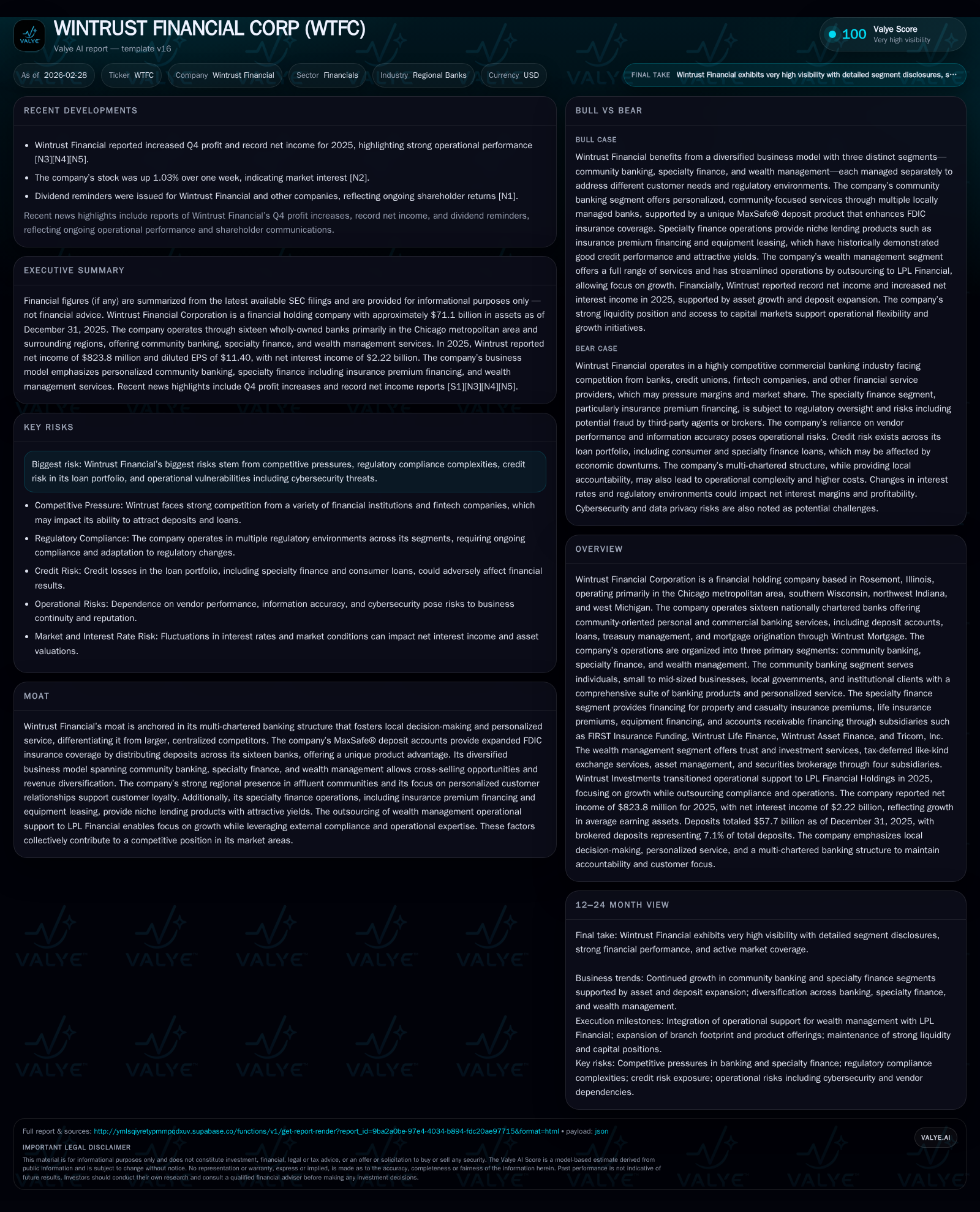
Wintrust Financial Corporation has demonstrated solid top-line growth driven by its community banking and specialty finance segments, highlighted by a 7.1% revenue increase in FY2024 and an 18.5% net income rise from FY2024 to FY2025. Its unique multi-chartered banking model supports localized decision-making and personalized services, while specialized niche lending in insurance premium financing and equipment leases broadens revenue streams. Regulatory pressures on interchange fees and competition pose risks, but continued expansion within affluent Midwest markets and cross-segment synergies sustain growth prospects. Prudently, Wintrust emphasizes dividend payouts supported by stable returns on equity approximating 11.3%, consistent free cash flow, and no recent share buybacks.
Community Anchored Growth: Historical Financial Performance Overview
Wintrust Financial has exhibited a pattern of steady financial progression exemplified by its 7.1% revenue growth in fiscal year 2024, continuing a multi-year expansion trend supported by its community banking scale-up and specialty lending activities [F1]. Net income advanced notably—registering an 18.5% increase between fiscal year 2024 and fiscal year 2025—reflecting strong operational leverage within its diversified business model. Operating cash flows remain robust, evidenced by a substantial increase of over 26% year-over-year into FY2025 despite prior volatility, underscoring the firm's capacity to generate liquidity to reinvest or distribute [F1]. This stability is realized against increasing expenditures typical of expanded workforce compensation packages supporting localized service mandates.
Historical performance (annual)
| FY | Rev ($mm) | Net ($mm) | CFO ($mm) | Capex ($mm) | Rev YoY | Net YoY |
|---|---|---|---|---|---|---|
| 2025 | 824 | 910 | 50 | +18.5% | ||
| 2024 | 616 | 695 | 722 | 86 | +7.1% | +11.6% |
| 2023 | 575 | 623 | 744 | 46 | +14.3% | +22.2% |
| 2022 | 503 | 510 | 1375 | 53 | +18.6% |
Source: SEC companyfacts cache [F1].
Capital returns and efficiency (annual)
| FY | Div ($mm) | Buybacks | FCF ($mm) |
|---|---|---|---|
| 2025 | 169 | 860 | |
| 2024 | 143 | 636 | |
| 2023 | 126 | 0 | 698 |
| 2022 | 108 | 0 | 1322 |
Source: SEC companyfacts cache [F1].
Annual financial metrics reflect expanded earnings capacity through targeted loan portfolio growth combined with disciplined expense management [F1].
Breaking Down Drivers: Multi-Chartered Banks and Specialized Lending
Wintrust’s hallmark multi-chartered approach encompasses sixteen nationally chartered banks concentrated primarily in affluent markets across Illinois, Wisconsin, Indiana, and Michigan [S1],[S5]. This decentralized structure empowers individual bank managers with significant decision-making authority—promoting responsiveness to local client needs while mitigating central bureaucracy common to larger regional players [S19]. The innovative MaxSafe® suite extends FDIC insurance coverage beyond conventional limits by distributing client deposits across the banking subsidiaries, which deepens customer trust and retention through enhanced deposit security [S5].
Specialty finance represents a complementary pillar comprising premium financing for property/casualty insurance policies and life insurance premiums nationally via FIRST Insurance Funding entities but also includes an equipment leasing portfolio valued at approximately $4.5 billion as of late-2025 [S4]. These niche lending categories generate attractive yields supported by collateralized loans diversified among numerous insurers—one insurer representing roughly only 9%, mitigating concentration risk [S4],[S11]. Operational outsourcing relationships such as wealth management support to LPL Financial streamline brokerage processes without detracting from client-facing activities [S7].
Emerging Challenges: Interchange Fee Regulation and Competitive Pressures
Regulatory evolution presents the foremost near-term risk vector with the Federal Reserve’s recent proposed rule slated to significantly reduce maximum allowable interchange fees on debit card transactions from a base rate of $0.21 to approximately $0.144 per transaction beginning post-adoption—potentially compressing a non-trivial component of Wintrust's fee income derived from payment processing [S1],[S13]. This pressure could impact margins especially given Wintrust’s asset scale exceeding $10 billion that classifies it under Regulation II.
Parallelly, Wintrust contends with intensifying competition from both larger regional banks which wield scale advantages in deposit pricing strategies as well as fintech entrants contributing to digital service expectations [S19]. Cybersecurity remains an operational concern flagged formally without indication of material incidents; yet vigilance remains crucial given sensitivity around client data and transactional integrity [S27].
Growth Outlook: Opportunities Within Core Markets and Specialty Finance
The company's entrenched presence in prosperous Midwestern metro areas provides an advantageous platform for continued organic loan growth coupled with selective geographic expansion punctuated by branch openings in Chicago metropolitan environs and southern Wisconsin during the last year [S19],[N6]. Increased demand for premium finance products continues as commercial insurance premium receivables grow fueled by stable underwriting partner ratings monitored rigorously to guard credit exposure [S4],[S11].
While explicit forward guidance is absent publicly, observed trends suggest management's focus on leveraging cross-selling opportunities within its tripartite segments—community banking clients being introduced incrementally to wealth management offerings facilitated through broker networks increasingly embedded in banking branches [S7],[N6]. Growing digital infrastructure investments underscore efforts toward enhanced client engagement platforms conducive to customer acquisition.
Capital Returns Focus: Dividend Growth, ROE Stability, and Buyback Absence
Wintrust’s capital allocation reflects conservatism paired with shareholder value commitment via steadily increasing dividends—up over 18% year-over-year for fiscal year end 2025—supported by free cash flow approximating $860 million calculated from CFO minus capital expenditures [F1],[S28]. Return on equity stands near an estimated ~11.3%, illustrative of efficient equity utilization balanced against measured risk appetite and regulatory capital requirements maintained comfortably above Basel III thresholds [F1],[S17],[S25].
The deliberate absence of share repurchases since fiscal years preceding the pandemic suggests current strategic preference for dividend reinvestment over buybacks amid regulatory uncertainty relating partly to capital adequacy metrics and evolving industry dynamics [F1],[S28]. Debt maturities are managed prudently with modest borrowings under revolving credit facilities mainly used for asset liability matching rather than aggressive leverage enhancement [S6],[S12].
Investor's Lens: Key Metrics to Monitor Moving Forward
Market participants should closely track regulatory developments around debit interchange fee adjustments following Federal Reserve final rulings given their potential materiality to fee income components [N3],[S1],[S13]. Credit performance within specialty finance portfolios warrants ongoing surveillance particularly life insurance premium loans whose collateral profiles depend variably on insurer financial strength leading to heightened monitoring requirements [S4].
Operating cash flow trajectories offer real-time liquidity health insights complementing balance sheet moves hinting at shifts in asset funding composition or reserve provisioning seen in detailed SEC filings each quarter [N3],[S2],[S3]. Additionally, any shifts in wealth management segment results arising from market valuation swings or brokerage activity volumes constitute meaningful sentiment indicators due to their influence on non-interest income.
In summary, Wintrust Financial’s hybrid local-centric plus specialty finance business architecture has produced proven earnings scalability accompanied by strong capital discipline manifested into sizeable dividends sustained via healthy free cash flows and controlled credit risks. Prudence regarding evolving regulation alongside vigilant market position defense will be essential themes shaping its medium-term enterprise value profile.
This analysis is based exclusively on publicly available data as of February 28, 2026, including SEC filings, company disclosures, and credible market news sources without speculative assumptions or investment recommendations.
Disclaimer: This is research-only, informational analysis and not investment advice. It may include AI-generated interpretation and general industry context. Always verify important details using primary sources.

Comments