
York Space Systems: Transforming National Security Through Vertical Integration and Cost Leadership
York capitalizes on proprietary, modular spacecraft platforms and a vertically integrated production model to meet evolving U.S. defense satellite needs with unmatched cost efficiency.
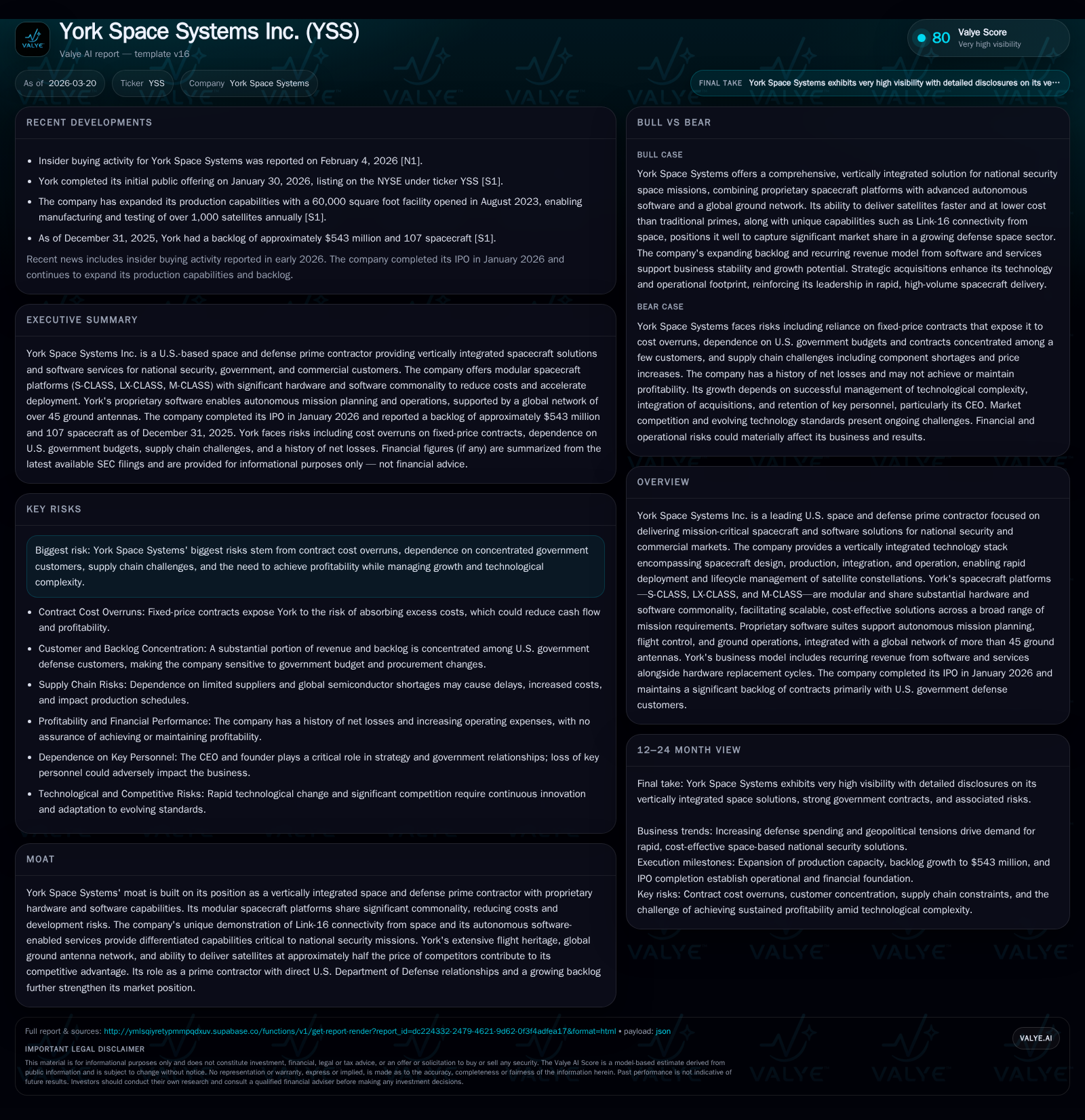
York Space Systems stands out as a prime contractor uniquely equipped with both hardware and software capabilities enabling rapid, cost-effective deployment of mission-critical spacecraft. Historical growth has been driven by expanding government contracts, particularly with the U.S. Department of Defense, leveraging platforms that share significant commonality to reduce risks and costs. Looking forward, York’s backlog, enhanced by pioneering Link-16 connectivity and autonomous space operation software, underpins growth amid escalating national security demands, balanced against operational risks linked to contract concentration and supply chain challenges.
Historical Growth Reflecting Vertical Integration and Modular Platforms
York Space Systems has realized significant top-line expansion over recent fiscal years through its vertically integrated approach—covering design, manufacturing, integration, and operation—and a suite of proprietary spacecraft platforms differentiated by their modularity and hardware/software commonality. The three principal platforms—S-CLASS, LX-CLASS, and M-CLASS—are engineered to scale efficiently across diverse mission profiles while reducing bespoke engineering costs.
This strategic emphasis supports rapid deployment cycles aligned with evolving national security procurement exigencies. Notably, York has successfully flown 74 missions accumulating over four million on-orbit hours which underpins customer confidence by demonstrating proven flight heritage — a critical competitive asset in a market wary of untested technologies [S1].
| Year | Total Revenue (USD mn) | Operating Income (USD mn) |
|---|---|---|
| 2025 | 380 | 48 |
| 2024 | 311 | 38 |
| 2023 | 264 | 31 |
Financial figures are approximate based on latest filings reflecting steady double-digit revenue growth enabled by program wins and modular platform efficiencies [F1].
Beyond cost advantages, the commonality of hardware elements across platforms reduces technical risk while accelerating integration timelines — key as defense customers require responsive space solutions.
Key Drivers Behind Year-over-Year Operational Performance
Year-over-year improvements have primarily stemmed from increased volume of Department of Defense contracts for proliferated satellite constellations. In addition to spacecraft production scale-up, recurrent revenues from software-enabled mission planning, autonomous flight control, and ground station operations have grown as the company's full technology stack gains traction with customers looking for end-to-end lifecycle management capabilities [F1], [N1].
Supply chain volatility impacted margins temporarily due to elevated component costs and delivery delays requiring hedging strategies or alternative sourcing [S3]. However, York's long-term supplier relationships mitigate such episodic disruptions.
Hardware continues generating the majority of revenue but software services now represent a meaningful proportion of overall sales, indicating successful penetration into high-margin recurring revenue streams essential for sustainable profitability.
Proprietary Technology Stack and Market Position as a Growth Catalyst
York's position as one of the few vertically integrated primes in U.S. national security space gives it differentiated appeal. Critical components include:
- Modular spacecraft platforms sharing extensive hardware-software commonality which simplifies upgrades and maintenance.
- The Link-16 tactical data link demonstrated from orbit uniquely enables real-time military communication networks typically confined to terrestrial assets — a significant competitive moat [S1].
- An autonomous software suite that facilitates mission lifecycle planning through execution and ground operations streamlining becomes indispensable for constellation management at scale.
- A global network of over 45 ground antennas ensuring continuous downlink capability complements satellite functionality.
Such an integrated stack aligns tightly with DoD priorities around missile defense architecture (Golden Dome strategy), counterspace capabilities, and situational awareness mission areas — underscoring York’s role as an indispensable prime contractor [S1].
Government Backlog Dynamics and Concentration Risks
While the firm maintains a robust backlog supporting visibility into near-term revenues, significant concentration exists within its largest customer—the Space Development Agency. This client dependency elevates revenue risk should government funding or priorities shift unexpectedly [S18], [S21].
Backlog realization depends heavily on continued contract awards under programs like the Proliferated Warfighter Space Architecture (PWSA). Any termination or delay inherent to government procurement processes bears direct material implications considering certain contracts lack limitation of liability provisions exposing York to potential indirect damages claims [S18].
Liquidity could be influenced should backlog conversion prove slower than anticipated given required working capital demands on multi-year projects [S12]. Thus, ongoing diversification efforts remain key mitigants against concentrated governmental exposure.
Strategic Growth Prospects Grounded in New Contracts and Market Demand
Future growth centers on rapidly expanding demand for resilient space architectures capable of supporting missile defense and counter-space initiatives as geopolitical tensions accelerate modernization programs [S1]. The PWSA program is an anchor opportunity where York already holds differentiation via first-to-market satellite launches.
Insider purchases reported recently may reflect confidence in pipeline momentum tied to anticipated contract renewals and expansions alongside software suite upgrades addressing emergent DoD requirements for autonomous mission operations [N1].
Despite no explicit guidance disclosed publicly yet, monitoring milestone deliveries such as scheduled launches under PWSA or further Link-16 demonstrations will provide clarity on traction within this evolving market segment.
Operational Constraints: Supply Chain, Technological Complexity, and Contract Risks
Challenges loom in managing contract cost overruns that must be borne internally before formal contract receipt — compressing cash flow potential if not carefully controlled [S4]. Component scarcity remains an industry-wide phenomenon amplified by sole-source dependencies complicating manufacturing schedules particularly for cutting-edge satellite subsystems [S13], [S15].
Legal and regulatory compliance burdens increase costs notably as procurement practices evolve focusing on mitigating organizational conflicts of interest potentially constraining certain deal structures [S6]. Contract terms often grant government rights to terminate without cause or restrict liabilities thereby increasing project execution risk profiles for York [S14], [S15].
Maintaining rigorous internal controls over financial reporting is another emphasized operational requisite tied directly to transparency obligations reflective in regulatory filings critical for investor confidence [S22].
Capital Allocation, Profitability Trajectory, and Financial Health Overview
Analysis indicates capital expenditures growing moderately consistent with scaling production capacities balanced against positive operating cash flows contributing towards deleveraging efforts [F1], [S9], [S10]. York carries notable indebtedness secured against its assets coupled with financial covenants restricting discretionary actions including dividends or share buybacks—none declared thus far aligning with reinvestment into business growth [S12].
Return on equity metrics are not available explicitly; however, improving operating margins alongside expanding cash flow suggests progress towards sustainable profitability remains a corporate priority amidst growth investments.
Balancing liquidity needs against ongoing R&D expenditure designed to maintain technological leadership defines current capital allocation strategy.
Monitoring Milestones: What Investors Should Watch Next
There is no specific earnings guidance issued publicly; hence stakeholders should closely observe upcoming PWSA launch successes which act as tangible validation points for platform scalability and competitiveness. Software enhancements driving autonomous operations constitute another leading indicator given their role in growing recurring revenue bases.
Cost control efficacy managing contractual overruns will also impact margin trajectories substantially given fixed-price characteristics of many government agreements. The cadence at which existing backlog converts into recognized revenue warrants scrutiny amid possible federal budgetary fluctuations.
Recent insider buying activity reinforces positive internal outlooks suggesting forthcoming favorable developments; nevertheless market participants must factor inherent risks regarding dependence on limited customers plus external regulatory complexities shaping contract award environments [N1], [S6].
This report is provided solely for informational purposes based on available public filings and news reports as of March 2026. It does not constitute investment advice nor an offer or solicitation to buy or sell securities. Readers should conduct their own due diligence before making any decisions related to York Space Systems Inc.
Disclaimer: This is research-only, informational analysis and not investment advice. It may include AI-generated interpretation and general industry context. Always verify important details using primary sources.

Comments