
York Space Systems Unlocks Scale Advantages Through Vertical Integration and Rapid Deployment
York Space Systems leverages its vertical integration and proprietary technologies to drive recurring revenue and cost-effective national security satellite solutions.
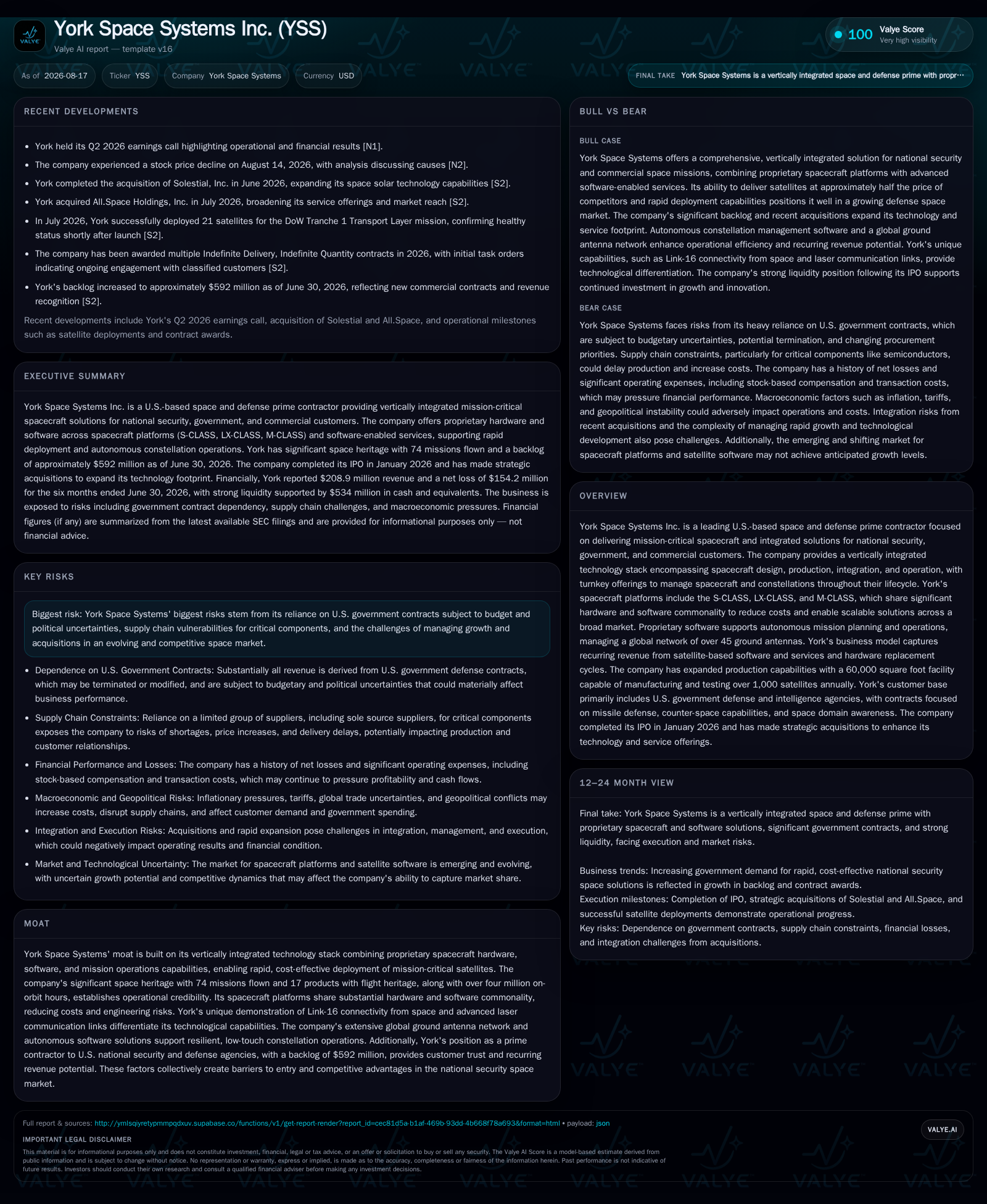
York Space Systems’ Q2 2026 filings reveal a strategic emphasis on recurring software and service revenues alongside hardware replacement cycles, enhancing revenue stability beyond spacecraft sales. Its vertically integrated model—covering spacecraft design, production, mission operations software, and ground segment infrastructure—enables faster deployment at roughly half the satellite cost of traditional primes. The company’s role as a prime contractor in U.S. national security space programs drives growth but also concentrates risk with key government customers. Despite ongoing operating losses, York maintains a strong liquidity position supported by IPO proceeds, positioning it to invest in growth amid supply chain challenges and evolving defense space demands.
Recurring Revenue Momentum Anchored by Software & Replacement Cycles
York Space Systems’ latest quarterly filing underscores a deliberate pivot toward recurring revenue streams derived from satellite-based software services coupled with steady hardware replacement cycles [S2]. Contracts typically feature fixed fees for software maintenance with options for on-orbit upgrades throughout the satellite lifecycle. The expected replacement cycle of five to six years provides a predictable cadence for hardware sales alongside ongoing service revenues. This structural shift enhances revenue visibility and cash flow stability in an industry traditionally characterized by lumpier capital sales
The integration of recurring software offerings with hardware refreshes aligns with broader aerospace trends where prime contractors seek to monetize full mission lifecycles through combined hardware-software-ground system solutions.
Vertical Integration Enables Differentiated Cost & Speed-to-Launch Advantage
York’s fully integrated business model spans spacecraft platform design and manufacturing, proprietary mission operations software including autonomous flight control systems, constellation management services, and ground segment infrastructure. This vertical integration reduces complexity through hardware-software commonality across its S-CLASS, LX-CLASS, and M-CLASS platforms while shortening production cycle times relative to legacy competitors [S1][S2]
These efficiencies enable York to offer satellites at roughly half the price per unit compared to other aerospace primes on awarded U.S. Department of Defense programs—a significant competitive advantage stemming from streamlined production aided by specialized test equipment that boosts first-pass yield and reduces reliance on slower subcontractor networks [S1]
York’s technological leadership extends to being the first company demonstrating Link-16 connectivity from space—a critical real-time military tactical data link—and deploying advanced laser communication links that enhance data throughput. Their global network of more than 45 ground antennas supports resilient mission operations for individual satellites and large constellations alike [S1].
This capability stack positions York as an agile prime contractor able to rapidly deliver complex national security satellite solutions meeting compressed timelines demanded by evolving geopolitical dynamics.
Competitive Dynamics: Balancing Innovation with Established Defense Primes
Within aerospace defense prime contracting, York occupies a specialized niche focused on rapid deployment of mission-critical spacecraft optimized for national security use cases. This contrasts with broader aerospace primes like Lockheed Martin Space or Maxar Technologies that maintain diversified portfolios covering launch vehicles, large satellite systems, or commercial markets.
York’s innovation-driven speed-to-market and cost advantages in modular constellation solutions differentiate it but scaling reliability to zero-tolerance military standards remains a challenge where incumbents hold entrenched reputations backed by decades of heritage [S1].
Customer concentration primarily centers on U.S. government agencies involved in missile defense and space domain awareness initiatives—especially the Space Development Agency (SDA)—which underpins backlog volumes but amplifies exposure to federal budget shifts influencing contract awards [S1]
Successfully scaling operational footprint while maintaining stringent quality assurance will be critical as York seeks greater share within prime contract opportunities traditionally dominated by established incumbents.
Pathways to Growth through Expanding National Security and Constellation Demand
York’s growth thesis is strongly supported by macro-level defense sector trends including rising budgets directed toward space-based missile warning systems requiring responsive constellation architectures fielded rapidly and cost-effectively—areas where York’s vertically integrated technology stack is strategically positioned.
Emerging applications such as enhanced space domain awareness sensors demand prompt data delivery supported by onboard processing capabilities bundled with automated mission planning—features enabled by York’s proprietary autonomous control software suites [S1]. Laser communication technologies further enhance payload bandwidth capabilities.
Commercial proliferated satellite constellations also represent an expanding addressable market seeking turnkey solutions encompassing launch coordination, ground terminal usage contracts, continuous operational support—all delivered via York’s end-to-end vertical stack.
Key operating metrics linked to growth include accelerating order win rates for new platform launches aligned with expanding government ambitions alongside measurable improvements in constellation uptime driven by software upgrades.
Risk Factors: Government Contract Dependency and Supply Chain Vulnerabilities
York faces risks common among aerospace primes reliant predominantly on U.S. government contracts. Political or budgetary volatility could delay or reduce award volumes substantially impacting near-term revenues given SDA program concentration [S1][S2].
Operational risks also stem from supply chain vulnerabilities amid inflationary pressures and geopolitical uncertainties affecting critical electronic components essential for spacecraft assembly.
Despite ongoing investment-phase losses reflected in a quarterly operating loss of $41 million and accumulated deficit of $423 million as of June 30, 2026, York maintains strong liquidity supported by $534 million cash against $148 million debt—providing runway for near-term execution while scaling production capacity without compromising reliability [S2][F1]
Mitigation efforts focus on maximizing first-pass yields through advanced test equipment and pursuing supplier diversification where feasible to manage supply disruptions.
What Next: Upcoming Contract Milestones and Operational KPIs to Monitor
Investors should monitor developments in contract backlog composition aimed at reducing customer concentration risk beyond SDA exposure to improve revenue stability. Expansion of the ground antenna network footprint will signal scaling capability relevant to sustaining constellation management offerings.
Operational KPIs such as constellation uptime improvements reflecting successful deployment of autonomous mission planning software upgrades merit close attention alongside order win rates indicating market acceptance velocity for new spacecraft platforms.
Financial covenant compliance tied to leverage ratios within existing credit facilities will require scrutiny as ongoing operating losses may necessitate additional capital raises or refinancing actions contingent upon future cash flow generation [S2][F1]
Updates related to recent acquisitions like All.Space Holdings enhancing propulsion capabilities will also be material for assessing future growth trajectories [N1][S3][S12].
Financial Profile Discussion: Cash Position Supports Strategic Execution Amid Losses
As of June 30, 2026, York holds $534 million in cash against $148 million in total debt resulting in a net cash-like position that supports operational runway beyond twelve months under current burn rates [F1][S2]. The company's current ratio stands robustly above 5x indicating ample short-term asset coverage over liabilities
Negative operating income persists at approximately -$41 million this quarter reflecting continued investment in scaling production capacity and research & development essential for sustaining competitive advantage [F1][S2]
Debt agreements contain covenants including minimum trailing twelve-month revenue thresholds rising through late 2028 along with leverage ratio targets requiring vigilant compliance management to avoid defaults or accelerated repayments [S6][S10][S13]
While liquidity remains solid due to IPO proceeds raised earlier this year ($583 million net), achieving sustainable positive operating cash flow will depend on accelerating contract wins translating into scalable production throughput balanced against efficient overhead control.
Disclaimer: This analysis synthesizes publicly available SEC filings through August 14, 2026. It aims to provide an informed view based on disclosed operating performance, financial condition, business model dynamics, competitive positioning, industry context, and risk factors relevant to York Space Systems Inc., without constituting investment advice.
Disclaimer: This is research-only, informational analysis and not investment advice. It may include AI-generated interpretation and general industry context. Always verify important details using primary sources.

Comments