
Apogee Acquisition Corp 2026 Q2: Liquidity Strong but Business Combination Deadline Raises Liquidation Risk
Apogee Acquisition Corp reports substantial going concern doubt and material control weaknesses as it approaches its July 2027 merger deadline.
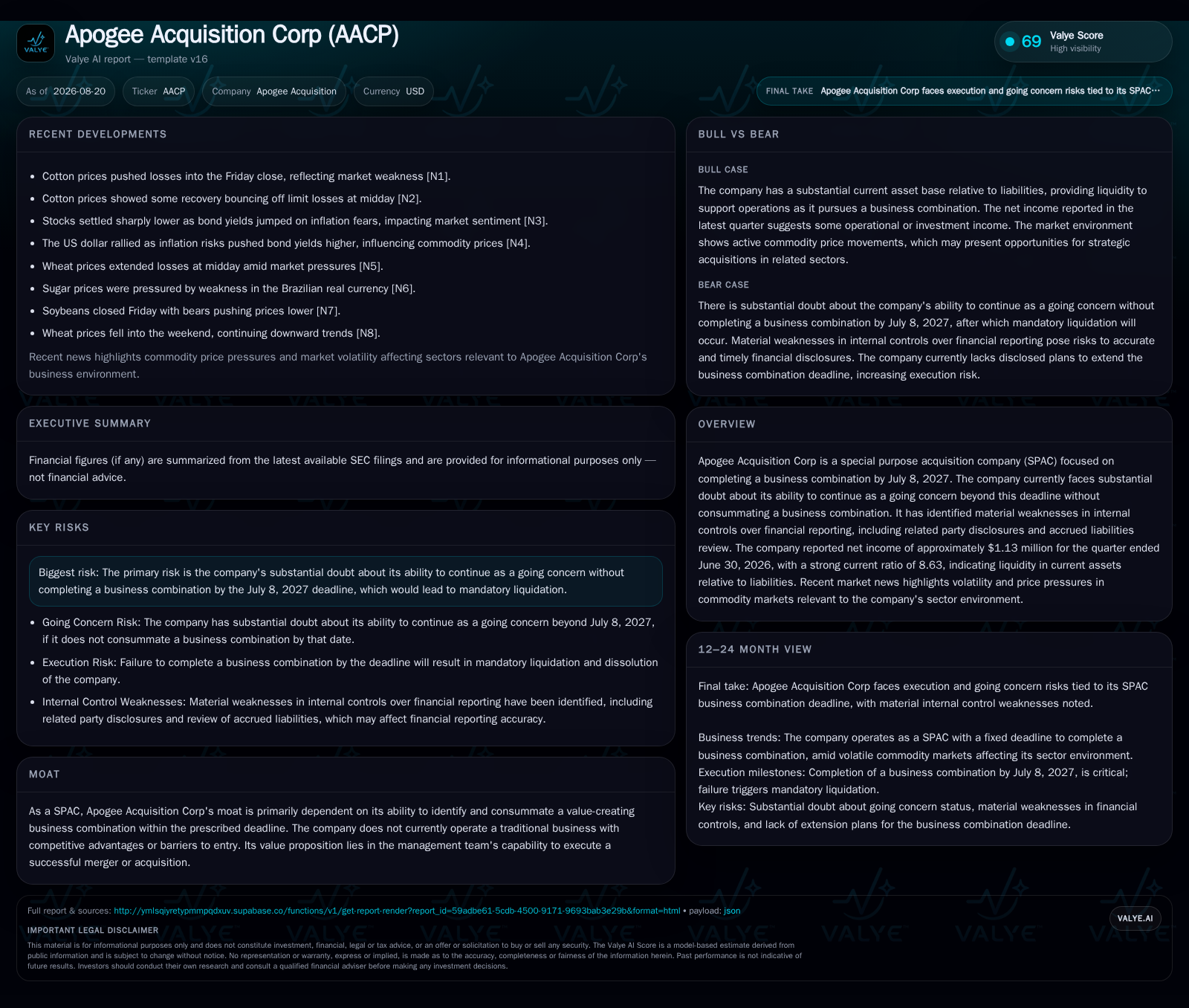
In its Q2 2026 10-Q filing, Apogee Acquisition Corp disclosed substantial doubt about its ability to continue as a going concern beyond its mandatory business combination deadline of July 8, 2027. The company identified material weaknesses in internal controls related to related party disclosures and accrued liabilities review. Despite a strong liquidity position with a current ratio of 8.63, the SPAC's future depends on completing a merger before the deadline to avoid liquidation. These governance and operational risks pose significant challenges to the company’s path forward.
Q2 2026 Operating and Financial Update
Apogee Acquisition Corp’s Q2 2026 10-Q filing, dated August 20, 2026, reveals critical updates on its financial and operational status as it approaches the July 8, 2027 deadline to consummate a business combination. The company reported net income of approximately $1.13 million for the quarter, consistent with limited operating activity typical of a Special Purpose Acquisition Company (SPAC) structure [S2]. No material operating revenue was recorded, reflecting the SPAC’s nature as a shell company holding funds in trust.
The balance sheet shows a strong liquidity position with current assets of $558,096 and current liabilities of $64,683 as of June 30, 2026, yielding a current ratio of 8.63 [F1]. Specifically, deficiencies were identified in the disclosure of related party transactions and the review of accrued liabilities [S2]. These weaknesses raise reasonable possibility that material misstatements in financial statements may not be prevented or detected timely. Such control issues are significant in the SPAC context, where transparent and accurate financial reporting is critical for investor confidence and regulatory compliance during merger negotiations and SEC filings.
The related party disclosure weakness arose from the omission of certain legal and consulting services in the notes to the financial statements, highlighting governance gaps. The accrued liabilities review weakness further underscores challenges in ensuring precise financial accruals. Together, these control deficiencies increase operational risk and could complicate the process of executing a business combination.
SPAC Business Model and Going Concern Implications
Apogee Acquisition Corp operates as a SPAC, raising capital through an initial public offering by selling units to investors and holding these funds in trust while seeking a private company to merge with. The SPAC must complete a business combination by July 8, 2027, or face mandatory liquidation and dissolution [S2]. This deadline imposes a structural risk unique to SPACs: failure to consummate a merger terminates the company’s existence and returns investor capital from the trust account.
The company explicitly stated substantial doubt about its ability to continue as a going concern beyond the July 8, 2027 deadline without completing a business combination [S2]. This doubt reflects the fixed timeline risk inherent in the SPAC model. No approved plan exists to extend the deadline, making the upcoming milestone critical for the company’s survival.
Scenario Analysis: Merger Completion vs. Liquidation
One possible outcome is that Apogee Acquisition Corp successfully identifies and consummates a business combination before the July 8, 2027 deadline [S2][F1]. If this occurs, it could alleviate the substantial doubt about the company's ability to continue as a going concern. Such a transition would involve moving from a SPAC structure to an operating public entity and may require remediation of the internal control weaknesses to meet regulatory and investor expectations. Confirmation of this scenario would include public announcements of a definitive merger agreement, improved disclosures on internal controls, and removal of going concern qualifications in future SEC filings.
Conversely, failure to complete a merger by the deadline would trigger mandatory liquidation and dissolution. This scenario is plausible given the absence of an extension plan, ongoing material control weaknesses, and the operational challenges they pose. Confirmation would come from lack of merger announcements by mid-2027, disclosures indicating liquidation plans, or deterioration in liquidity and investor confidence [S2]
Conclusion and What to Watch
Apogee Acquisition Corp’s Q2 2026 disclosures highlight the structural and operational risks facing SPACs with fixed merger deadlines. The company reported a strong liquidity position with current assets of $558,096 and current liabilities of $64,683 as of June 30, 2026, yielding a current ratio of 8.63 [F1]. The company’s future hinges on completing a business combination before July 8, 2027. Material weaknesses in internal controls add a layer of governance risk that could impair financial reporting accuracy and complicate merger execution.
These indicators will be critical to assessing whether Apogee Acquisition Corp can navigate the challenges ahead or face mandatory liquidation.
Disclaimer: This is research-only, informational analysis and not investment advice. It may include AI-generated interpretation and general industry context. Always verify important details using primary sources.

Comments