
Advance Auto Parts Q2 2026: Operational Efficiency Gains Amid Asset Footprint Optimization
Advance Auto Parts reported improved Q2 2026 profitability driven by margin expansion and restructuring benefits, supported by stable liquidity.
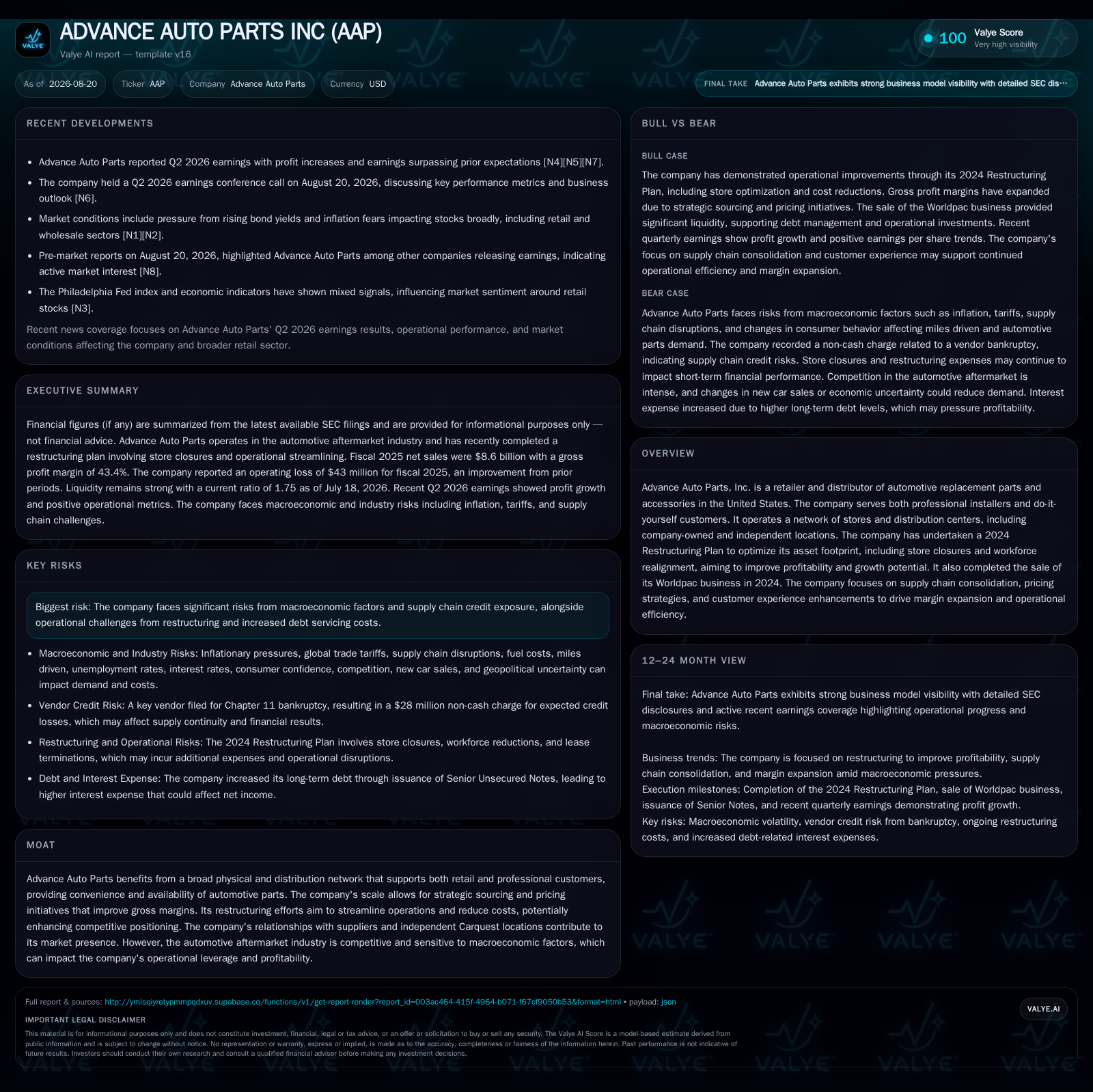
Advance Auto Parts Inc’s Q2 2026 results show a significant improvement in gross profit margin and a narrowed operating loss compared to Q2 2025, reflecting the benefits of its 2024 Restructuring Plan. The completion of the company’s U.S. asset footprint optimization and ongoing supply chain consolidation have contributed to margin expansion and operational efficiency. As of July 18, 2026, the company maintains a stable liquidity position with a current ratio of 1.75 and $3.12 billion in cash and equivalents, supporting its ability to manage restructuring costs and debt obligations.
Q2 2026 Operating Performance and Margin Expansion
Advance Auto Parts Inc reported improved operating results for the quarter ended July 18, 2026, with gross profit margin expanding compared to the same period in 2025 [S2]. This margin improvement reflects the successful execution of margin expansion initiatives, including better pricing strategies and a reduction in restructuring-related inventory charges that had previously weighed on profitability. The operating loss narrowed significantly year-over-year, driven by lower restructuring expenses and gains in operational efficiency as the company continues to realize benefits from its 2024 Restructuring Plan [S2].
The restructuring efforts included optimizing the company’s U.S. asset footprint through store closures and workforce realignment. These actions have reduced excess and obsolete inventory, thereby improving inventory turnover and lowering associated charges, which directly supports gross margin expansion [S2]. Additionally, the company is consolidating its supply chain and converting distribution centers into market hubs to leverage economies of scale, enhance parts availability, and optimize transportation routes. These supply chain improvements contribute to operational leverage and service level enhancements, which underpin the margin gains observed in Q2 2026 [S2].
Liquidity and Balance Sheet Stability
As of July 18, 2026, Advance Auto Parts maintained a stable liquidity position, with current assets totaling $7.47 billion exceeding current liabilities of $4.28 billion, resulting in a current ratio of 1.75 [F1]. This ratio indicates that the company holds sufficient short-term assets to cover its short-term obligations, which is critical for managing ongoing restructuring-related cash outflows and operational needs.
Operating cash flow showed improvement compared to prior periods, although it remains influenced by cash charges related to restructuring [S2]
Business Model and Competitive Positioning
Advance Auto Parts serves professional installers and do-it-yourself (DIY) automotive customers across the United States. The company generates revenue primarily from retail sales of automotive replacement parts and accessories through its network of company-owned stores and independent Carquest stores [S1]. Vendor incentives, including volume rebates and promotional allowances, play a role in reducing cost of goods sold or operating expenses, thereby influencing gross margins.
Margins in this sector depend heavily on effective inventory management, pricing strategies, and operational efficiency [S1][S2]. The company’s scale in physical stores and distribution centers enables strategic sourcing and pricing advantages. The ongoing restructuring and supply chain consolidation aim to reduce costs and improve service levels, which are essential competitive factors in the automotive aftermarket retail industry.
Industry Context and Structural Drivers
The automotive aftermarket retail industry is characterized by a broad physical footprint and competitive pressures on pricing and service. Key performance indicators include comparable store sales growth, gross profit margin, inventory turnover, and operating leverage. Vendor relationships and scale influence rebate terms and margin potential. The sector is moderately cyclical, influenced by vehicle usage patterns and macroeconomic conditions affecting consumer spending on automotive maintenance and repairs.
Advance Auto Parts’ recent operational improvements and restructuring align with industry imperatives to optimize store density, enhance supply chain efficiency, and manage inventory obsolescence. These factors collectively support sustainable margin expansion and profitability in a competitive environment.
Analytical Conclusions and Scenario Analysis
The margin expansion observed in Q2 2026 is structurally supported by the completion of the 2024 Restructuring Plan, which has reduced excess inventory and improved supply chain efficiency [S1][S2]. This conclusion is based on the decline in inventory-related charges that previously depressed margins and the ongoing initiatives to consolidate supply chain operations and convert distribution centers into market hubs. Confirmation of this scenario would include sequential quarterly margin improvements, positive operating cash flow trends, and potential upgrades in management guidance.
This scenario would be confirmed by flat to modestly improving margins, stable liquidity ratios, and consistent operating results [S2]
A downside scenario involves intensified macroeconomic headwinds or restructuring execution challenges leading to margin compression, weaker sales, and liquidity pressure. Indicators would include declining gross margins, negative operating cash flow, and deteriorating liquidity ratios.
Watchpoints
Investors and analysts should monitor sequential quarterly gross margin trends to assess the sustainability of margin expansion. Comparable store sales growth rates will provide insight into top-line momentum amid the optimized store footprint. Operating and free cash flow generation trends are critical to evaluating the company’s ability to fund restructuring costs and service debt. Lastly, ongoing restructuring-related expenses and inventory reserve adjustments will be important to track for their impact on profitability and cash flow.
Disclaimer: This is research-only, informational analysis and not investment advice. It may include AI-generated interpretation and general industry context. Always verify important details using primary sources.

Comments