
Apple iSports Group Struggles with Capital Needs While Pivots to Outsourced Platform and Live Streaming
Latest quarter reveals ongoing liquidity challenges amid strategic shifts toward joint ventures and content-driven engagement.
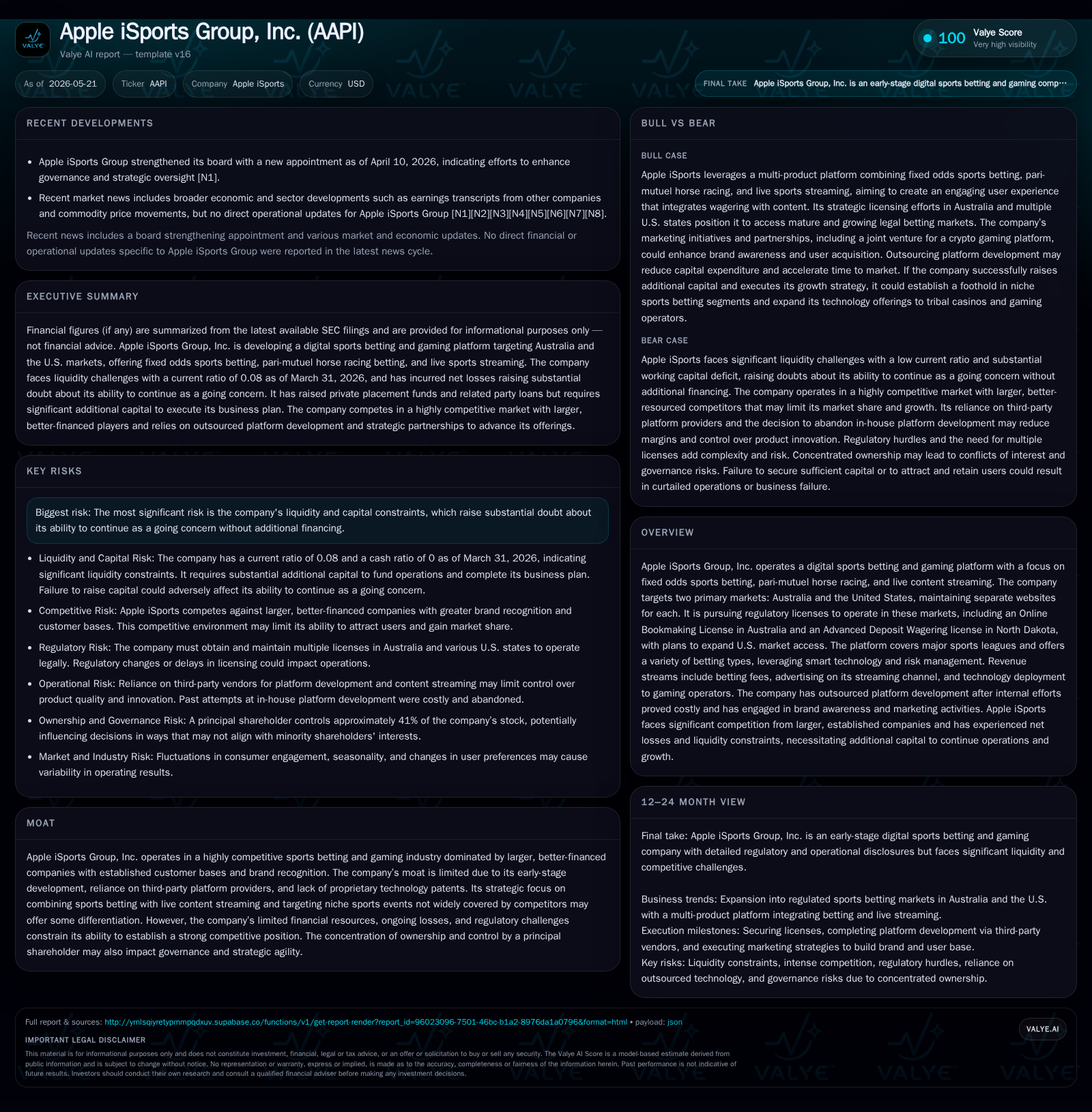
Apple iSports Group, Inc. operates a growing digital sports betting and gaming platform targeting Australia and the U.S., focusing on fixed odds betting, pari-mutuel racing, and live sports streaming. The company’s latest quarterly filing highlights continued financial struggles, including large operating losses, a sharp working capital deficit, and reliance on capital raises to sustain operations. Strategically, Apple iSports has abandoned in-house platform development in favor of outsourced solutions and recently entered a joint venture leveraging an online crypto gaming platform. Content differentiation through niche live streaming is central to its user engagement approach. Regulatory licensing progress remains incremental, with key approvals pending in major U.S. states and Australia.
Recent Operating Update
The company continues to post losses reflecting nearly $6.4 million net loss for fiscal year ending December 2025 ([F1]). While Apple iSports has not generated meaningful revenue yet ([F1]), it aims to monetize through multiple streams including betting fees, advertising on its live content channel, and technology licensing to third-party operators ([S1]). However, the most recent quarterly disclosures do not indicate any material commercial launch or customer traction.
A notable operational development is the abandonment of internal platform development after three years due to high costs and low return prospects ([S8]). Instead, Apple iSports opted for outsourcing platform technology, signing a joint venture agreement effective March 1, 2026 with Apple iCasino—an external operator offering an existing crypto gaming platform ([S17][S21]). This move reorients strategy towards leveraging off-the-shelf technology solutions rather than investing heavily in proprietary systems until financial footing improves.
Business Model
Apple iSports Group generates revenue primarily via sports betting activities conducted on its digital platform tailored for fixed odds wagers on major sports leagues, pari-mutuel horse racing pools via Advanced Deposit Wagering accounts (notably licensed in North Dakota), alongside ad-supported live streaming video content featuring niche sporting events such as drag racing or beach volleyball ([S1][S8]). These diversified streams are intended to increase user engagement through multiple touchpoints within its ecosystem.
Users fund accounts upfront (ADW model) enabling them to place bets across regulated jurisdictions where the company holds licenses or is actively pursuing them ([S16]). Apple iSports operates separate websites tailored for its key territories: appleisports.com.au in Australia and appleisports.com for the U.S., reflecting distinct regulatory regimes and localized offerings ([S8],[S24]).
Revenue mechanics depend on volume of bets placed (amount wagered), take-out percentages (betting fees retained), advertising monetization through its proprietary streaming channel, and technology deployment fees charged to partner gaming operators ([S1],[S8]). The company experiments with freemium models, microtransactions, and subscription services for its content offerings but these remain exploratory.
Margins are constrained currently by expenses related to licensing efforts, marketing acquisition costs, platform maintenance fees payable under outsourced agreements, plus administrative costs associated with maintaining public company reporting compliance ([S4]). Given no own proprietary platform at present ([S8]), margin leverage will depend heavily on scaling users before fixed infrastructure costs subside.
Industry Structure & Competitive Position
Apple iSports exists within the highly competitive online sports betting landscape dominated by deeply capitalized incumbents with advanced technology stacks and established brand equity ([S11]). Major peers often offer expansive market presence across U.S. states with mature mobile apps integrating sportsbook and casino verticals alongside comprehensive media content.
The company's defensive moat remains limited due to:
- Reliance on third-party platform providers rather than owning scalable proprietary technology that allows greater margin capture or feature differentiation.
- Lack of patent filings protecting betting processes or innovations; intellectual property measures are limited predominantly to trademark registrations mainly pending approval ([S11],[S18]).
- Small scale operations reflected in low cash reserves and high operating deficits reducing ability to invest aggressively in marketing or regulatory expansion.
- Concentrated ownership structure giving disproportionate control to principal shareholders potentially affecting governance agility ([S27]).
Despite these constraints, Apple iSports pursues differentiation by combining live streaming niche sports content unavailable on competitor platforms with betting products anchored around less saturated racing pools (parimutuel horse racing) alongside fixed odds sports wagers (,[S8]). This integration may create some stickiness among dedicated fans seeking unique wagering experiences augmented by interactive media.
Growth Drivers
The company's growth ambitions hinge on several key drivers:
- Licensing Expansion: Obtaining broader state-level licenses across up to 20 U.S. jurisdictions combined with completion of Australian Online Bookmaking License could unlock significant addressable market share given legalized gambling expansions globally ([S16],[S8]).
- Market Penetration: Leveraging digital marketing techniques including SEO/PPC/SEM campaigns intended to boost user acquisition once foundational licensing achieved; social media strategies aim for organic growth despite current suspension of brand campaigns in Australia due to funding shortfalls ([S8],[S21]).
- Platform Optimization & JV Leverage: The March 2026 JV provides access to an operational crypto-capable gaming platform allowing rapid geographic market entry without costly tech buildouts contributing scalability if adoption follows ([S17],).
- Content Differentiation: Focusing live streaming efforts on niche sporting events targets fans underserved by traditional sportsbooks fostering unique engagement propositions—a potential anchor for cross-selling betting products (,[S8]).
- Technology Licensing: Plans for deployment of backend technology solutions into Tribal Casinos and other gaming operators add diversification beyond direct user-facing revenues which could generate implementation fees plus recurring income streams upon rollout success (,[S1]).
Risks & Constraints
Significant risks surround Apple iSports’ ability to execute:
- Severe Financial Constraints: With a working capital deficit near $5.9 million including over $3 million owed related parties repayable on demand but currently non-payable puts extreme pressure on liquidity; failure to raise significant new funds jeopardizes continuation of business plans ([F1],[S1],[S5]).
- Dilution Risk: Current debt-to-equity conversions plus planned equity raises mean existing shareholders face substantial dilution with uncertain impact on shareholder value ([S9],[S10]).
- Regulatory Complexity: Fragmented U.S. gambling regulations require tailored compliance per state increasing administrative burden; expanding internationally further complexifies regulatory adherence potentially inflating costs materially beyond initial estimates ($300-$500K annually just for compliance) ([S4],[S18]).
- Technology Dependency & IP Exposure: Outsourcing critical technological infrastructure limits control over product roadmap while absence of patent protection exposes processes potentially replicable by competitors undermining competitive sustainability (,[S18]).
- Market Competition & Branding Challenges: Entrenched vertical leaders have deeper pocket marketing engines making user acquisition costly especially when starting from negligible brand recognition; paused Australian broadcast ads underscore difficulty scaling engagement without adequate resources (,[S21]).
- Governance Risks: Concentrated shareholder control may reduce managerial accountability impacting strategic decisions unfavorably relative to minority shareholders’ interests (,[S27]).
What To Watch Next
Key milestones investors should monitor include:
- Progress updates regarding receipt of Online Bookmaking License in Australia and Advanced Deposit Wagering license approvals in North Dakota plus other targeted U.S. states over the near-term three-year horizon confirmed in filings ([S16],).
- Capital raising developments including utilization of existing Equity Backstop agreements offering up to $25 million drawdown capacity subject to registration statement completion designed to alleviate liquidity constraints (,[S21]).
- Operational results post-launch of the JV-backed crypto gaming platform as it rolls out into new countries where success indicators such as user signups, bet volumes, and revenues will validate viability ( [S17],).
- Restart of marketing campaigns particularly brand awareness initiatives suspended earlier given their vital role in customer acquisition cost optimization ( [S8],).
- User engagement metrics from the live streaming channel including ad sales performance that subsidizes overall monetization efforts ( [S8],).
- Any strategic acquisitions or partnerships announced that could accelerate scale or expand intellectual property assets given historical intent expressed toward M&A growth pathways ( [S11]).
Financial Profile Briefly
Operating results reflect deep ongoing investment phases without positive income generation evidenced by net losses above $6 million during the prior full year ending December 2025 corroborating the company’s early-stage developmental status reliant heavily on capital markets support rather than self-sustaining cash flows upon which future growth depends [F1]
Dilution risks loom large given both outstanding convertible debt owed primarily to affiliates ($3.15 million) alongside open-ended private placements targeting multi-million-dollar proceeds at prices around $0.25 per share indicating shareholder dilution potential remains a critical concern.[[F1], [S9], [S10]]
This analysis focuses strictly on information publicly disclosed via SEC filings up to May 21st, 2026 without conjecture beyond documented evidence or speculative forecasts regarding future performance outcomes or investment suitability.
Disclaimer: This is research-only, informational analysis and not investment advice. It may include AI-generated interpretation and general industry context. Always verify important details using primary sources.

Comments