
G-III Apparel Group’s Strategic Leap with Marc Jacobs Joint Venture
The latest quarterly filing details G-III's progressing acquisition of Marc Jacobs, underscoring integration challenges and growth prospects.
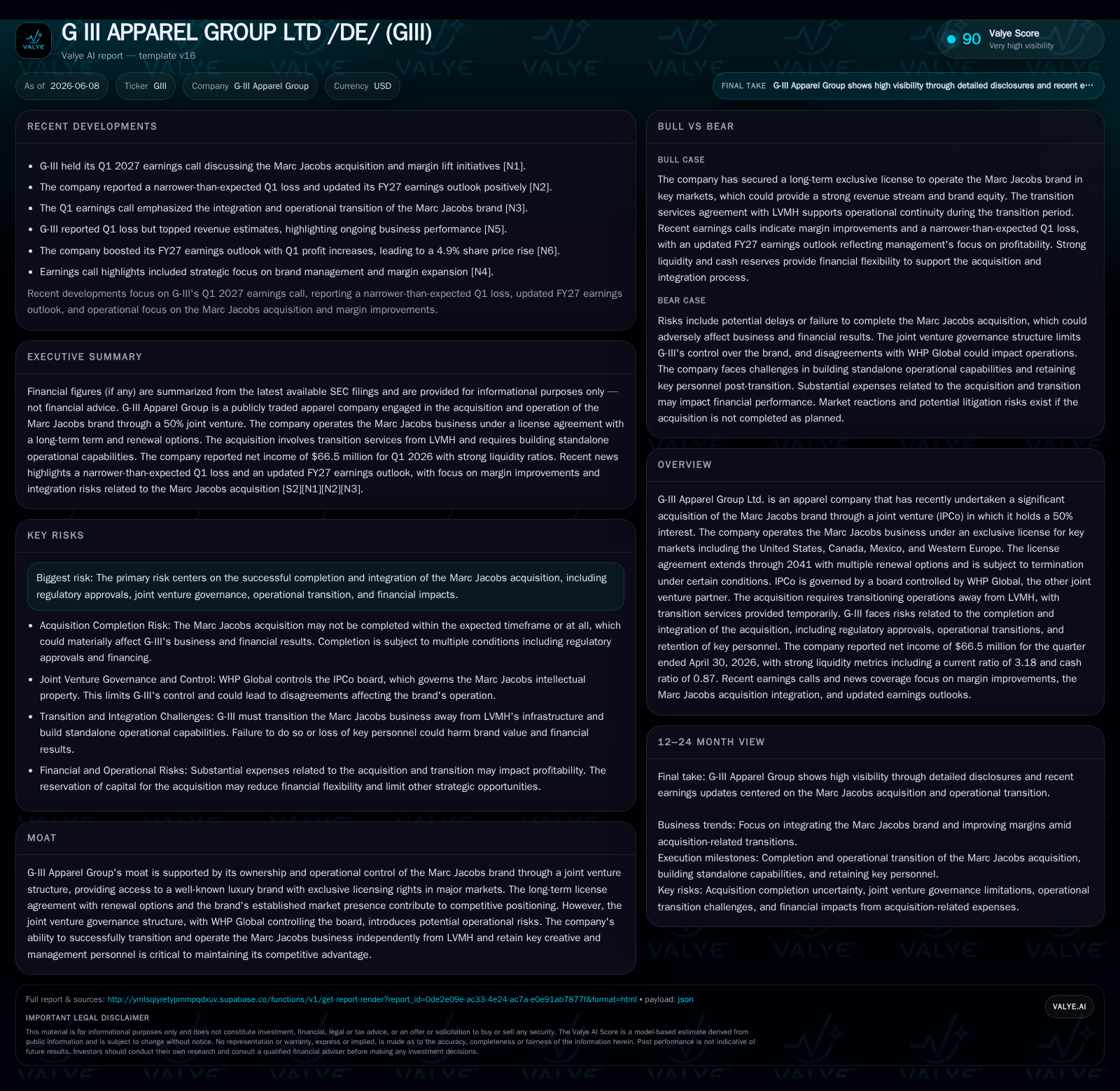
G-III Apparel Group recently reported Q1 fiscal 2027 results that highlight critical developments in its acquisition and operational transition of the Marc Jacobs brand via a joint venture with WHP Global. The company continues navigating complex closing conditions, transition services from LVMH, and governance dynamics that bear on its strategic control and margin trajectory. The move augments G-III’s portfolio into higher luxury market segments with a long-term exclusive license across major Western markets. While risks related to integration, regulatory approvals, and key personnel retention remain material, completion would offer durable competitive advantages driven by brand ownership and licensing revenue potential.
Latest Quarterly Operating Update: Acquisition Progress and Earnings Revisions
G-III Apparel Group’s 10-Q filing for the fiscal quarter ended April 30, 2026 [S2], supplemented by an 8-K release [S3], details ongoing progress toward the strategic acquisition of the Marc Jacobs brand through the IPCo joint venture with WHP Global. The transaction remains contingent on customary closing conditions, including antitrust approvals and financing arrangements, with no definitive closing as of quarter-end. Binding agreements have been executed to facilitate completion.
In Q1 FY27 earnings commentary [N1][N2][N3], management reported narrower-than-expected losses, attributing this to robust revenue growth offset by elevated acquisition-related expenses. The company raised full-year earnings guidance, anticipating margin expansion driven by integration of the luxury Marc Jacobs portfolio.
Transition services from LVMH are critical for operational continuity during this period. G-III is contractually obligated to fulfill payment and indemnification commitments under this arrangement [S23]. The company faces the operational challenge of rapidly building standalone infrastructure and supply chain capabilities, previously supported by LVMH’s systems.
G-III’s Business Model: Licensing and Wholesale Synergies in Marc Jacobs Partnership
G-III operates a hybrid business model combining wholesale apparel manufacturing and distribution with brand licensing [S1][S4]. The IPCo joint venture grants G-III a 50% ownership stake and operational control over Marc Jacobs in exclusive territories including the US, Canada, Mexico, and Western Europe, under a license extending through 2041 with renewal options.
Governance of IPCo assigns WHP Global majority board control [S4], requiring consensus for major decisions such as mergers, acquisitions, and indebtedness beyond thresholds. This shared control introduces operational complexity, though G-III manages day-to-day operations within licensed geographies.
Revenue generation centers on wholesale distribution to department stores and specialty retailers, complemented by royalty income from licensed product lines. Managing the wholesale-to-licensing revenue mix is essential to optimize channel margins and preserve brand equity amid luxury market dynamics.
Operating expenses are elevated due to transition-related investments, including IT infrastructure migration from LVMH platforms [S23]. These costs are expected to normalize as standalone capabilities scale.
Industry Context: Positioning Within Apparel and Luxury Conglomerates
G-III’s acquisition of Marc Jacobs marks a strategic move into the premium luxury segment, differentiating it from peers like Tapestry Inc. and Capri Holdings, which typically maintain wholly owned brand portfolios. This joint venture model shares financial exposure but complicates governance and strategic alignment.
Success factors include maintaining creative leadership stability, optimizing omnichannel distribution, and leveraging licensing revenue streams to enhance profitability and brand longevity.
Growth Drivers: Transition Execution and Margin Expansion
Key growth catalysts include the successful transition of Marc Jacobs operations from LVMH to autonomous management while safeguarding product quality and design innovation. Retention of creative talent is critical to sustaining brand equity [S23]
Margin expansion opportunities arise from optimizing the wholesale channel mix to increase royalty income, which typically commands higher margins than direct wholesale sales. G-III’s expertise in distribution and licensing positions it to enhance e-commerce capabilities and expand digital reach.
The multi-decade exclusive license provides long-term revenue visibility and a structural moat, contingent on performance thresholds and renewal terms.
Risks and Watchpoints: Governance, Integration, and Market Coverage
Regulatory approval timing remains uncertain, with antitrust reviews potentially delaying closing and impacting liquidity, as approximately $500 million in capital is reserved for acquisition funding [S2]
Shared governance with WHP Global may complicate decision-making during the critical integration phase, potentially slowing strategic initiatives.
Retention of key creative personnel is uncertain; loss could diminish brand appeal and sales performance.
Geographic control gaps, notably in China and Japan where the brand remains outside IPCo’s license, pose risks to global brand consistency and intellectual property protection.
Integration costs have pressured near-term margins despite underlying demand strength [N2]. The pace of phasing out LVMH transition services will influence operating income recovery.
Financial Overview: Liquidity and Earnings Trends
As of April 30, 2026, G-III held $394 million in cash and equivalents, supporting liquidity [F1]. Current assets of $1.45 billion versus current liabilities of $455 million yield a strong current ratio of approximately 3.18x [F1], indicating solid short-term financial health despite acquisition-related capital commitments.
Net income trends improved relative to prior periods, driven by incremental revenues from new brand initiatives and cost controls outside acquisition expenses [F1]. However, total debt remains elevated, reflecting revolver borrowings earmarked for acquisition funding [F1].
Conservative financial management will be essential if closing delays or integration cost overruns occur.
Looking Ahead: Milestones in Closing, Integration, and Profitability
Key upcoming milestones include confirmation of deal closing following satisfaction or waiver of all conditions, including regulatory approvals. Subsequent priorities involve phasing out LVMH transition services and establishing full standalone back-office and supply chain operations.
Initial post-close quarters will test IPCo’s ability to convert revenue growth into margin expansion under dual-member governance. Monitoring retention of creative and design leadership will provide early signals of brand health.
Market attention will focus on distribution channel adjustments and digital commerce platform enhancements to broaden customer engagement.
Management updates via investor communications will clarify synergy realization timelines and refine earnings guidance as integration progresses.
Disclaimer: This analysis is based solely on publicly available information including SEC filings dated through June 8, 2026 ([S1]-[S29]), company facts dataset ([F1]), and recent news transcripts ([N1]-[N6]). It contains no investment advice or price forecasts. Readers should consult company disclosures directly for comprehensive risk assessment.
Disclaimer: This is research-only, informational analysis and not investment advice. It may include AI-generated interpretation and general industry context. Always verify important details using primary sources.

Comments