
Columbus McKinnon’s Strategic Reset and Industrial Focus After Recent Divestiture
Following its early 2026 divestiture of U.S. power chain hoist operations, Columbus McKinnon is streamlining toward specialized material handling equipment amid ongoing financial pressures.
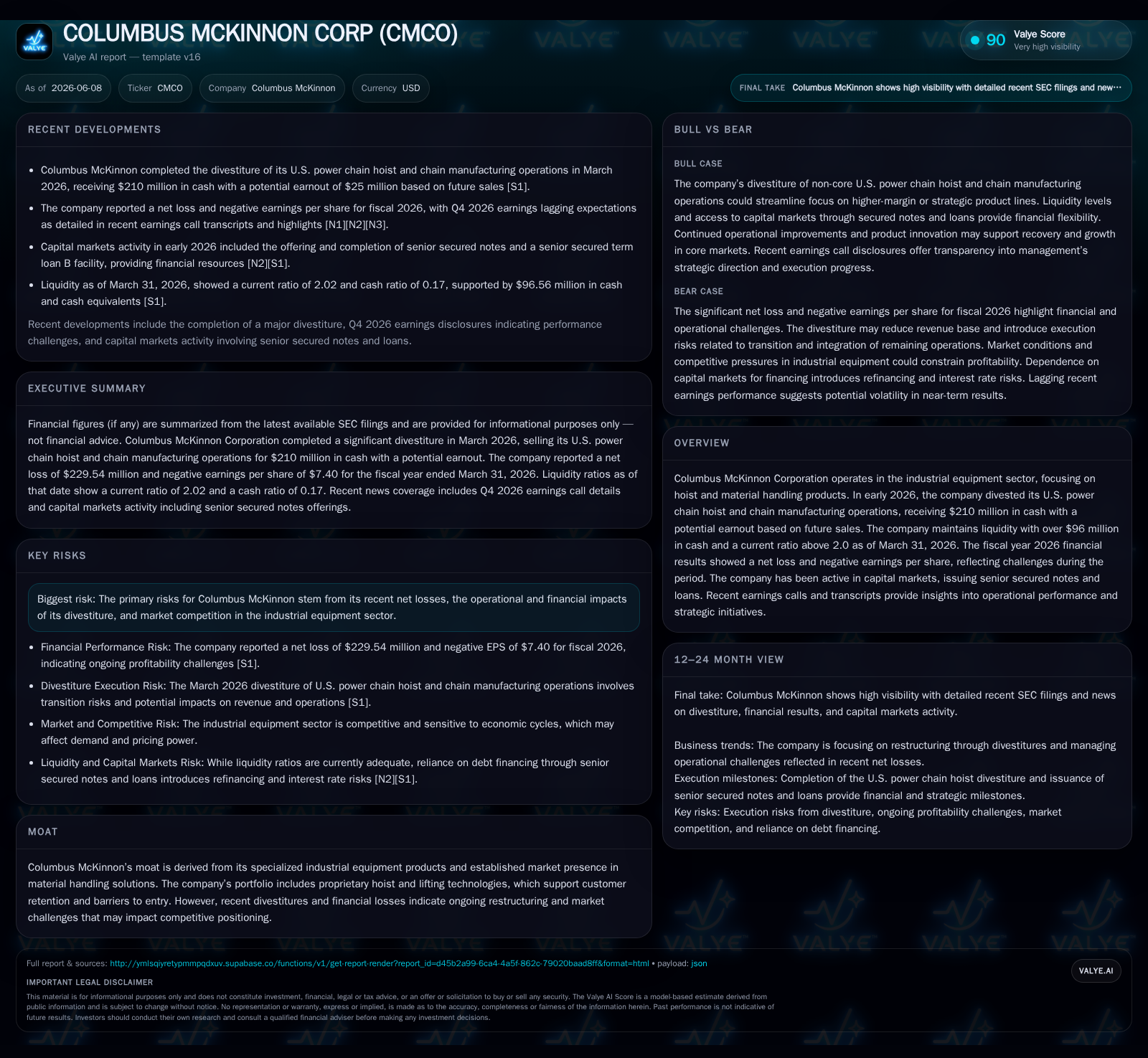
In February 2026, Columbus McKinnon completed the divestiture of its U.S. power chain hoist and chain manufacturing businesses, generating $210 million in cash proceeds with potential earnout payments. This transaction significantly reshaped the company’s revenue base and operational footprint, contributing to reported quarterly operating losses despite improving liquidity. The company now focuses on proprietary hoist and lifting solutions, leveraging a technological moat to maintain pricing power and customer retention in a competitive industrial equipment sector. Growth is expected from strategic acquisitions like Kito Crosby and expanding aftermarket services, although margin recovery faces headwinds from restructuring costs and market competition. Near-term performance hinges on integration execution and realizing earnout thresholds while managing leverage and profitability challenges.
Recent Operating Update: Quarter Impact of Divestiture
Columbus McKinnon Corporation’s 10-Q filing dated February 9, 2026 [S2] details the completion of its divestiture of the U.S. power chain hoist (excluding Little Mule® products) and chain manufacturing business segments in early 2026. The transaction yielded $210 million in upfront cash consideration, with potential additional earnout payments up to $25 million contingent upon future sales targets during fiscal years 2027-28 [S5], [S8]. This sale marks a critical transition as the company narrows its operational scope to concentrate on higher-value specialized material handling equipment.
While this strategic move boosts liquidity—reflected in a robust current ratio above 2.0 and cash & equivalents exceeding $96 million as of March 31, 2026 [F1]—the latest quarter includes operating losses attributed to ongoing restructuring costs linked to the divestiture [S2]. Such losses underscore near-term profitability pressures despite the positive cash inflow. The shrinking revenue base following the removal of volume-heavy chain manufacturing impacts top-line stability but allows refocusing capital allocation towards more proprietary products.
Focused Business Model: Specialized Hoists and Handling Solutions
The company's business model post-divestiture primarily revolves around designing, manufacturing, and marketing technologically advanced hoists and material handling systems [S1], distinguished by proprietary lifting technologies that establish a moat in its marketplace [N1]. Unlike commodity-driven chain manufacture, these specialized products command stronger pricing power supported by quality standards essential for industrial safety and performance reliability.
Customer retention benefits from this proprietary positioning as buyers in industries such as manufacturing automation, construction, and logistics often prioritize durable equipment with reliable service support. The shift away from legacy manufacturing towards engineered solutions may improve unit economics over time but requires execution against competitive innovation cycles.
Competitive Positioning in Industrial Material Handling
Within the industrial equipment sector, Columbus McKinnon now operates a leaner asset base compared to peers maintaining vertically integrated supply chains spanning raw materials to finished product assembly [S1], [N3]. This divestiture reduces operational complexity but also limits scale economies relative to competitors.
The firm's differentiation hinges on patented hoist designs and application-specific lifting solutions which provide barriers to entry by burdening potential entrants with substantial R&D investment needs. However, competitors with broader integrated capabilities may exert pricing pressure or leverage bundled product-service offerings that challenge Columbus McKinnon's narrower portfolio.
Growth Drivers: Demand Trends and Strategic Acquisitions
Post-divestiture growth prospects are anchored by the acquisition of Kito Crosby Limited completed in February 2026 [S3], [S12], which complements Columbus McKinnon’s existing engineered products portfolio with access to broader markets in Europe and Asia. Kito Crosby's product lines emphasize premium lifting devices that resonate with industrial customers seeking quality upgrades or automation-enabled solutions [N2].
Further demand catalysts include increasing adoption of industrial automation requiring precision material handling equipment and replacement cycles driven by regulatory safety standards enforcement. Moreover, expanding aftermarket services offer recurring revenue streams aiding margin expansion as new equipment installation volumes face cyclicality.
Risks and Challenges: Profitability and Market Competition
Despite strategic repositioning efforts, Columbus McKinnon confronts significant risks including persistent net losses recorded in the latest fiscal year reflecting restructuring expenses post-divestiture [F1], [S2]. Reduced scale exposes margins to volatility amid competition where price sensitivity may intensify due to macroeconomic factors affecting capital expenditure in end markets.
Additionally, reliance on fewer core product lines heightens operational risk if demand weakens or competitors innovate more rapidly. Financial leverage remains elevated relative to cash flows given the timing of divestiture proceeds versus debt maturities [F1], emphasizing vulnerability should earnings not recover as forecasted. The realization of earnout payments tied to divested business sales introduces an execution uncertainty that impacts financial planning.
Near-Term Monitoring: Upcoming Milestones and Guidance
Stakeholders should track several key indicators in the coming quarters: backlog trends for core hoist products provide forward-looking demand insight; management narratives from earnings calls will clarify cost-saving initiatives progression and synergies realized from integrating Kito Crosby [N1], [N2].
Additionally, monitoring sales performance linked to the divested businesses is critical given its direct impact on potential earnout inflows scheduled for fiscal years 2027-28 [S5], which would bolster liquidity further.
Operational efficiency metrics will be informative around how well Columbus McKinnon adapts its leaner asset-light model amidst competitive pressures.
Financial Snapshot: Liquidity and Balance Sheet Overview
As of March 31, 2026, Columbus McKinnon maintains cash & equivalents totaling approximately $96.6 million alongside current assets totaling $1.18 billion versus current liabilities near $584 million, yielding a current ratio slightly above 2.0—indicative of healthy short-term liquidity sufficient to support ongoing operations despite recent operating losses [F1]
Total debt remains at an estimated $462.6 million with net debt around $366 million after accounting for cash balances [F1]. While ample liquidity mitigates immediate solvency risks post-divestiture, sustained negative operating income highlights ongoing profitability challenges necessitating careful margin restoration efforts.
In conclusion, Columbus McKinnon's strategic reset through asset divesture and targeted acquisitions signals a deliberate pivot towards high-quality industrial hoists backed by proprietary technology. Although this sharpens competitive focus and improves balance sheet flexibility via significant cash inflows, achieving consistent profitability demands navigating restructuring costs alongside competitive industry headwinds. Near-term investors should prioritize monitoring backlog momentum, integration effectiveness of newly acquired assets, and progress toward financial breakeven established in forthcoming earnings releases.
This analysis is based solely on publicly available SEC filings up to June 8, 2026 ([S1],[S2],[S3]) along with corroborative earnings call transcripts ([N1],[N2],[N3]) and validated companyfacts data ([F1]). It does not constitute investment advice or research views.
Disclaimer: This is research-only, informational analysis and not investment advice. It may include AI-generated interpretation and general industry context. Always verify important details using primary sources.

Comments