
FuelCell Energy’s Cash Position Strengthens as Clean Hydrogen Trends Accelerate
FuelCell Energy reinforces its commercial footing with robust liquidity and strategic alignment to global clean hydrogen incentives despite ongoing losses.
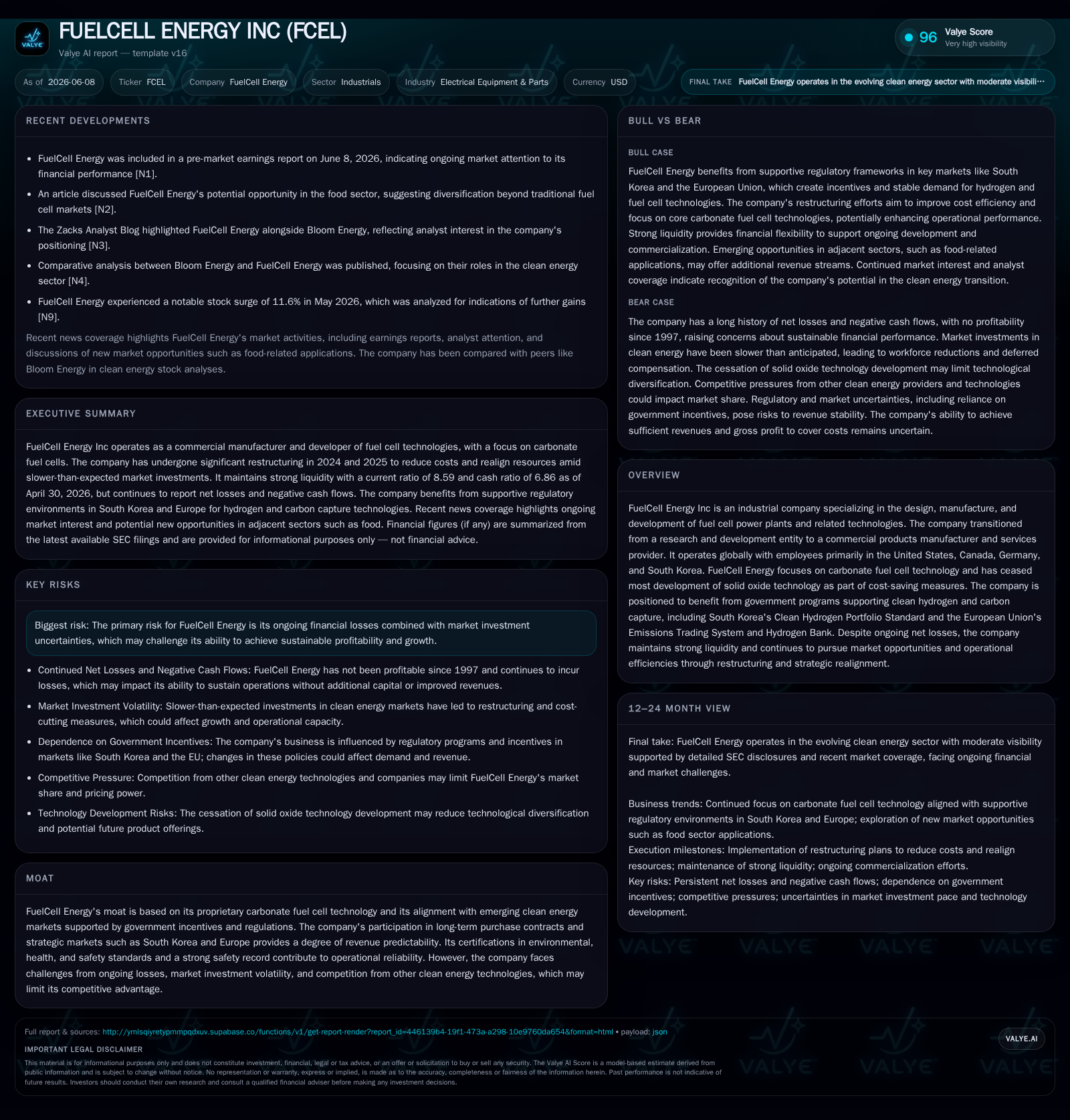
The latest Q2 FY2026 10-Q filing reveals FuelCell Energy's strong cash balance of $373 million and a healthy current ratio above 8, positioning the company to meet obligations for the next year. The company continues its transition from a research-centric entity to commercializing carbonate fuel cell technology, scaling operations in key regulated markets like South Korea and Europe. While ongoing operating losses remain a challenge, government-backed long-term contracts and contract backlog provide revenue visibility and underpin growth initiatives. Cost discipline through workforce reductions and R&D prioritization supports a path toward operational scalability amid an evolving clean energy landscape.
Latest Quarterly Update Reveals Liquidity Strength Amid Profitability Challenges
FuelCell Energy’s Q2 FY2026 SEC 10-Q filing dated June 8, 2026, underscores a materially strengthened liquidity position juxtaposed against persistent operating losses [S2],[F1]. The company reported unrestricted cash and cash equivalents of $373 million as of April 30, 2026, representing an increase of nearly $95 million compared to October 31, 2025’s $278 million balance. This upward trend stems largely from capital raises via at-the-market equity sales generating net proceeds north of $155 million during the six-month period ended April 30, while continuing receipts from contracted backlog bolster confidence in meeting obligations for at least the coming year.
Management explicitly cautions that while positive operating cash flows have not yet stabilized, the combination of cash reserves plus expected backlog receipts provides sufficient runway under existing business plans [S2],[F1]. This financial footing is critical because FuelCell Energy remains in active capital deployment mode across development, manufacturing scale-up, and technology commercialization initiatives.
Product Portfolio Focus and Commercialization Strategy
FuelCell Energy’s business model centers on proprietary carbonate fuel cell technology designed for efficient onsite power generation with carbon capture capabilities embedded. In recent years, the company phased out most solid oxide fuel cell R&D activities as part of a cost rationalization initiative triggered by slower-than-expected market injections into clean energy infrastructure [S1]. This deliberate pivot concentrates resources on commercializing mature carbonate fuel cell platforms which can generate electricity with low emissions profiles suitable for markets emphasizing decarbonization.
Revenue primarily derives from three streams: product sales (fuel cell modules), service agreements ensuring operational uptime and maintenance at deployed sites, and electricity generation contracts often backed by long-term power purchase agreements. Advanced Technologies contracts related to carbon capture development supplement but do not constitute core revenue drivers currently. Certification under stringent environmental and safety standards augments product quality perception and operational reliability—key moats in utility-scale energy equipment supply chains where downtime penalties are steep.
Market Structure and Competitive Position in Global Clean Energy Transition
A defining characteristic shaping FuelCell Energy’s competitive positioning is its alignment with policy-driven demand in priority geographies. Foremost among these is South Korea’s CHPS program, which facilitates up to 15-year hydrogen-related purchase contracts coupled with a forward bidding market launching in 2027 that promises progressive growth in hydrogen-powered electricity share — targetting up to ~7% share by mid-2030s [S1]. Similarly, the European Union leverages its ETS framework alongside a €3 billion Hydrogen Bank fund designed to accelerate carbon capture-enabled hydrogen generation projects.
These structural regulatory frameworks provide contract visibility enabling recurring revenue potential absent in many competing technology domains lacking such long-tenor agreements [N10]. Within this ecosystem, FuelCell Energy differentiates itself against peers like Bloom Energy by virtue of its carbonate fuel cell focus serving combined heat-and-power applications rather than solely power generation fuel cells; this niche aligns both with hydrogen portfolio standards and carbon capture utilization requirements unique to these regions
Growth Drivers: Government Incentives and Contract Backlogs
Government programs remain central growth catalysts underpinning FuelCell Energy’s backlog trajectory and near-term cash flow sustainability. Long-term contracts secured under regulatory programs function as tangible pre-paid purchase commitments or power purchase agreements that feed product order pipelines and generation revenues alike. The company emphasizes advancing advanced technologies such as carbon capture integration within its carbonate fuel cell systems—aligned with EU ETS credits regimes—to enhance future project economics and eligibility for incentive structures.
Contracted backlog receipts directly support operational cash flows needed to fund ongoing module manufacturing capacity utilization [S4]. Operational execution success on current deployments within prioritized markets will critically impact revenue realization timing and margin progression potential. The company's strategic use of tax equity financing and project-specific debt further demonstrates their approach leveraging non-traditional capital sources tied directly to underlying asset economics characteristic of utility-scale clean energy projects
Risks and Constraints Impacting Operational Scalability
Despite robust liquidity metrics, FuelCell Energy faces inherent risks stemming from prolonged net losses—which totaled approximately $103 million over the past six months—and negative operational cash flow trends [S2],[F1]. This challenges progression toward sustainable profitability absent acceleration in volume scale or margin improvements facilitated through cost reductions.
Structural constraints include complex project execution timelines necessitating timely completion within budget parameters; delays or overruns could jeopardize financing arrangements or customer performance guarantees [S5]. Market adoption rates hinge heavily on capital expenditure cycles within utilities or industrial off-takers susceptible themselves to macroeconomic cycles or subsidy regime changes.
The company also contends with competitive pressures from alternative clean energy technologies including battery storage providers, renewable power generators coupled with electrolyzers, plus emerging solid oxide competitors. Although carbonate fuel cells maintain differentiation based on combined heat-and-power efficiency profiles, scalable manufacturing capacity expansion remains contingent on successful financing executions described in recent filings [S14],[N14].
What Investors Should Monitor Next
Key upcoming milestones include:
- Progress updates on project completions within South Korea CHPS-related deployments especially any commissioning timelines or budget adherence disclosures,
- Execution progress along capacity expansions tailored toward carbonate fuel cell production reflecting efficiency gains or cost reduction outcomes,
- Clarity on capital raising initiatives or alternative financing structures needed beyond current equity sales programs,
- New orders secured under long-term purchase contracts serving both product sales growth and generation portfolio extensions. Monitoring these KPIs will shed light on backlog conversion velocity—critical given operating losses—and scalability prospects alongside government incentive stability crucial for the company’s commercial momentum [S13],[S4],[S2].
Financial Summary: Cash Position and Capital Structure
As highlighted in the Q2 filing dated June 8, 2026, FuelCell Energy reported unrestricted cash and cash equivalents of approximately $373 million as of April 30, 2026 [S2],[F1]. This strong cash position supports ongoing capital deployment and operational needs. Historical total debt figures remain minimal relative to cash balances, indicating a low-leverage profile [F1]. This ample liquidity supports not only near-term financial flexibility but also strategic spending aimed at commercialization enhancements.
Nevertheless, the absence of profitable operations continues to weigh on earnings narratives as indicated by net loss figures trending above $100 million over six months ended April 30 versus prior comparable periods. Operationally negative free cash flows necessitate continual capital access conditioned on maintaining shareholder support and favorable market conditions reflective of clean energy sector volatility characteristics [F1],[S2].
This analysis synthesizes publicly available SEC filings and market information as of June 2026 without providing investment advice or research views.
Disclaimer: This is research-only, informational analysis and not investment advice. It may include AI-generated interpretation and general industry context. Always verify important details using primary sources.

Comments