
Dillard's Strategic Advantage Reinforced by Latest Quarterly Performance
Dillard’s Q1 2026 results underscore robust private label brand appeal and integrated multi-channel footprint sustaining competitive positioning.
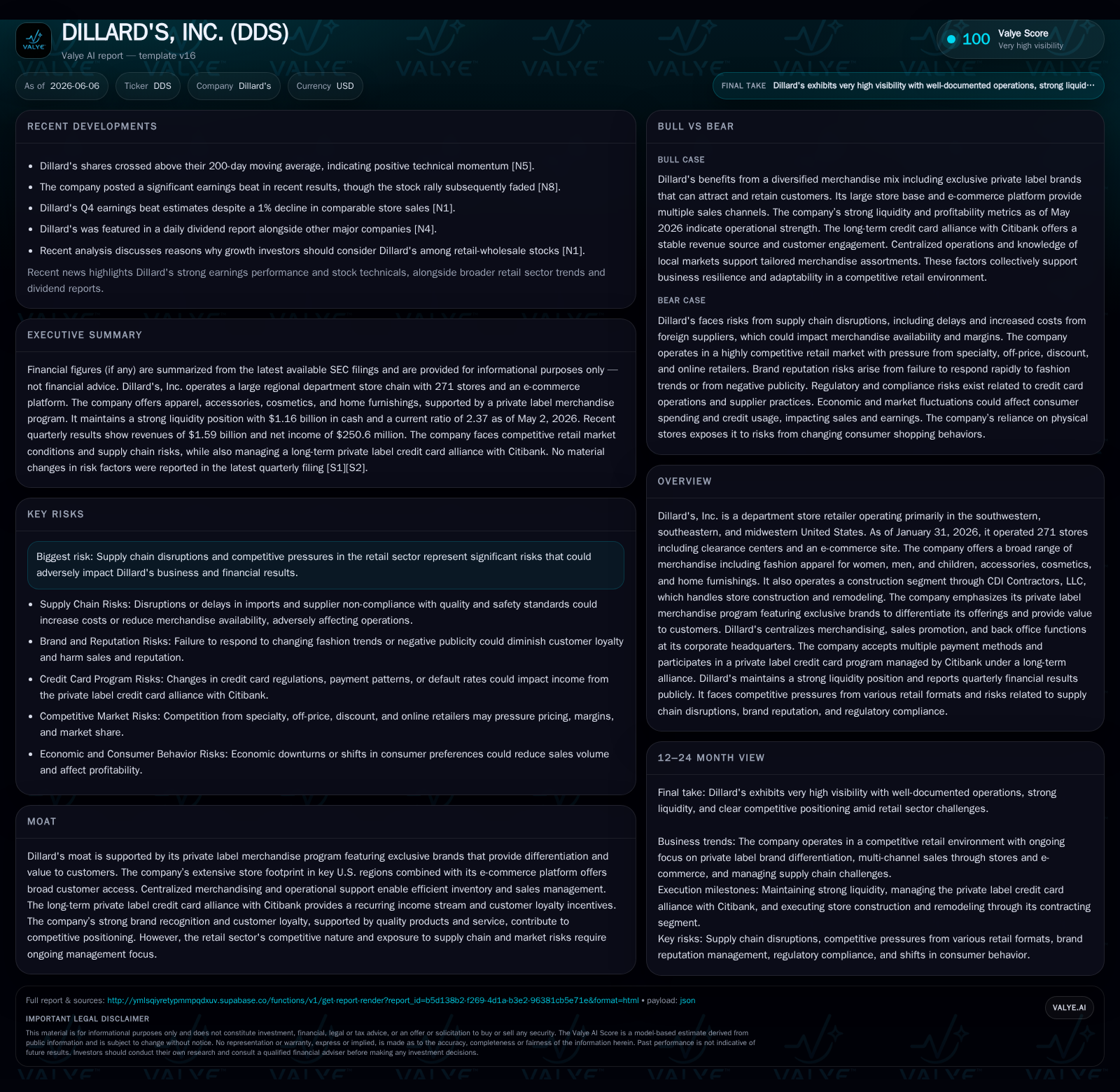
In its latest quarterly filing, Dillard's reports sustained operational strength driven by its private label merchandise program and expansive store network enhanced by a growing e-commerce platform. The company’s centralized merchandising and a strategic credit card partnership with Citibank continue to differentiate its offering in a competitive retail landscape. While supply chain and promotional intensity remain industry challenges, Dillard’s balance sheet exhibits solid liquidity supporting its growth initiatives.
Q1 2026 Operating Update: Key Highlights and Implications
Dillard's latest Form 10-Q filed June 5, 2026, confirms continuity in core operating strengths with no material changes in risk factors or internal controls [S2]. The quarter concluded with stable disclosure controls and no new legal proceedings expected to materially affect operations. Significantly, the company completed a transaction pursuant to its March merger agreement on June 4, which could influence capital structure going forward but does not immediately alter operating fundamentals [S3]. Recent repurchase activity has been paused leaving approximately $165 million authorization available under the Board-approved $500 million repurchase plan [S2]. This fiscal discipline coexists with Dillard’s execution of differentiated merchandising strategies and an evolving credit alliance.
Dillard’s Business Model: Exclusive Brands and Multi-Channel Sales Engine
Dillard's operates a department store model focused on fashion apparel, accessories, cosmetics, and home furnishings across its 271 stores predominantly located in the southwestern, southeastern, and midwestern United States [S1]. These locations are purposefully chosen for strong anchor tenant traffic within malls or open-air shopping centers to maximize footfall. A notable aspect is the company's investment in a portfolio of exclusive private label brands such as Antonio Melani, Gianni Bini, and Roundtree & Yorke that drive differentiation by offering customers higher quality products often at lower prices than national brands [S7]. This strategy leverages trademark protections maintained over time with continuous design innovation.
Crucially, merchandising decisions are centralized at corporate headquarters enabling swift response to market trends while regional offices ensure assortments meet specific local tastes and sizing requirements [S1][S7]. Dillard's also capitalizes on an increasingly important e-commerce platform integrating its physical footprint with online sales channels delivering enhanced customer convenience. Revenue mechanics hinge on volume growth through both channels alongside price management mitigated by controlled promotional intensity relative to off-price competitors.
Supporting these sales channels is Dillard's strategic decade-long marketing alliance with Citibank launched in August 2024 that manages the company’s private label credit cards including a co-branded Mastercard [S17][S18]. Citi assumes credit risk but shares earnings payments with Dillard’s based on portfolio performance. This program creates sticky customer relationships through rewards incentives while providing the retailer a stable revenue stream outside pure merchandise sales.
Competitive Positioning: Store Footprint, Brand Strength, and Credit Program Synergies
Dillard's competitive moat is anchored by its exclusive brand portfolio which minimizes direct comparability with national or off-price retailers that must compete primarily on price. Where peers like Macy’s have seen incremental comparable sales growth recently [N1], Dillard's benefits from sharper assortments promoting full-price selling — reducing markdown pressures common elsewhere. The company's stores maintain high productivity driven by curated regional tailoring of inventory supported by centralized logistics.
The Citibank credit card alliance enhances stickiness beyond typical retail loyalty programs by embedding long-term consumer finance incentives tightly linked to Dillard's merchandise ecosystem. This contrasts with some competitors whose private label programs are smaller scale or carry higher credit risk internally.
While online competitors proliferate nationally, Dillard’s advantage lies in combining brick-and-mortar presence where consumers value immediate access with digital accessibility powered by backend integration ensuring consistent inventory flow across channels. This hybrid model mitigates channel conflict risks seen in other specialty apparel retailers.
Industry Framework: Consumer Apparel Retail Dynamics and Competitive Pressures
The broader retail apparel industry remains challenged by evolving consumer behavior shifting toward e-commerce marketplaces but still valuing experiential shopping in well-appointed department stores. Promotional intensity across many apparel players leads to elevated markdown rates eroding gross margins; however, Dillard's controlled approach through private labels sustains better full-price sell-through rates.
Inventory aging management is critical amid supply chain disruptions caused by geopolitical events affecting foreign sourcing jurisdictions [S25]. Demand seasonality centered around holiday quarters adds volatility requiring nimble merchandise planning — an area supported at Dillard’s by sophisticated data analytics from both corporate and regional teams.
Growth Drivers: Enhancing Store Experience, E-Commerce Integration, and Loyalty Expansion
Dillard’s path for sustainable growth includes refreshing its exclusive brands aimed at driving fashion-forward appeal to attract repeat customers while reducing reliance on deep discounts. Continued augmentation of the e-commerce platform broadens reach beyond physical store catchment allowing cross-selling opportunities.
Further penetration of the Citibank credit program represents a lever for driving incremental purchase frequency and spend per household given associated rewards programs that incentivize loyalty [S18]. Store renovations guided by consumer preference insights also promise improvements in shopper experience — vital for attracting younger demographics amid competition from digitally native brands.
Operationally, Dillard's centralized merchandising aids efficient SKU mix optimization critical for managing inventory turns favorably compared to peers struggling with assortment clutter or slow-moving goods.
Risks and Constraints: Supply Chain Challenges and Market Competition
The company acknowledges the persistent risks related to its extensive international supplier base which faces potential import delays, tariff escalations, labor law compliance issues, and regulatory scrutiny [S25]. Any disruption could inflate cost bases or constrain merchandise availability impacting sales momentum.
Competition remains intense from national department stores, discount retailers, specialty apparel chains, and innovative online merchants competing for overlapping consumer segments [S11]. Pricing pressure can compress margins if promotional wars ensue beyond manageable levels. Additionally, maintaining relevance of brick-and-mortar locations is constrained by limited availability of desirable new retail spaces or escalating rents [S1].
No material updates to risk factors were noted this quarter indicating ongoing monitoring without emerging threats at this time [S2][S23].
Upcoming Catalysts: Guidance, Market Signals, and Execution Milestones
Investors should track forthcoming management commentary on merger integration outcomes following the June transaction closing [S3]. Monitoring same-store sales trends in subsequent quarters will yield insights into consumer appetite compared to peers such as Macy's which recently reported earnings beats driven by comparable sales gains [N1].
Additional milestones include progress on expanding credit card user activation rates within the Citibank alliance portfolio as well as any announced new store openings or planned remodels enhancing overall footprint productivity.
Financial Overview: Balance Sheet Health Supports Strategic Flexibility
As of May 2026 quarter-end, Dillard’s held approximately $1.16 billion in cash and equivalents against current liabilities near $1.29 billion yielding a current ratio of roughly 2.37 — indicative of robust short-term liquidity [F1]. Although total debt figures are historic with best-effort data around $615 million from older reports [F1], net debt calculations suggest a net cash position providing balance sheet flexibility absent recent leverage increases.
This liquidity stance supports operational investments in store upgrades, e-commerce enhancements, and marketing initiatives while providing buffers against supply chain volatility or unexpected expenses related to ongoing litigation typical within retail operations [S2][S12]
Disclaimer: This analysis is intended solely for informational purposes based on available SEC filings and public disclosures; it does not constitute investment advice or research views.
Disclaimer: This is research-only, informational analysis and not investment advice. It may include AI-generated interpretation and general industry context. Always verify important details using primary sources.

Comments