
Quanex Building Products Strengthens Global Footprint Amid Operational Challenges
Q2 2026 filings reveal revenue growth driven by Tyman acquisition offset by margin pressure and ongoing financial controls remediation.
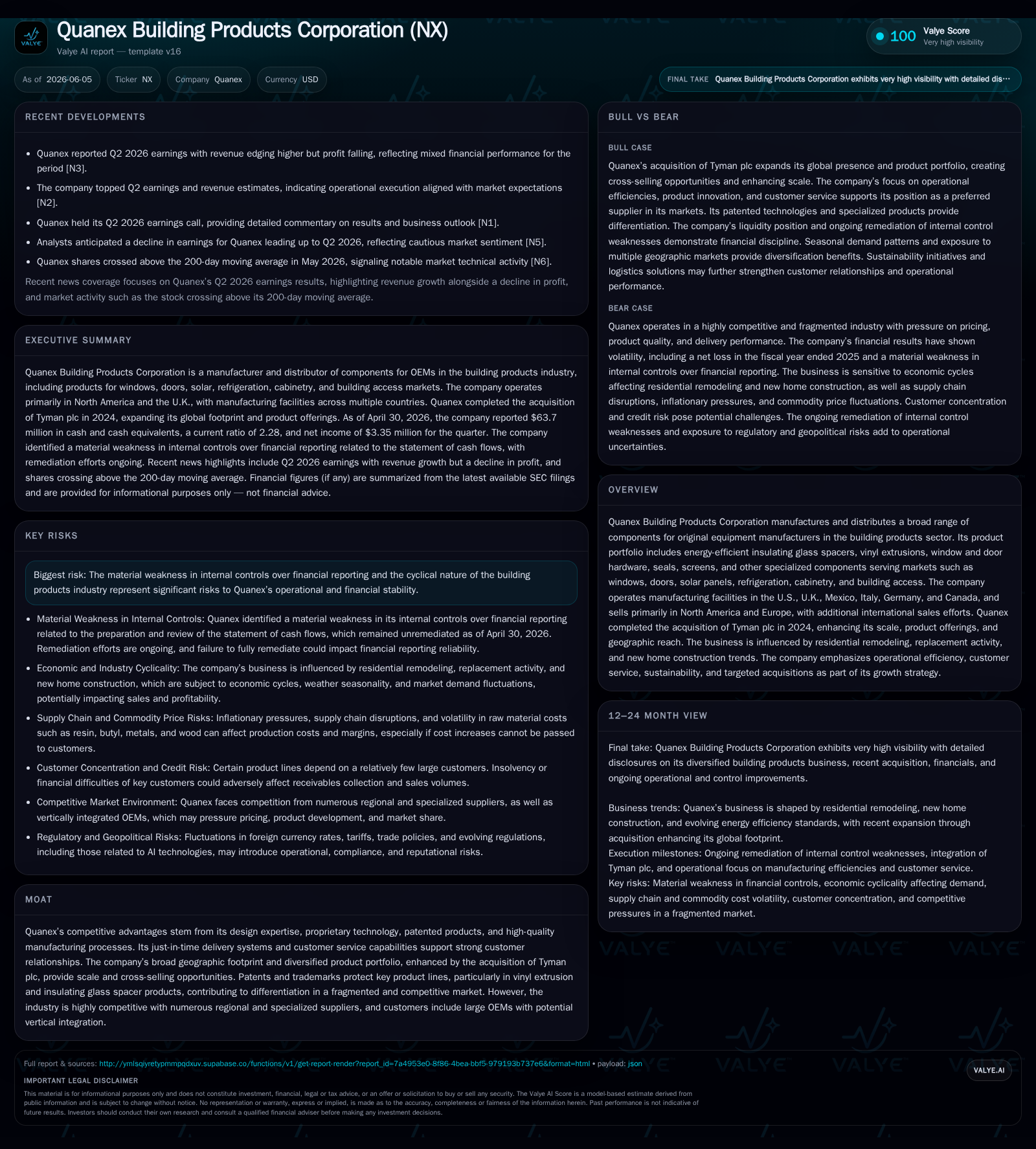
Quanex Building Products’ Q2 2026 results underscore the integration of its 2024 acquisition of Tyman plc, expanding geographic reach and product breadth. While revenue showed modest improvement, profitability declined due to operational challenges and a material weakness in internal financial controls that remains unremediated. The company’s business model leverages proprietary technology and a diverse product portfolio serving OEMs in the building products sector, with strategic growth hinging on cross-selling and operational efficiencies across its expanded global footprint. Industry cyclicality and legacy control weaknesses present risks amid an evolving competitive landscape.
Q2 2026 Operational Highlights: Growth vs. Margin Pressure
Quanex Building Products’ latest quarterly filing dated June 5, 2026 ([S2]) provides a mixed picture as it balances near-term growth against persistent operational headwinds. Revenue increased modestly compared to prior periods reflecting contributions from the Tyman acquisition finalized in August 2024 and ongoing demand in OEM building components. However, operating income deteriorated markedly with reported loss measures highlighting integration expenses and margin pressures. Additionally, the company disclosed an unremediated material weakness in internal controls over financial reporting related specifically to the preparation of the statement of cash flows. Remediation efforts are underway including enhanced review procedures and targeted training for finance personnel, with management aiming to resolve this issue by the October 31, 2026 control evaluation deadline.
Sales backlog remains moderate at approximately $54 million as of October 2025 ([S1]), aligned with the industry’s typically short lead times for custom-configured building products. Demand continues to reflect seasonal factors plus varied end-market conditions in residential remodeling and new construction segments. These dynamics represent an ongoing push-pull scenario where Quanex leverages scale from Tyman but faces margin erosion triggered by cost inflation and operational complexity ([N3]).
Quanex Business Model: Product Portfolio, Customer Base, and Delivery Mechanisms
Quanex manufactures and distributes a broad portfolio of specialized components for OEM customers within the building products sector ([S1]). Its core offerings include energy-efficient insulating glass spacers vital for thermal performance improvements in fenestration applications; extruded vinyl profiles critical for windows and doors; various window/door hardware components; seals and screens; as well as specialty elements deployed in solar panels, refrigeration units, cabinetry, and access control systems.
The business model centers on engineering expertise combined with cost-effective production processes delivering customer-specific solutions. Key revenue drivers involve contract manufacturing relationships with largely national or regional OEMs who pay for customized orders typically on a just-in-time basis to minimize finished goods inventory ([S1]). Pricing mechanisms incorporate volume commitments alongside mix considerations shaped by product innovation pipelines protected by patents particularly in insulating glass spacer technology.
Customer concentration is notable given reliance on large OEM accounts that exercise bargaining power and occasionally consider vertical integration alternatives ([S1]). Therefore, Quanex prioritizes differentiated design wins combined with high-quality manufacturing standards supported by robust logistics capabilities aimed at timely delivery. The inclusion of Tyman plc expanded both geographic reach—especially across Europe—and product breadth enabling more comprehensive solutions that enhance cross-selling opportunities across customer bases ([N1]).
Competitive Landscape and Industry Dynamics Impacting Quanex
Quanex operates in a fragmented supplier environment serving building products manufacturers where regional players dominate specific niches such as vinyl extrusions or sealing technologies ([S1]). Its scale—34 U.S. facilities plus operations across the U.K., Mexico, Italy, Germany, and Canada after acquiring Tyman—creates competitive advantages over smaller suppliers lacking geographic breadth or global supply chain depth.
Nonetheless, cyclical demand fluctuations tied closely to U.S. single-family housing starts (forecast stable/slightly rising in 2026) and remodeling activity drive periodic volume volatility impacting utilization rates ([S1],[N5]). Pricing power is limited due to raw material inflation exposure common across the industry as input cost pass-through mechanisms are imperfect and time lagged.
Moreover, OEM customers with volume leverage pose risks given potential vertical integration initiatives that could disintermediate component suppliers like Quanex ([S1]). Proprietary patents on insulating glass spacers and vinyl profiles offer partial protection against commoditization but require continuous investment in R&D to sustain differentiation.
Strategic Growth Drivers Post-Tyman Acquisition
The strategic acquisition of Tyman plc has been transformational for Quanex addressing several structural hurdles ([S1],[N1]). It adds substantial manufacturing footprint particularly in European markets alongside complementary product lines such as window hardware previously outside Quanex’s scope. This broadening fosters meaningful cross-selling potential within overlapping customer networks.
Operationally, the enlarged plant network aims to capture economies of scale while pursuing efficiency enhancements through standardizing best practices implemented during integration. Management emphasizes improving capacity utilization post-acquisition given initial complexities related to aligning supply chains and harmonizing systems ([N1]). This is critical since building component businesses operate on tight margins exacerbated by raw material price swings.
Innovation continues to be prioritized leveraging patent portfolios across energy-efficient insulating glass spacers—a segment growing structurally amid regulatory energy codes—and advanced extrusion technologies targeting higher-performance windows and doors ( [S1]). Backlog conversion metrics will signal demand sustainability since short lead times necessitate maintaining a steady pipeline to optimize plant throughput.
Operational and Financial Risks To Monitor
A prominent risk highlighted repeatedly relates to the ongoing remediation of a material weakness in internal controls over financial reporting specifically concerning statement of cash flows preparation ([S2]). This deficiency indicates past shortcomings in classification accuracy requiring enhanced verification steps. Failure to remediate fully could restrict investor confidence or invite regulatory scrutiny.
The cyclical nature of residential construction cycles exposes Quanex to demand volatility affecting revenue visibility and capacity planning ([S1],[N5]). Further risk arises from several pending legal claims linked to historic commercial sealant products manufactured during the early 2000s ([S9],[S17]), though management currently assesses no material adverse impact expected.
Customer concentration coupled with their vertical integration considerations remains another watchpoint given that loss of major OEM contracts could materially disrupt sales volumes ([S1]). Credit risk from financially stressed distributors or contractors also warrants close monitoring as evidenced by sector-wide consolidation trends potentially altering purchasing patterns ([S27]).
Forward-Looking Expectations: Execution Milestones and Market Signals
Attention will focus on Quanex’s success in fully remediating its internal control weaknesses by fiscal year-end October 2026 as outlined in recent filings ([S2]). Subsequent quarterly disclosures should reveal progress indicators validating management’s governance strengthening initiative.
From a demand perspective, housing market data including NAHB indices on starts/remodels will serve as leading signals guiding production scheduling decisions impacting backlogs ([N5],[S1]). Moreover, realization of synergy targets from Tyman integration through increased cross-selling penetration or cost rationalization programs constitutes a critical execution milestone.
Price pass-through effectiveness amid fluctuating commodity costs alongside maintenance or improvement of operating margins will remain key metrics watching resilience under inflationary pressures ([N3],[S2]). Additionally, settlement progression or management commentary regarding legacy litigation outcomes should be tracked given potential contingent liabilities effects.
Latest Financial Position Supported by Q2 Results
As of April 30, 2026, Quanex held approximately $63.7 million in cash and equivalents against total debt estimated at about $679 million resulting in net debt near $615 million consistent with post-acquisition leverage funded primarily via amended credit facilities maturing August 2029 ([F1],[S4],[S5]). The company's current ratio stood at a solid 2.28 supporting sufficient near-term liquidity amidst working capital demands ([F1]).
Despite top-line revenues around $1.8 billion reported from fiscal year-end October 31, 2025 data sources showing growing scale post-Tyman, operating losses reached nearly $194 million while net loss totaled approximately $251 million reflecting substantial non-recurring charges associated with acquisition integration costs plus elevated amortization expenses linked to purchase price allocations ([F1],[N3]). Ongoing investments into operational capabilities balanced against demand uncertainty frame the current financial landscape.
The analysis is grounded solely on disclosed SEC filings up to June 5, 2026 combined with corroborative recent market data without any inferred investment research views.
Disclaimer: This is research-only, informational analysis and not investment advice. It may include AI-generated interpretation and general industry context. Always verify important details using primary sources.

Comments