
Abercrombie & Fitch’s Q1 2026 Results Highlight Resilient Americas Growth and Strategic Investments
Q1 earnings reveal a firm footing in Americas amid EMEA headwinds, supported by focused capital deployment in digital and store experience enhancements.
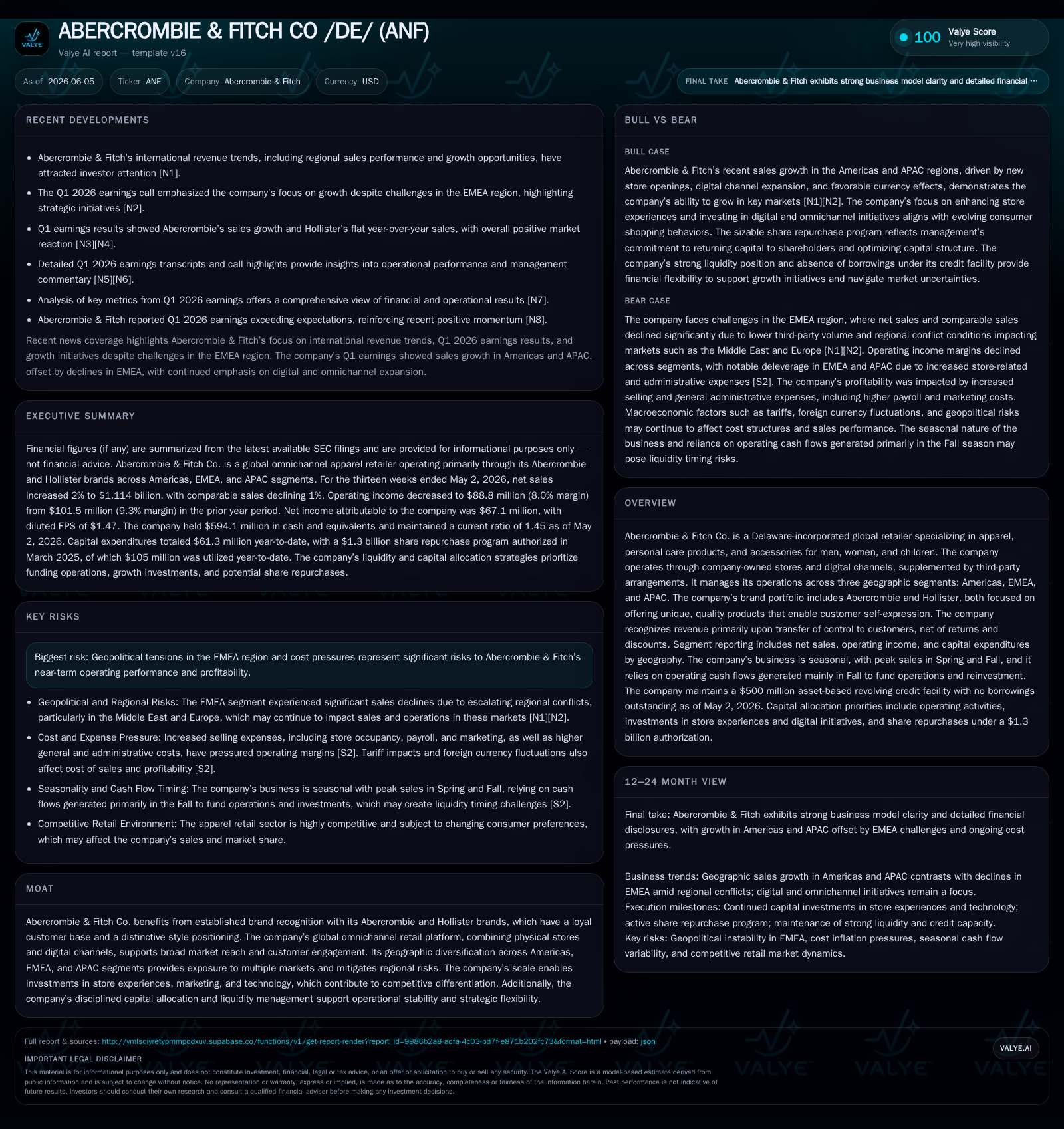
Abercrombie & Fitch reported a modest 2% net sales increase in Q1 2026, driven by a resilient Americas segment with 3% growth and robust APAC expansion at 24%, while EMEA experienced a double-digit sales decline. Operating income contracted as margin pressures emerged from regional challenges and cost inflation. The company continues to invest aggressively in omnichannel initiatives and store experience upgrades, balancing these against an active share repurchase program and maintaining strong liquidity. Near-term growth is expected to hinge on international market stabilization and sustaining sell-through discipline through seasonal cycles.
Q1 2026 Operating Results: Segment Performance Landscape
Abercrombie & Fitch’s first quarter for fiscal year 2026 offered a study in contrasts across its geographic segments. Total net sales edged up by a modest 2% versus Q1 the prior year, reaching approximately $1.11 billion [S2]. This topline gain was largely courtesy of the Americas segment, which posted a steady 3% rise in net sales to nearly $900 million, driven by roughly flat comparable store sales adjusted for currency and low single-digit jumps in average unit retail (AUR). In stark contrast, the Europe, Middle East, and Africa (EMEA) segment declined sharply by over 10%, reflecting both weaker demand and ongoing geopolitical tensions weighing on consumer confidence. Asia-Pacific (APAC) stood out with an impressive 24% jump in net sales fueled by a robust 15% increase in comparable sales, evidencing successful international expansion initiatives [S2].
Despite slightly higher revenues overall, operating income shrank to about $88.8 million or an 8.0% operating margin—a contraction from last year’s stronger profitability at 9.3% [S2]. This margin compression signals increased promotional activity and inflationary pressures impacting cost of goods sold and selling expenses across several regions. Notably, the company's commitment to managing markdown intensity reflects heightened caution given inventory aging risks inherent to the apparel sector’s seasonal cadence
Revenue Composition and Brand Portfolio Dynamics
Abercrombie & Fitch Co. generates income primarily through its two core youth- and young adult-focused brands: Abercrombie and Hollister. These brands blend apparel, personal care items, and accessories marketed via company-owned stores complemented by e-commerce channels alongside select wholesale arrangements [S1]. Over the reported quarter, revenue benefited from an improved mix towards full-price selling despite regional headwinds.
The Americas segment's AUR growth owes much to refreshed assortments anchored in quality design aligned with shifting consumer tastes towards casual yet expressive apparel offerings—a strategic focus that underpins sell-through rates critical for mitigating inventory markdowns [S2]. Meanwhile, Hollister’s flat year-over-year sales underscore stabilization efforts amidst intense category competition from specialty peers emphasizing loyalty programs and experiential retail.
Internationally, APAC’s double-digit growth is attributable to expanding physical footprints combined with targeted digital marketing campaigns tailored to local fashion sensibilities—leveraging omnichannel synergies that drive engagement and repeat business [N1][N2]. Conversely, EMEA’s declines partly stem from heightened promotional activity diluting pricing power amid geopolitical uncertainty that disrupts supply chains and elevates operational costs.
Competitive Environment and Industry Positioning
Within the specialty apparel landscape targeting younger demographics, Abercrombie & Fitch contends with brands striving for differentiation through product freshness, channel innovation, and pricing discipline. The company leverages established brand recognition coupled with global omnichannel reach encompassing proprietary retail estates supported by direct-to-consumer e-commerce platforms [S1]. This hybrid model facilitates tighter control over pricing integrity relative to wholesale-reliant competitors.
Abercrombie & Fitch's ability to sustain sell-through rates at moderate promotional intensity is vital given sector trends where excess inventory often triggers aggressive markdowning negatively impacting gross margins. Additionally, loyalty program effectiveness - while not explicitly detailed - remains a tactical lever industry-wide for customer retention amid a generation prone to rapid preference shifts [N3]. Progress on digital transformation initiatives positions A&F favorably versus some peers lagging in ecommerce sophistication.
Supply Chain and Inventory Management Insights
The company reported inventory reductions from about $601 million at start of calendar year to approximately $533 million as of May-end—a nearly 12% drawdown indicating disciplined inventory management following previous periods of backlog accumulation [S2]. Managing stock levels effectively before peak Fall selling periods is paramount to minimizing markdown necessity while maintaining assortment availability.
This careful balance extends through supply chain agility enhancements designed to optimize procurement timing aligning with seasonal fashion cycles—spring and fall remain key revenue drivers [S1][S2]. Such operational prudence supports cash conversion efficacy essential when operating cash flows concentrate heavily during the latter half of the fiscal year.
Growth Catalysts: Omnichannel Expansion and International Opportunities
Capital allocation underscores Abercrombie & Fitch’s commitment to bolstering long-term competitive advantage through investments targeting new store concepts enhancing experiential appeal alongside deepened digital capabilities syncing mobile commerce, fulfillment logistics, and personalized marketing [S4]. Year-to-date capital expenditures totaled $61.3 million toward such initiatives with full-year forecasts near $225 million emphasizing consistent reinvestment pace.
Internationally, APAC traction signals meaningful runway for scaling physical presence paired with local ecommerce infrastructure buildout—counterbalancing moderating conditions across EMEA markets [N1][N2]. The firm remains opportunistic about selective marketplace expansions aligning with demographic shifts favoring style-conscious younger consumers worldwide.
Risks and Operational Constraints: Regional Tensions and Cost Pressures
Abercrombie & Fitch faces clear near-term constraints stemming predominantly from geopolitical instability within EMEA territories which exacerbates supply chain complexities while engendering consumer hesitancy impacting retail traffic patterns [S6]. Inflationary cost environments further pressure margins via raw materials pricing hikes and wage inflation particularly notable in logistics segments.
Together these factors contribute to diminishing operating income despite revenue growth—underscoring sensitivity around sustaining profitability amidst macroeconomic headwinds requiring vigilant price/mix management alongside cost containment strategies [S2][N3]
Capital Allocation Priorities: Investments versus Share Buybacks
Management balances aggressive share repurchase execution—completing roughly $105 million worth of stock buybacks YTD under an open-ended $1.3 billion authorization—with substantial reinvestment spending aimed at digital transformation projects and store experience innovations [S4][S10]. This dual approach reflects confidence in intrinsic value creation potential while navigating evolving consumer landscapes.
Liquidity remains strong with cash holdings near $594 million complemented by unused revolving credit capacity of about $450 million under asset-based lending facilities—all facilitating flexible capital deployment without incremental leverage buildup [F1][S8]. Such conservative financial stewardship provides strategic optionality amidst uncertain external market conditions.
What Investors Should Monitor Next
Going forward, market participants will watch quarterly comparable sales progression especially within EMEA for signs of stabilization or further deterioration; margin trajectory reflecting efficacy of markdown management; digital channel penetration metrics; along with success milestones tied to new store formats rollout aligned strategically against evolving consumer engagement behavior [N2][S2]. Seasonal buying patterns into Fall will serve as tangible demand barometers confirming merchandising strategy efficacy.
Additionally noteworthy will be any updates incorporated into forthcoming quarterly guidance addressing inflation outlook adjustments or geopolitical developments potentially altering revenue pacing or profitability forecasts.
Financial Overview Highlights (Latest Quarter)
In conjunction with operational commentary, Abercrombie & Fitch disclosed underlying cash flow improvements generating approximately $44 million from operations this quarter contrasted against slight negative flow last year illustrating progress in working capital optimization despite elevated reinvestment outlays [S2][S7]. Capital expenditure usage accelerated reflecting front-loaded spending on growth initiatives while share repurchases maintained material pace reducing outstanding shares contributing positively toward per-share metrics.
The balance sheet continues exhibiting healthy current ratios around 1.45x underscoring adequate short-term liquidity backed by sizable cash reserves exceeding current debt levels resulting in a negative net debt position by best estimates [F1]. This financial flexibility supports ongoing commitments while buffering against unforeseen operational disruptions.
This analysis integrates the latest quarterly disclosures alongside sector context benchmarks without offering investment research views or price targets. It aims exclusively to equip buy-side professionals with coherent insights grounded strictly on verifiable corporate filings and reputable news sources as cited throughout.
Disclaimer: This is research-only, informational analysis and not investment advice. It may include AI-generated interpretation and general industry context. Always verify important details using primary sources.

Comments