
Flag Ship Acquisition Corp Navigates Nasdaq Compliance Challenges Amid Active Merger Negotiations
The company's June 2026 quarterly filing highlights ongoing Nasdaq deficiency notices due to late SEC filings, alongside strategic merger pursuits to complete a business combination within critical deadlines.
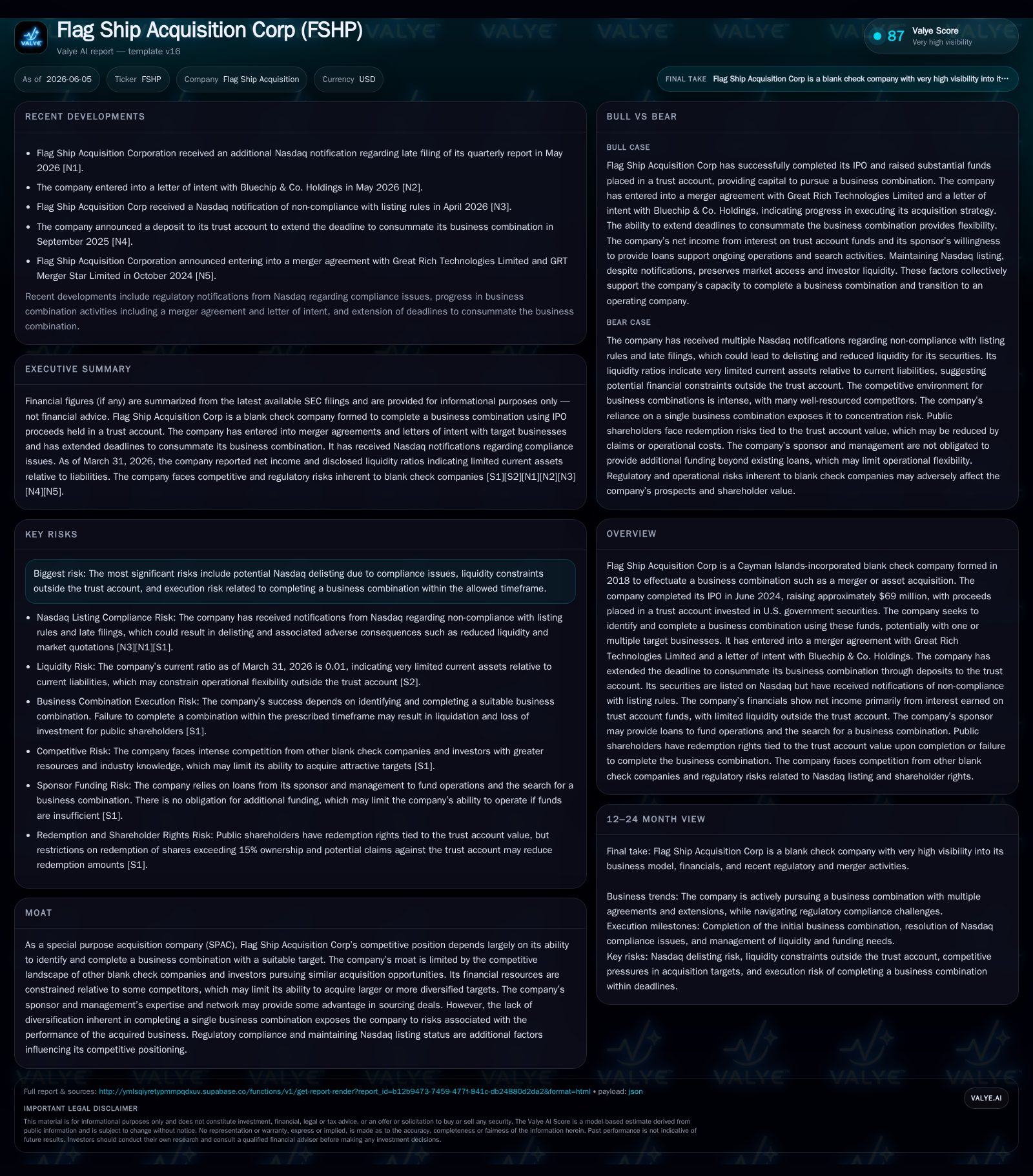
Flag Ship Acquisition Corp remains delinquent in timely SEC filings, prompting multiple Nasdaq deficiency notices and risking delisting if compliance is not restored by October 12, 2026. Concurrently, the company has terminated its prior merger agreement with Great Rich Technologies and is pursuing a business combination with Great Future Technology Inc., supported by a letter of intent with Bluechip & Co. Holdings. Execution risks persist amid liquidity constraints outside the trust account and intense competition for acquisition targets, underscoring the importance of successful transaction closure within Nasdaq’s extended cure period.
Latest Quarterly Filing Update: Compliance and Transaction Progress
Flag Ship Acquisition Corp's Form 10-Q filed June 5, 2026, confirms ongoing Nasdaq compliance challenges resulting from delayed SEC filings for the year-end 2025 Form 10-K and the March 2026 Form 10-Q. These delays have led Nasdaq to issue multiple deficiency notices as recently as May 21, 2026, setting an October 12, 2026 deadline for Flag Ship to submit an acceptable plan to regain compliance or face potential suspension or delisting [S2][S3][N1]. The company has extended its timeline by depositing additional funds into its trust account but must resolve these issues promptly.
Concurrently, Flag Ship ended its prior merger agreement with Great Rich Technologies in early May but replaced it by entering into a new merger agreement with Great Future Technology Inc., signaling a strategic focus on viable acquisition targets aligned with its SPAC mandate. Additionally, a letter of intent signed on May 8 with Bluechip & Co. Holdings indicates ongoing efforts to secure transformative business combinations despite regulatory headwinds and compressed timelines [S1][S6][N2][S15].
Business Model Overview: Trust Account Mechanics and Investor Protections
Incorporated in the Cayman Islands in 2018 and completing its IPO in June 2024 raising approximately $69 million net of underwriting costs placed in a trust account invested primarily in U.S. Treasury securities, Flag Ship operates as a blank check company focused on effecting a business combination using these funds [S1]. This trust account structure protects public investors by segregating IPO proceeds until either consummation of an initial business combination or liquidation.
Public shareholders maintain redemption rights allowing them to redeem shares for their pro-rata share of trust assets upon completion of the business combination [S1]. These redemption rights can materially affect transaction economics depending on election rates at closing. Meanwhile, sponsor shares generally do not carry redemption rights aligning sponsor incentives with deal completion rather than redemptions
Flag Ship currently generates operating income principally from interest earned on trust account holdings while maintaining minimal operating expenses prior to business combination [F1][S2]. However, operational liquidity outside the trust account is minimal—approximately $1,811 as of March 31, 2026—while current liabilities stand at about $1.65 million, highlighting tight cash flow conditions that underscore dependence on external financing or timely deal execution
Regulatory and Listing Risks: Nasdaq Compliance Pressure
Nasdaq’s enforcement of filing deadlines reflects heightened regulatory scrutiny post-2024 SPAC reforms aimed at improving disclosure timeliness and investor protections [S3][N3]. Flag Ship’s repeated late filings have triggered deficiency notices without yet resulting in delisting but impose material pressure to rectify governance weaknesses swiftly
Failure to submit an acceptable remediation plan by October 12 risks suspension or removal from Nasdaq trading, which would impair liquidity and capital raising capabilities while undermining shareholder confidence. These regulatory risks compound competitive execution challenges faced by the company.
Competitive Landscape: Navigating Intense SPAC Market Dynamics
Flag Ship competes within an intensely contested SPAC ecosystem comprising numerous blank check companies alongside private equity players targeting high-growth sectors like technology. Its roughly $69 million IPO proceeds limit target size relative to better-funded competitors able to pursue larger or multiple acquisitions concurrently [S1]
Success hinges on leveraging management expertise and networks for efficient target sourcing and due diligence under constrained timelines amid evolving regulatory demands.
Growth Drivers: Strategic Merger Initiatives
Renewed merger negotiations with Great Future Technology Inc., following termination of an earlier agreement with Great Rich Technologies Ltd., demonstrate Flag Ship’s commitment to securing an initial business combination within Nasdaq’s extended cure period. The concurrent letter of intent with Bluechip & Co. Holdings provides optionality for alternative or complementary acquisitions.
Completion of these transactions would transition Flag Ship from a shell entity dependent on trust account interest income into an operating public company capable of generating revenues tied directly to acquired businesses’ performance.
Risks and Watchpoints: Execution Uncertainty and Liquidity Constraints
Additional regulatory uncertainties arise from potential complications involving foreign-based targets subject to government reviews that could prolong closing timelines or impact valuations negatively [S5].
Upcoming Catalysts: Compliance Plans and Shareholder Approvals
Market participants should monitor Flag Ship’s submission of Nasdaq compliance cure plans ahead of October 12 as a key near-term event determining continued listing status. Subsequent filings related to definitive merger agreements and proxy statements soliciting shareholder approvals will provide insight into transaction progress.
Redemption election rates will also be critical indicators reflecting public investor sentiment toward proposed deals.
Financial Snapshot: Operational Liquidity Challenges Despite Trust Account Security
As of March 31, 2026, Flag Ship held only approximately $1,811 in cash outside its trust account against current liabilities exceeding $1.64 million—a current ratio near 0.01—signaling serious short-term liquidity constraints excluding protected trust funds dedicated solely for investor redemptions upon business combination completion [F1]
While the $69 million trust account secures principal amounts invested conservatively in U.S. government securities safeguarding investor capital, operational continuity depends heavily on sponsor support or timely transaction closings releasing funds beyond the trust structure [S1][S7]
This analysis reflects publicly filed information through June 5, 2026 without speculative forecasts or investment research views.
Disclaimer: This is research-only, informational analysis and not investment advice. It may include AI-generated interpretation and general industry context. Always verify important details using primary sources.

Comments