
DocuSign's Multi-Pronged Growth Strategy Drives Subscription Revenue Expansion
Q1 FY2027 earnings reveal accelerating adoption of DocuSign’s IAM platform supporting steady subscription revenue growth amidst evolving market dynamics.
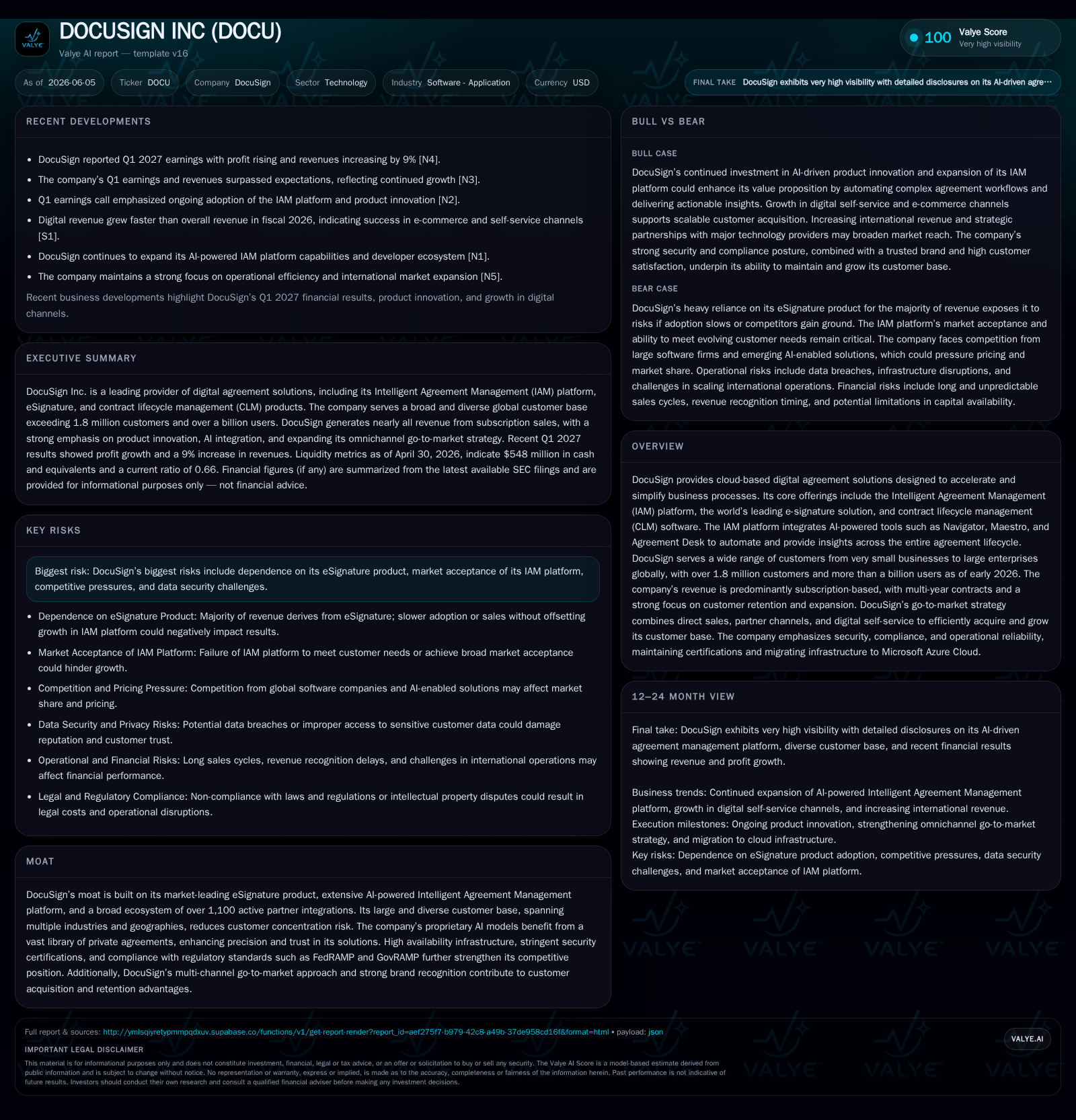
In its latest quarterly filing, DocuSign reported continued growth driven by expansion in its Intelligent Agreement Management (IAM) platform alongside its flagship eSignature product. The company’s multi-channel go-to-market strategy, combining direct enterprise sales, partner ecosystems, and digital self-service, supports incremental adoption and cross-sell within a large and diverse customer base. Despite competitive and cybersecurity risks, DocuSign leverages its leading AI-powered platform and extensive integrations to maintain differentiation in a rapidly evolving digital agreement management market.
Latest Quarterly Operating Performance: Broadening Platform Traction
DocuSign's Q1 FY2027 results, disclosed in the June 5, 2026 10-Q [S2] and June 4 earnings release [S3], reflect ongoing momentum in its core subscription business despite mixed macro technology sector performance [N10]. Subscription revenue continues to drive top-line growth fueled by increased uptake of the Intelligent Agreement Management (IAM) platform among its sizable direct enterprise customer segment. The company reported no material declines in eSignature usage — still the dominant revenue contributor — but highlighted meaningful expansion within IAM deployments. As of January 31, 2026, approximately 25,000 customers were subscribing to IAM solutions representing over 10% of annual recurring revenue [S1], [S24]. Q1 progress indicated ongoing expansion beyond basic electronic signature workflows towards comprehensive lifecycle agreement management.
Direct sales teams have been restructured to align incentives with multi-year growth goals centered on broad IAM adoption across enterprise accounts [S5]. This is complemented by a robust suite of AI-powered modules like Navigator for contract intelligence and Maestro for workflow automation that boost platform stickiness via deeper integration into organizational processes [S17]. The combination of persistent long sales cycles characteristic of enterprise SaaS coupled with accelerating cross-sell success underpins improved wallet share per client.
Subscription-Centric Business Model Anchored in Agreement Lifecycle Solutions
DocuSign operates a predominantly subscription-based model where roughly 98% of revenue is from contracts typically lasting one to three years paid annually or upfront [S1], [S11]. Contracts vary across customer segments: very small businesses (VSBs) primarily convert through digital channels requiring minimal sales engagement; commercial and enterprise customers engage longer direct sales cycles but provide higher contract values and expansion opportunities [S1], [S4]. In Q1 FY2027, the company continued leveraging its land-and-expand approach where initial low-touch acquisition funnels via digital self-service mature into high-value platform-wide IAM implementations through direct sales or partner-led upsells [S6].
Pricing is structured around usage units (Envelopes) for eSignature and user licenses for IAM subscriptions with multiple tiers catering to different business sizes and vertical-specific needs [S23], [S24]. Notably, customers with $300k+ annualized contract value rose to 1,205 as of year-end fiscal 2026 from 1,131 a year earlier signaling solid enterprise wallet expansion [S11]. Add-ons such as identity verification services (CLEAR), remote notarization (Notary), payments integration, and AI-assisted review further diversify revenue streams.
Market Dynamics and Competitive Positioning in Digital Agreement Management
DocuSign holds a commanding position in the software application category focusing on digital agreement solutions with particular strength demonstrated by over a billion users worldwide as of early fiscal 2026 [S1], Valye excerpt. Its moat comprises a comprehensive AI-powered Intelligent Agreement Management platform with deep integrations through an ecosystem of over 1,100 partners including Microsoft, Salesforce, SAP — relationships that enhance distribution reach and embed DocuSign capabilities into broader productivity stacks [S5], [S8], Valye excerpt.
Competition includes Adobe Acrobat Sign as the primary large-cap rival along with specialized providers for narrower CLM functionalities. Emerging threats also arise from general-purpose large language models (LLMs) entering the agreement analytics space [S18]. To maintain differentiation, DocuSign emphasizes the security certifications such as FedRAMP Moderate and GovRAMP authorities required by sensitive government clients—an increasingly important trust factor—alongside advanced identity-proofing technologies that strengthen compliance across global jurisdictions including Europe’s eIDAS framework [S17], [S27].
Peer SaaS retention rates highlight the criticality of seat expansions and contract renewals; here DocuSign's combined direct sales support and digital self-service funnel enhances gross retention versus many peers reliant solely on organic growth or channel partners.
Growth Catalysts: Multi-Channel Sales Strategy and AI Innovation
DocuSign’s go-to-market transformation continues prioritizing a triad approach: expanding direct sales penetrations particularly targeting mid-market to large enterprises; unlocking incremental reach through strategic global partnerships; and scaling the digital self-service channel as an efficient acquisition engine that drove roughly 15% of total fiscal-year 2026 revenues [S5], [S6], [S21]. Realignment of field territories and incentive comp plans introduced early FY2026 underscore a focus on solution selling that promotes full-stack IAM adoption rather than single-product engagements.
On the innovation front, integration of AI tools like Docusign Iris powers core workflow efficiencies detected via Navigator’s contract repository insights plus AI-assisted review capabilities that minimize manual contract processing time. The launch of APIs enables partners and developers to embed these functionalities within third-party apps or bespoke internal environments enhancing customization potential at scale [S17]. Recent platform availability within AI chatbots such as ChatGPT signals DocuSign's intent to lead agreement lifecycle transformation amid growing AI adoption trends.
These combined efforts benefit from strong brand equity associated with trustworthy signature processes noted by external rankings (e.g., Newsweek naming DocuSign the most trustworthy US software company) compounded by an expansive partner ecosystem facilitating co-selling motions alongside friendly integration partners like Microsoft Azure cloud hosting migration underway to improve scalability and operational efficiency [S17], [S27].
Key Risks and Execution Challenges Ahead
Despite evident strengths, DocuSign faces notable execution risks detailed in recent filings including possible declines in standalone eSignature demand absent corresponding IAM uptake which is still relatively early in market penetration [S2]. Competition intensifies not only from established vendors but also emerging AI-first solutions offering overlapping contract analytics functionalities potentially commoditizing certain use cases.
Cybersecurity remains paramount given handling of sensitive contractual data; management oversight incorporates frequent board-level cybersecurity reviews together with layered technology defenses aligned with industry standards to mitigate reputational damage from breaches or service disruptions—a critical factor given customers’ trust expectations underpinning renewals [S1], [S25].
Long sales cycles combined with unpredictable timing challenges accurate financial forecasting highlighting the importance of disciplined pipeline management and flexible expense control. Further recruitment and retention of skilled personnel especially within product development and sales remains essential for sustaining innovation velocity amidst competitive talent markets.
Investor Watchlist: Upcoming Milestones and Metrics to Monitor
Key indicators for upcoming quarters include observation of net retention rates reflecting customer loyalty alongside churn patterns segmented by product line (eSignature vs IAM). Monitoring growth velocity among top-tier enterprise accounts exceeding $300k ARR will illustrate deepening wallet penetration critical for margin improvement. Announcements expanding strategic alliances or new API adoption milestones may signal accelerating ecosystem network effects.
Progress measurement toward broad IAM adoption beyond initial departmental pilots into company-wide deployments also forms a crucial execution barometer. Official guidance updates regarding revenue trajectories or operating margins post recent organizational realignments will help contextualize scaling efficiency gains.
Financial Overview: Recent Trends in Profitability and Liquidity
From a financial vantage point anchored in the latest SEC disclosures through April 30, 2026 [F1], DocuSign ended Q1 FY2027 holding $548 million in cash & equivalents against negligible debt (~$6 million last reported), resulting in a robust net cash position that supports strategic flexibility. Operating income reported earlier at ~$298.6 million underscores profitability progression paralleling subscription base growth while maintaining investment spending focused largely on R&D innovation and Go-To-Market execution enhancements.
While current ratio near 0.66 reflects typical SaaS working capital dynamics weighted toward deferred revenues rather than immediate liquidity strain [F1], management’s emphasis remains on disciplined capital allocation balancing growth initiatives against sustainable profit generation per filings [S2].
This analysis consolidates reported financial data with regulatory filings alongside detailed operational context to distill present momentum drivers shaping DocuSign’s trajectory without investment research views or speculative projections.
Disclaimer: This is research-only, informational analysis and not investment advice. It may include AI-generated interpretation and general industry context. Always verify important details using primary sources.

Comments