
Veeva Systems Advances AI-Powered Industry Cloud with Strengthened Margin Pressures
Veeva's latest quarterly report highlights expanded AI investments and rising professional services costs amid growing end-user demand for its life sciences cloud platform.
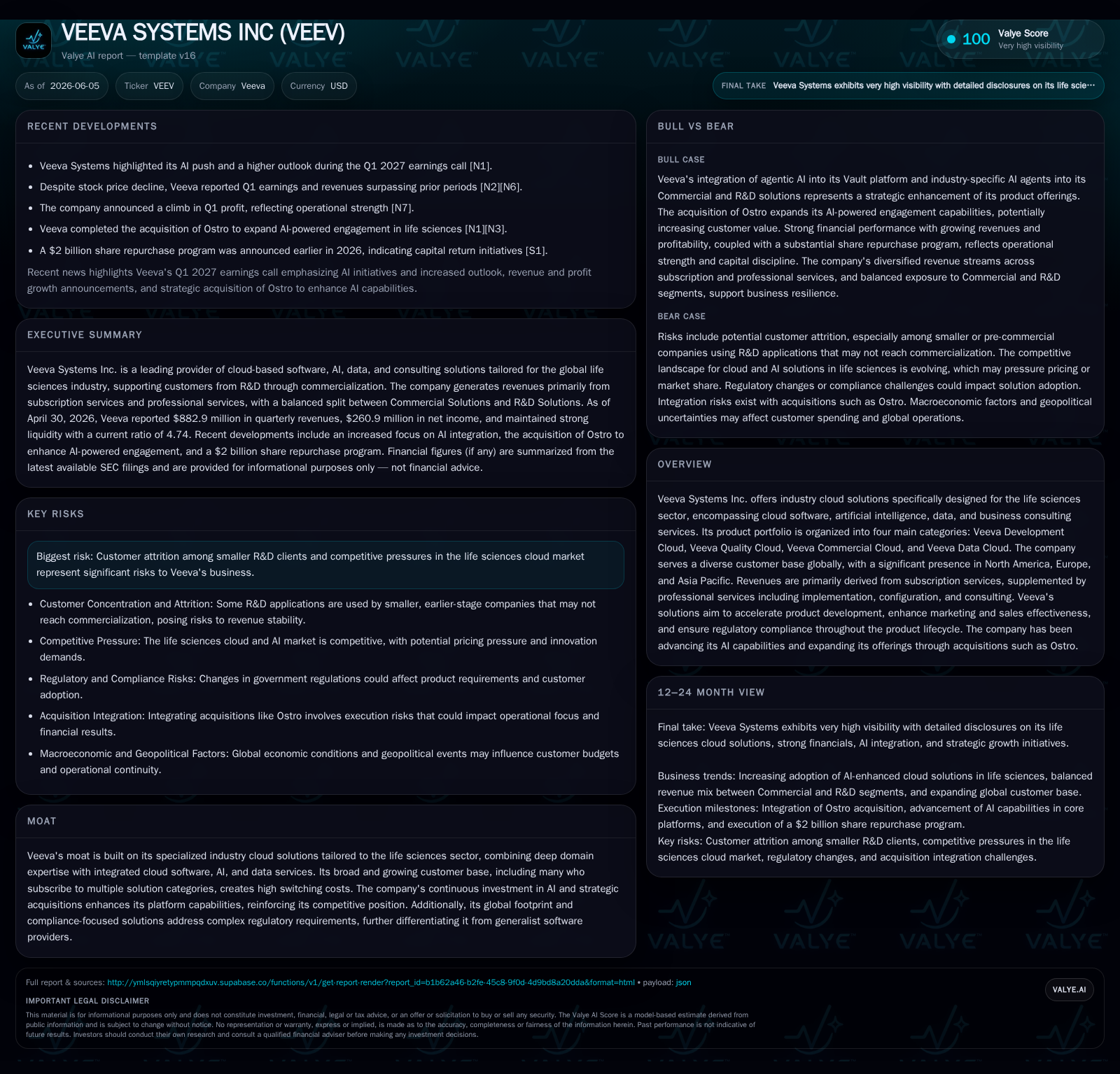
In its Q1 fiscal 2027 filing, Veeva Systems reported increasing infrastructure expenses driven by a larger and more active end user base, alongside stepped-up investment in data solutions and AI capabilities. While subscription revenue growth remains robust, margin compression arose principally from expanding professional services headcount to support implementation demand. Veeva's vertically tailored cloud platform retains a competitive edge through deep regulatory integration and multi-cloud product breadth, driving strong customer lock-in in the specialized life sciences sector. Key near-term focus areas include managing margin pressures while scaling AI-enabled offerings and monitoring deferred revenue trends as indicators of contract renewal momentum.
Latest Quarterly Operational Highlights and Cost Dynamics
Veeva’s first quarter fiscal 2027 (ending April 30, 2026) filing reveals notable shifts in operating cost structure aligned with underlying demand growth and strategic investments. The increase in computing infrastructure expenses stemmed primarily from an expanded base of end users engaging more heavily with subscription services. This volume-driven cost rise was complemented by higher data-related expenditures attributed to the company’s deliberate push into advanced data solutions underpinned by artificial intelligence. Simultaneously, gross margins on professional services suffered a decline from 23% in the prior year quarter to 20%, reflecting significant expansion of the consulting and implementation workforce deployed to meet surging customer onboarding needs. These professional service activities are inherently more labor-intensive and carry lower relative margins compared to the core subscription software offerings.
This near-term cost profile underscores a trade-off where accelerating AI-enhanced platform capabilities and user adoption entail upfront expense increases before scale efficiencies can materialize fully. Management commentary corroborates this cost-investment phase as integral to sustaining Veeva’s leadership in life sciences cloud innovation [S2][N1][S3].
Subscription-Driven Business Model Enhanced by AI Capabilities
At the core of Veeva’s revenue mechanics lies a recurring subscription model delivering specialized cloud software tailored exclusively for the global life sciences sector. Its portfolio groups around four principal categories: Development Cloud (clinical operations and regulatory management), Quality Cloud (manufacturing compliance), Commercial Cloud (sales/marketing orchestration), and Data Cloud (analytics and customer insights). These offer deeply integrated workflows from R&D through commercialization phases that few vendors can replicate due to stringent regulatory compliance requirements intrinsic to pharmaceutical and biotech processes.
Revenue streams predominantly arise from subscriptions granting access over contract terms supplemented by professional services focused on implementation, configuration, and business consulting. The subscription revenues carry high gross margins typical of SaaS businesses while professional services yield materially lower margins but are key enablers for customer success.
A distinctive feature elevating relevance is Veeva AI's incorporation into platforms such as Vault, which embeds agentic AI capabilities helping automate document management, trial protocols, and marketing analytics [S1][S2][N1]. These domain-specific intelligence layers amplify product differentiation by reducing manual workloads while capturing increasingly complex data signals vital for regulatory adherence and commercial effectiveness. This technology stack upgrade also drives stickiness through higher switching costs as clients integrate AI-driven processes deeply into operational routines
Competitive Position: Life Sciences Cloud Differentiation and Customer Lock-in
Veeva enjoys a defensible moat originating from its unwavering focus on life sciences verticals combined with comprehensive platform breadth covering R&D to commercial stages, enhanced by AI augmentation. Unlike generic cloud or CRM providers venturing into healthcare, Veeva pairs advanced software functionality with exacting adherence to evolving regulatory frameworks internationally—a critical barrier given FDA protocols, GxP manufacturing standards, privacy rules like HIPAA/GDPR, and clinical trial regulations.
The company's extensive multicloud adoption among leading pharmaceutical companies creates sticky ecosystems where multiple solution categories are cross-sold within accounts. This multi-product footprint significantly raises switching friction not only because of operational disruption risks but also due to entrenched compliance documentation dependencies.
Peer analyses suggest that competing firms with less integrated product suites or narrower functional depth face challenges replicating Veeva's seamless life science alignment. Its continuous investment in proprietary data sets and AI tools further extends competitive distance relative to legacy EMR vendors or broader SaaS competitors entering this space tentatively [S1][N12].
Growth Drivers: User Expansion, AI Integration, and Data Solutions Scale
Key engines fueling Veeva’s growth encompass both volume expansion—via seat counts across existing customers—and new client acquisitions leveraging enhanced AI-powered features. The rise in active end users directly impacts infrastructure consumption leading to higher variable costs but also boosts subscription billings reflective of usage-based pricing components embedded increasingly across data solutions.
Continuous rollout of AI agents specialized for clinical trial optimization or commercial targeting has spurred improved adoption rates as clients seek efficiency gains amid tightening R&D productivity globally. Additionally, the Data Cloud segment benefits from increasing complexity of healthcare datasets requiring robust analytics platforms capable of real-time insights.
These factors collectively support a favorable net retention profile for subscription revenues despite broader industry cyclicality associated with pharmaceutical R&D spending fluctuations [S2][N1]. The balancing act lies in scaling professional service capabilities fast enough without disproportionately eroding overall gross margins
Risks and Constraints: Margin Headwinds and Customer Concentration
The expansion of professional service personnel necessary to sustain accelerating implementation demand presents clear margin pressure risks amid typically low labor-leverage business lines. In the latest quarter, gross margin contraction in this segment signals that cost discipline must be carefully managed during this scaling phase.
Moreover, a portion of Veeva’s customer base comprises smaller biotech firms engaged in early-stage R&D whose budgets can be volatile. Potential attrition within these cohorts owing to competitive consolidation pressures or budget tightening represents an ongoing risk highlighted in recent risk factor disclosures.
Competitive dynamics could intensify as other specialized life sciences technology providers deepen their cloud offerings or as large generalist SaaS incumbents invest aggressively in adjacent health care domains though they lack Veeva’s regulatory thread expertise [S2][S1].
What to Watch Next: Execution Milestones and Market Adoption Signals
Upcoming quarterly results will be pivotal in confirming whether margin pressures ease as deployment efficiencies mature post headcount ramp in consulting teams. Closely monitoring deferred revenue composition—in particular the weighting between short-cycle renewals versus multiyear contracts—will provide insights into subscription sales momentum stability.
Progress metrics related to the penetration rate of new AI-enabled platform modules across existing customers will serve as early indicators of product stickiness improvements aiding future ARR growth.
Additionally, any market or peer competitive moves involving acquisitions or innovative platform launches deserve scrutiny given potential implications for share dynamics within this niche industry cloud vertical [S3][N4].
Financial Snapshot: Margins, Liquidity, and Deferred Revenue Trends
As of April 30, 2026, Veeva held cash and cash equivalents approaching $1.9 billion with a robust current ratio near 4.7x reflecting strong balance sheet liquidity facilitating sustained investment flexibility amid rising operating expenses [F1][S2]
Gross margin pressure was most evident in professional services driven by expanded headcount supporting implementation demand; however, high-margin recurring subscription revenue streams continue underpinning solid overall profitability.
This analysis synthesizes explicit operating disclosures from Veeva Systems’ latest SEC filings providing grounded perspectives on evolving cost structures amid strategic emphasis on AI-enhanced industry cloud solutions tailored for the complex life sciences market landscape.—End—
Disclaimer: This is research-only, informational analysis and not investment advice. It may include AI-generated interpretation and general industry context. Always verify important details using primary sources.

Comments