
Noble Roman’s Recovery Supported by Non-Traditional Franchise Growth
Noble Roman’s latest annual and quarterly filings reveal accelerated non-traditional franchise expansion counterbalanced by liquidity pressures and competitive challenges shaping near-term prospects.
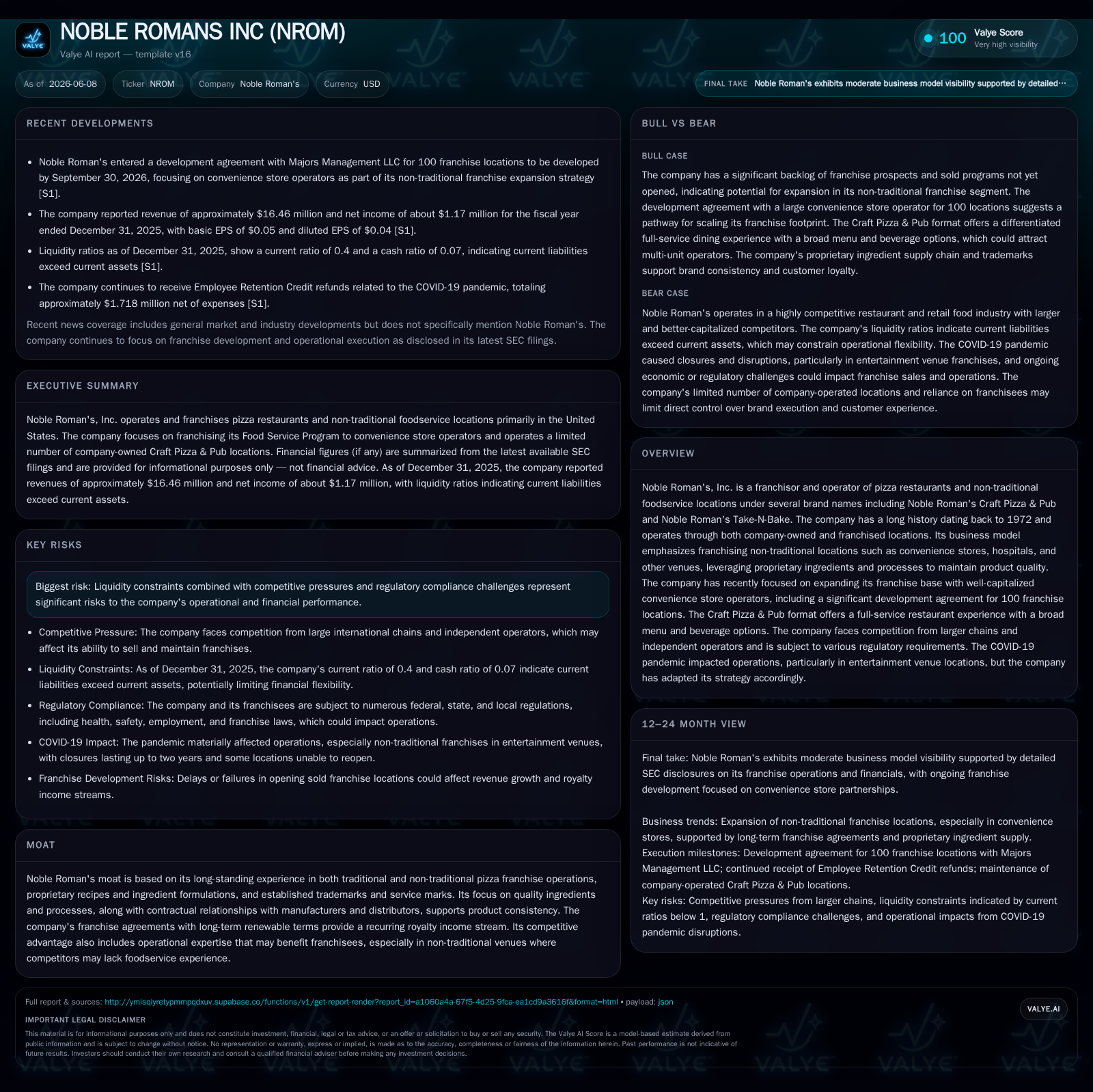
Noble Roman's has deepened its focus on franchising pizza operations within non-traditional venues, especially convenience stores, driving top-line revenue growth and improving profitability in 2025. The company's hybrid model combines recurring royalty income from long-term franchise agreements with limited company-operated full-service Craft Pizza & Pub locations. However, a deteriorated current ratio near 0.4 and substantial variable-rate debt mature by mid-2026 impose financial constraints. Competitive pressure from larger national chains and state-level franchise regulation further complicate execution. Key growth drivers include backlog conversions of sold but unopened units and large development agreements with major convenience store operators, offering measurable milestones in royalty revenue escalation. Prudence is warranted given liquidity risks and the imperative to successfully open new franchises amid seasonal sales variability.
Recent Operating Developments Highlight Franchise Momentum Amid Financial Strain
The latest quarterly filing ending September 30, 2025 reports higher revenues in company-owned non-traditional venues rising to $332,000 for Q3 compared to $218,000 a year earlier, with nine-month results showing a $921,000 increase from $693,000 in 2024 [S2]. Concurrently, segment expenses marginally declined reflecting disciplined cost management despite expansion. However, the company's liquidity picture remains strained; the current ratio plummeted to approximately 0.4 at September’s end from nearly double that level a year before, demonstrating elevated short-term liabilities vis-à-vis assets [S2][F1].
This juxtaposition of robust operational progress via broader franchise penetration against pronounced balance sheet vulnerabilities frames Noble Roman’s near-term execution landscape. While revenue traction validates strategic emphasis on scaled non-traditional location rollout—particularly within convenience stores—the liquidity constraints necessitate vigilant capital management.
Franchise-Focused Business Model Drives Recurring Revenue Streams
Noble Roman’s operates primarily through franchising its pizza concepts to non-traditional sites such as hospitals and most notably convenience stores under long-term agreements that often span ten years with renewal options [S1]. This contractual structure supports an annuity-like royalty income stream that underpins much of the company’s revenue stability. Proprietary ingredient formulations and standardized preparation processes preserve product quality across widely dispersed franchisees, reinforcing brand consistency.
The Craft Pizza & Pub concept embodies a full-service restaurant experience delivering an expanded menu and beverage offerings but is maintained as a limited base of company-operated stores designed as proof-of-concept for potential multi-unit franchise operators [S1]. This capital-light model leverages franchisees’ investment capabilities while minimizing corporate overhead burdens.
Revenue mechanics hinge upon initial franchise fees combined with recurring royalties calculated as percentages of franchisee gross sales volume. Therefore, key value drivers include growing the franchisee base (particularly in high-volume convenience store settings), maintaining consistent sales velocity at existing units despite seasonal headwinds, and managing operating expenses effectively to sustain margins.
Competitive Landscape Favors Niche Non-Traditional Platforms Amid Industry Intensity
Pizza foodservice remains fiercely competitive with dominant players like Domino’s and Papa John’s enjoying scale advantages in delivery infrastructure, branding budgets, and technological integration. By contrast, Noble Roman’s exploits a differentiated niche focusing on capital-constrained franchisees in non-traditional venues where turnkey foodservice solutions with simplified operational requirements appeal strongly [S1].
Regulations governing franchisor-franchisee relations further define this landscape; substantive state laws commonly restrict scope for termination rights or renewal refusals by franchisors, inducing operational complexity but also affording franchisees some contractual security [S1]. Against this backdrop, Noble Roman’s delivers competitive advantages through proprietary recipes ensuring strong product appeal coupled with extensive operational expertise tailored for non-standard retail environments.
This positioning enables Noble Roman’s to compete effectively on investment cost efficiency, labor simplicity, and distribution logistics relative to traditional pizza chains expanding into similar segments.
Growth Vectors Rooted in Backlog Conversion and Strategic Partnerships
A critical source of growth derives from execution against a backlog of sold but unopened non-traditional franchises alongside large-scale development agreements targeting up to 100 new convenience store locations [S1][S2]. These agreements reflect demand from well-capitalized convenience store owners increasingly seeking quality food offerings within their businesses post-pandemic.
Measured growth milestones involve tracking the pace at which these backlog units transition operationally from commitment to open status—directly correlating with incremental royalty revenue accrual—and monitoring early store performance metrics influenced by local traffic drivers.
Seasonal sales variability notably affects these dynamics; first-quarter periods typically register slower volume due to weather-related consumer behavior shifts and holiday timing both for traditional full-service pubs and non-traditional franchises [S1]. Operational support provided by Noble Roman’s to franchisees helps mitigate risk around initial ramp-up phases.
Risks From Tight Liquidity Conditions Coupled With External Pressures
The low current ratio (~0.4 as of September 2025) underscores acute liquidity risk stemming from current liabilities outpacing short-term assets, raising concerns about timely payment obligations without additional financing or operational cash flow improvements [S2][F1]. The sizable $6.1 million principal debt position dominated by a senior secured note carries an onerous interest cost linked to SOFR +9%, placing considerable strain on free cash flow ahead of June 2026 maturity requiring refinance or repayment strategies [S1].
Competition also imposes margin compression risk as larger national chains possess superior marketing firepower and entrenched consumer mindshare that can influence pricing dynamics adversely for smaller format franchise players [S1]. Regulatory complexity around jurisdiction-specific franchise laws demands persistent compliance vigilance lest contract enforceability be impaired.
These factors create an execution environment where measured growth must be balanced carefully against financing realities.
Monitoring Points Critical for Assessing Execution Trajectory
Going forward, close attention should be afforded to several key indicators:
- Progress in opening backlog franchise units particularly within convenience store channels,
- Renewal rates of existing franchises signaling brand loyalty and contractual durability,
- Operating margin trends segmented between franchised versus company-operated venues,
- Updates on refinancing or restructuring efforts regarding the Senior Note maturing June 30, 2026,
- Trading patterns impacted by weather/seasonality especially winter/holiday periods influencing same-store sales,
- Any material changes in regulatory frameworks affecting franchising rights or disclosure obligations across states.
Timely insight into these factors will clarify whether Noble Roman’s can sustain positive momentum while managing inherent financial risks.
Annual Financial Performance Synopsis: Profitability Improvement Despite Leverage Constraints
Historical performance (annual)
Capital returns and efficiency (annual)
Fiscal year 2025 results present solid operating income growth of approximately 63% year-over-year reaching $2.4 million accompanied by a swing into net profitability at $1.17 million compared to near breakeven previously [F1]. This advance reflects revenue growth near 8.7% amid tight expense controls and favorable leveraging effects associated with scale expansion primarily through royalties from increased franchise footprints.
Operating cash flow rose roughly 39% year-over-year to $1.24 million while capital expenditures remained subdued at $144 thousand supporting conservative reinvestment levels compatible with the capital-light franchising strategy [F1]. Total equity expanded above $3.4 million evidencing accumulated retained earnings support despite persistent modest leverage measured against equity capitalization.
In sum, financials underpin a narrative of cautious recovery boosted by structural improvements in underlying business economics tempered by significant refinancing imperatives.
Disclaimer: This analysis is based solely on information available from SEC filings dated through June 8, 2026 ([S1], [S2]) and company financial data ([F1]). It does not constitute investment advice or research views. All insights reflect interpretation grounded strictly in disclosed data without speculative assumptions or forward-looking predictions beyond stated company disclosures.
Disclaimer: This is research-only, informational analysis and not investment advice. It may include AI-generated interpretation and general industry context. Always verify important details using primary sources.

Comments