
Columbia Financial Advances Credit Risk Management Amid Regional Growth Initiatives
The latest quarter underscores Columbia Financial’s refined credit loss reserves alongside strategic moves to broaden its regional footprint.
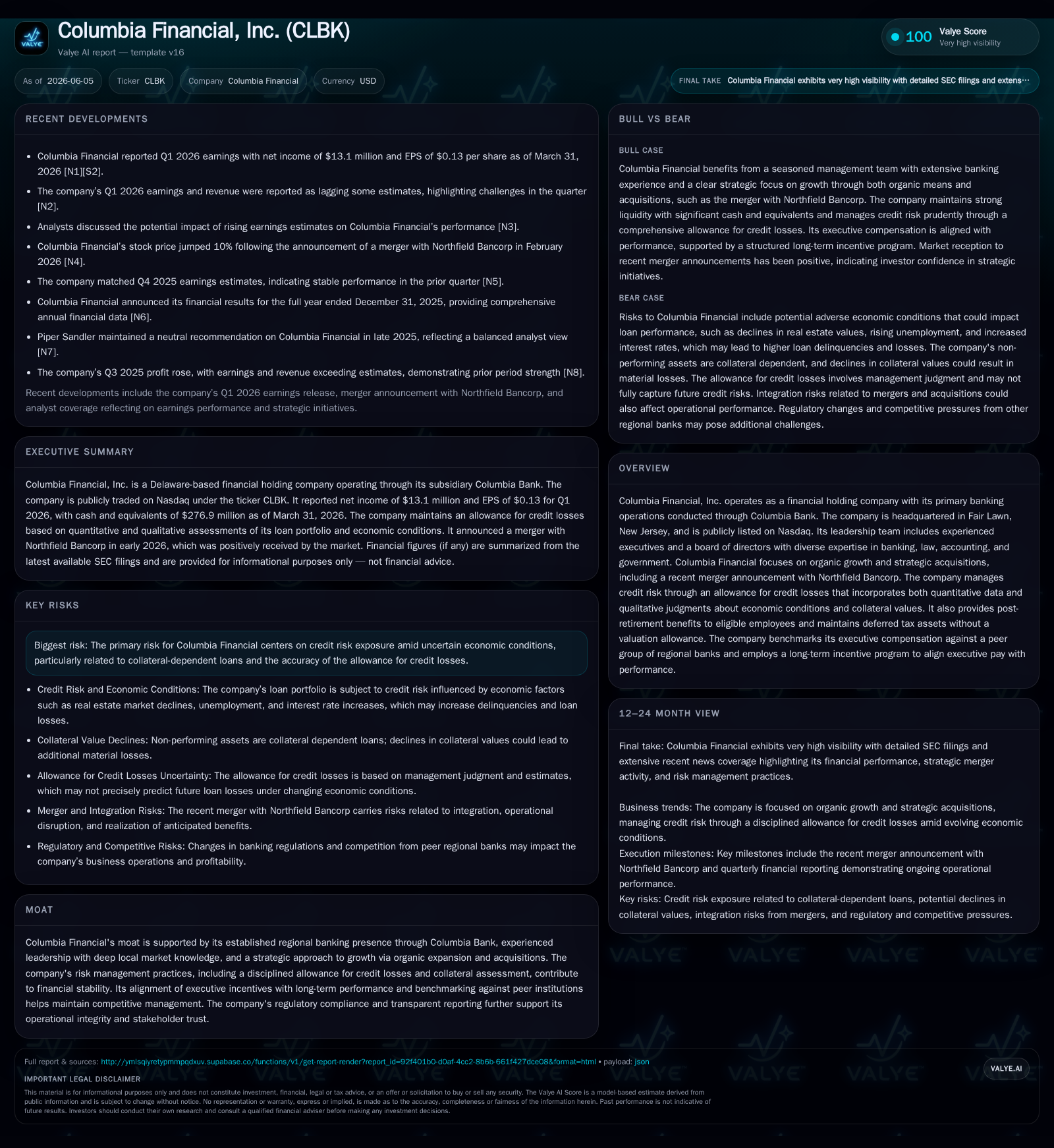
Columbia Financial’s Q1 2026 filing reveals enhanced allowance for credit losses incorporating qualitative overlays targeting portfolio risk nuances like large loan concentrations and collateral value shifts. This conservative stance on credit risk complements ongoing organic growth and the anticipated acquisition of Northfield Bancorp, signaling a dual focus on stability and expansion. The company’s revenue generation remains rooted in its regional banking operations through Columbia Bank, leveraging disciplined risk controls and a targeted deposit base. Going forward, key milestones include merger approvals and monitoring collateral appraisals, central to managing asset quality in a regionally competitive banking sector.
Latest Quarterly Operating Overview: Enhanced Credit Loss Reserves Reflecting Portfolio Nuances
In its May 11, 2026 Form 10-Q filing [S2], Columbia Financial detailed a more nuanced approach to its allowance for credit losses (ACL), layering qualitative adjustments atop quantitative models. Management specifically cites considerations for concentrations of large loan balances, delinquency trends, and segment-specific shifts in collateral values that traditional statistical reserves may not fully capture.
These proactive reserves are critical given that the majority of the company's non-performing assets remain collateral dependent. Annual reappraisals inform precise write-downs to fair collateral values less estimated sales costs, providing dynamic visibility into potential loss exposures. By integrating subjective judgments with hard data points—including individually analyzed loans—Columbia Financial reinforces its risk management framework aimed at stabilizing earnings during real estate valuation volatility.
Business Model: Regional Banking Focus with Integrated Risk Controls
Columbia Financial operates primarily through Columbia Bank, whose revenue streams stem from deposit gathering and diversified lending activities concentrated within the Northeast region [S1]. The firm generates income via net interest margin derived from loans and funded deposits while managing operational costs influenced by provisions such as post-retirement benefits accrued over employees' active service periods.
The bank’s disciplined credit evaluation process underscores loan quality preservation amidst growth efforts. Executive compensation governance aligns senior management incentives with long-term performance metrics benchmarked against peer regional banks, facilitating continuity and fostering strategic execution. Layered atop this model is an emphasis on organic portfolio development complemented by targeted acquisitions enhancing scale without compromising underwriting standards.
Industry Context: Competitive Pressures Among Northeastern Regional Banks
Within its Northeast regional bank cohort, Columbia Financial distinguishes itself through seasoned leadership possessing deep local market knowledge [S1]. The company's approach to ACL calibration aligns with broader industry shifts where peers incorporate qualitative overlays responding to recent economic challenges such as rising interest rates and real estate price movements.
Funding cost sensitivity is moderated by stable deposit bases likely reflecting conservative deposit beta dynamics typical of community-focused banks in this geography. This funding stability underpins steady net interest margins compared to competitors facing more volatile wholesale funding costs. Columbia's capacity to manage asset sensitivities without compromising capital adequacy permits responsive balance-sheet strategies tailored to evolving macro conditions.
Credit Quality and Collateral Assessment Practices: Sector-Native Risk Management Approaches
The latest disclosures reveal that most non-performing loans are secured by commercial or residential properties whose valuations are updated annually through appraisals [S2]. The company writes down these loans to their collateral’s fair value net of disposal costs—a practice that conveys realistic loss measurements but also ties potential charge-offs directly to fluctuations in real estate markets.
This dynamic necessitates vigilant monitoring as deleterious declines in property values could materially deteriorate loan recoveries. To offset these risks, management applies judgement informed by internal delinquency trends and external economic indicators when setting ACLs beyond mechanistic models. Recoveries on charged-off loans provide some offsetting benefit but cannot entirely mitigate adverse cycles. This layered provisioning approach evidences rigorous risk-adjusted asset quality management critical for sustaining financial health.
Growth Drivers: Organic Loan Expansion and Strategic Acquisition Pipeline
Columbia Financial’s growth ambitions hinge upon deepening loan penetration within existing markets while leveraging cross-selling capabilities to broaden customer relationships [S1]. Its recent announcement of merger approval conditions with Northfield Bancorp represents a significant acquisition poised to amplify scale and geographic reach immediately following the transition from mutual holding company structure.
Regulatory approvals remain a milestone watchpoint but management views this pipeline transaction as a logical extension of its strategic playbook emphasizing controlled growth balanced with credit discipline. Success here hinges on retaining core depositors post-merger while expanding commercial lending footprints amid competitive regional banking markets.
Risks and Constraints: Economic Sensitivities Impacting Loan Defaults and Collateral Values
The firm explicitly cites macroeconomic risks that could exacerbate credit losses including general economic slowdown, declining real estate prices, heightened unemployment rates, increasing vacancy levels on properties securing loans, as well as rising interest rates absent economic growth improvements [S2]. Each factor independently or synergistically impairs borrowers’ repayment ability pushing up delinquency rates.
These vulnerabilities translate directly into potential volatility in future ACL requirements since asset valuations underpin provision adequacy assessments. While management regards current reserves as appropriate given prevailing conditions, it cautions that reserve recalibrations may be necessary if forecast assumptions prove overly optimistic or if adverse external shocks ripple through its loan book.
Looking Ahead: Milestones in Credit Portfolio Monitoring and Deal Execution Timelines
Forward-looking focal points include continued annual appraisal updates which inform valuations underpinning non-performing asset write-downs—a key determinant of realized losses in upcoming periods [S3]. The pending merger’s closing timeline constitutes another critical event impacting future earnings trajectories via expanded scale effects.
Transparency in governance disclosures including material agreements with financial advisors like Keefe Bruyette & Woods further supports investor confidence during this transition phase [S3]. Regular stress testing of credit portfolios amid shifting macroeconomic backdrops will also provide measurable indications of emerging risk trends.
Financial Snapshot: Current Balance Sheet Position Supporting Strategic Flexibility
At quarter-end March 31, 2026, Columbia Financial held approximately $277 million in cash and equivalents against total debt near $1.24 billion resulting in net debt around $967 million [F1]. This liquidity profile offers a buffer supporting both organic growth initiatives and strategic acquisitions without immediate financing strain.
Deferred tax assets are recorded without any valuation allowance based on management’s judgment about future taxable income sufficiency [S2], signaling confidence in sustainable profitability outlooks despite current period provisioning impacts. The tight integration between risk provisioning practices and capital resource management demonstrates prudent stewardship amidst a competitive regional bank environment.
This analysis is grounded strictly on publicly filed information up to June 2026 regarding Columbia Financial's operating developments without extrapolation beyond validated disclosures. It is intended solely for informational purposes without investment research views or forecasts.
Disclaimer: This is research-only, informational analysis and not investment advice. It may include AI-generated interpretation and general industry context. Always verify important details using primary sources.

Comments