
Petco Health & Wellness' Q1 Performance and Refinancing Moves Signal Strategic Rebalancing
Petco's latest quarter reveals widening losses and liquidity tightness amid debt refinancing to support its integrated pet care growth strategy.
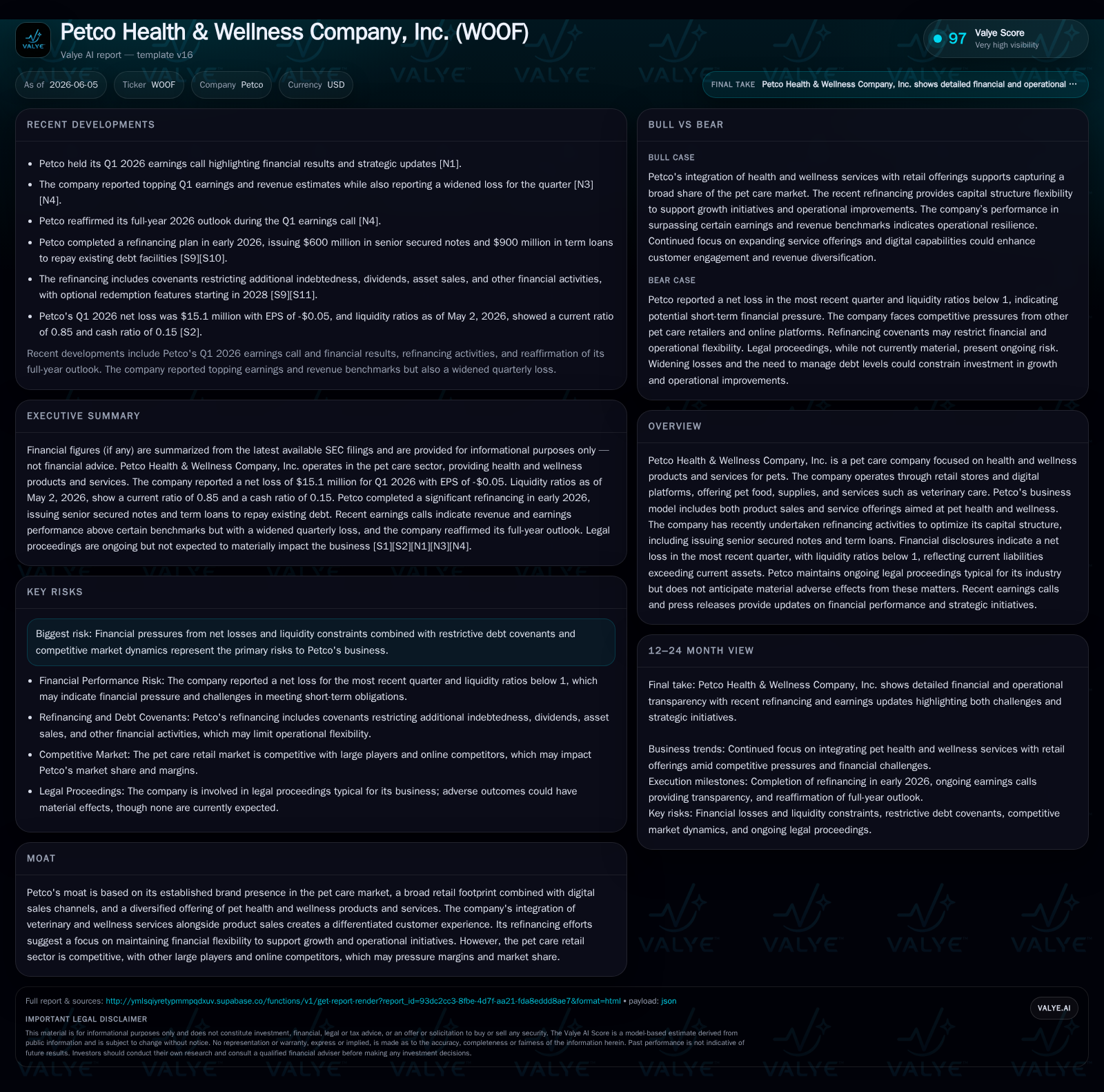
In its Q1 2026 filing, Petco Health & Wellness reported a widening net loss despite stable revenue growth, underscoring persistent margin pressures. The company’s liquidity position remains strained with a current ratio below 1, reflecting working capital challenges. Recent refinancing through senior secured notes and term loans aims to optimize capital structure but leaves leverage elevated, constraining financial flexibility. Petco’s business model combines retail product sales with veterinary and wellness services, positioning it uniquely in a competitive pet care retail market dominated by both specialty and eCommerce players. Growth hinges on expanding service attach rates and strengthening omnichannel penetration, while margin recovery and improved cash flow are key near-term hurdles.
Quarter Review: Operating Highlights and Cash Flow Dynamics
Petco's Q1 2026 filing dated June 5 reveals a continuation of financial headwinds as the company grappled with a widening net loss against a backdrop of stable revenue growth [S2][S3]. The detailed balance sheet indicates cash and cash equivalents totaling approximately $167 million juxtaposed with current liabilities exceeding $1.13 billion, producing a current ratio of roughly 0.85 — signaling working capital strain [F1]. This liquidity tightness reflects ongoing challenges in balancing inventory investment, receivables management, and short-term obligations.
Despite generating an operating income near $120 million in the most recent comparable period, net profitability remains thin with a net income around $9 million as of January-end [F1], highlighting margin pressure likely tied to competitive pricing dynamics and elevated operating expenses associated with health services.
The company maintains disclosures around routine legal litigations standard within retail but reports no material contingent liabilities that could disrupt near-term operations [S7]
Petco’s Business Model: Integrating Products with Veterinary and Wellness Services
Petco operates an integrated pet health ecosystem combining traditional retail distribution of pet food and supplies alongside veterinary care clinics, grooming services, and wellness programs embedded both inside stores and through digital platforms [S1]. This two-pronged approach facilitates recurring customer engagement beyond single product purchases — creating 'stickiness' via subscription-like service models.
The model demands sophisticated coordination between physical stores’ inventory management and clinical service delivery personnel. While product sales traditionally offer higher volume but lower margins, veterinary services contribute higher-margin revenue streams albeit with more complex cost structures driven by professional labor and regulatory compliance requirements.
Digital sales complement brick-and-mortar presence by enhancing reach and convenience; yet the fulfillment costs in omnichannel distribution remain nontrivial due to assortments ranging from consumables to specialty health products—necessitating tighter inventory turns and shrink controls for profitability gains.
Competitive Environment in Pet Health: Evolving Retail Dynamics and Peer Positioning
Petco faces competition from major online pet specialists like Chewy, which leverages advanced AI-driven operational efficiencies aimed at structural cost reductions in fulfillment centers [N7]. Chewy's scale-centric model enables aggressive pricing strategies that pressure Petco’s physical-retail-oriented pricing power.
Meanwhile, Petco differentiates through its combined retail-health service offering — a niche less penetrated by pure-play eCommerce competitors though challenged by broader discount grocers encroaching into premium private-label pet products at lower cost points. Maintaining breadth in assortment without compromising margins is an ongoing balancing act.
Peer benchmarking suggests that while Petco has advantages in store density across key US markets enabling impulse and convenience-driven sales, its eCommerce penetration lags behind leading pure online competitors. Closing this gap is essential for reinforcing pricing resilience.
Drivers of Growth: Expanding Service Footprint and Omnichannel Engagement
Growth momentum rests heavily on scaling the 'service attach rate,' i.e., the proportion of retail customers also utilizing Vet & wellness services—a key lever for deeper wallet share per customer visit [S1][N2]. Facilities expansion coupled with targeted marketing campaigns are pivotal in driving this metric upward.
Enhanced digital engagement aims to increase average basket sizes through recurring subscriptions for pet nutrition plans or preventive care packages — common membership economics typical within specialty retail sectors that improve customer lifetime value.
Omnichannel sales growth supports better inventory turnover by funneling excess stock through digital channels while spreading fulfillment costs across larger order volumes—but managing last-mile logistics costs remains complex given varied product weights and sensitivities.
Challenges Ahead: Liquidity Constraints, Margin Pressure, and Consumer Behavior
Petco's liquidity profile remains pressured given total debt nearing $1.5 billion offset only partially by cash reserves (~$167 million) resulting in significant net debt (circa $1.32 billion) levels as measured end-Q1 2026 [F1]. This leverage limits discretionary spending ability on capex or promotional investments amid competitive threats.
Current liabilities exceeding current assets underscore potential short-term funding risk heightened by supply chain disruptions or unexpected expense spikes associated with clinical services staffing or compliance matters.
Margins are further squeezed by consumer price sensitivity exacerbated by increasing online competition offering promotional depth unsupported by physical stores’ fixed overheads. Thus consumer elasticity toward premium multiservice bundles may test pricing power elasticity in the near term.
Upcoming Catalysts: Guidance Updates, Store Performance Metrics, and Refinancing Impacts
Key near-term indicators include same-store sales performance — often reflecting foot traffic trends post-pandemic normalization — alongside service revenue expansion signaling improvement in attach rates [N2][S3]. Management’s commentary from recent earnings calls emphasizes execution discipline on these fronts as critical milestones.
Monitoring progress against these metric targets will provide early signals on strategic rebalancing success.
Brief Financial Synopsis: Balance Sheet Leverage and Profitability Snapshot
As of May 2, 2026, Petco's financial posture includes approximately $166.8 million in cash equivalents counterbalanced against $1.13 billion in current liabilities yielding a sub-one current ratio (~0.85), evidencing ongoing working capital constraints [F1]. Total debt stands near $1.49 billion with net debt approximating $1.32 billion after accounting for cash holdings [F1].
Operating income recorded was about $120 million (January period), yet net income remains modest positive at approximately $9 million (period end January) highlighting continued profitability pressures under current cost structures [F1]
This financial setup underscores Petco’s dual challenge: managing leverage prudently while investing sufficiently in its integrated services model to sustain competitive differentiation within an increasingly digitized pet care marketplace.
Disclaimer: This analysis is based solely on publicly available information including SEC filings up to June 5, 2026, news reports, and sector context analysis. It does not constitute investment advice or a research view regarding any securities mentioned.
Disclaimer: This is research-only, informational analysis and not investment advice. It may include AI-generated interpretation and general industry context. Always verify important details using primary sources.

Comments