
U S Global Investors Faces Financial Restatement Amid Earnings Uncertainty
A recent internal controls failure has triggered a financial restatement and spotlighted operational risks in U S Global Investors’ thematic ETF business.
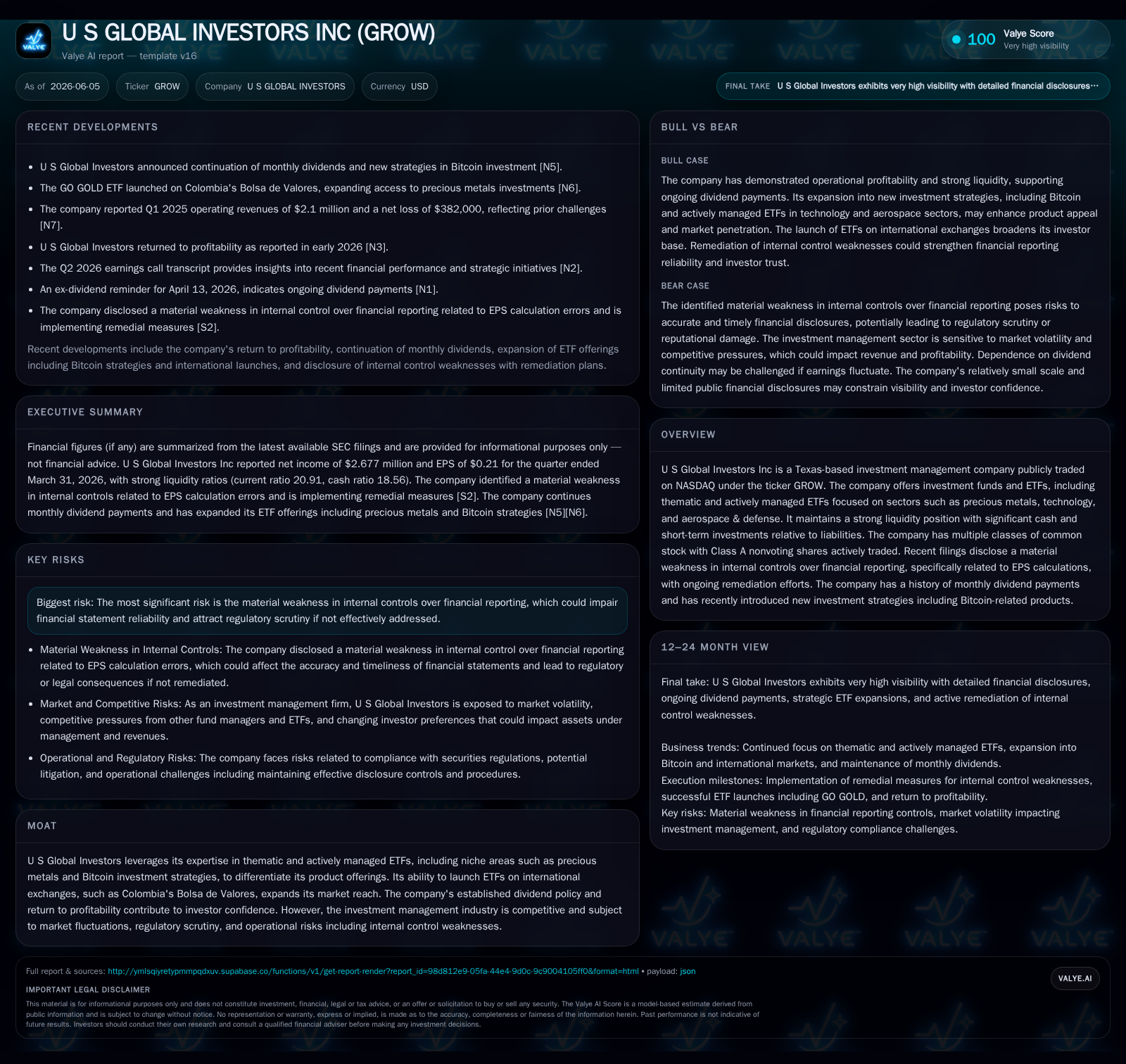
U S Global Investors disclosed a material weakness in internal controls over earnings-per-share reporting, leading to a restatement of its Q1 2026 financials. This development highlights governance challenges amid the company's ongoing expansion into thematic ETFs including precious metals and Bitcoin strategies. The firm maintains strong liquidity but faces investor scrutiny as it works to remediate control deficiencies while pursuing growth through innovative fund launches and international ETF distribution.
Quarterly Filing Restatement and Internal Control Challenges
U S Global Investors’ May 2026 quarterly filing (Form 10-Q) disclosed a critical accounting misstep related to the computation of weighted-average shares outstanding used in earnings per share (EPS) calculations [S2]. Subsequently, on May 29, 2026, the Audit Committee concluded that this error—a formula omission that improperly excluded approximately 700,000 shares—caused previously issued financial statements for Q1 2026 to be unreliable. This led to an announced intent to restate those statements [S3][S8]. Although net income and revenue figures themselves were unaffected, basic and diluted EPS were overstated by $0.02 for the quarter.
This material weakness reflects a failure in operating review controls over spreadsheet completeness and precision. Management is now implementing remediation measures including enhanced review procedures and formula integrity checks. This development draws attention to the operational risks inherent even in smaller public investment management firms where resource constraints can strain internal control frameworks. Transparency around these issues is critical given investor reliance on accurate EPS data.
Strategic Overview: Thematic ETF Business Model and Product Innovation
U S Global Investors operates as an investment management firm concentrating primarily on actively managed thematic exchange-traded funds (ETFs) rather than passive index replication. Its specialized product suite targets niche sectors such as precious metals—including gold mining—and extends into technology, aerospace & defense industries. More recently, it has ventured into Bitcoin-related investment vehicles designed to capitalize on growing interest in digital assets [S1]
Revenue is predominantly generated through management fees on assets under management (AUM), which grow with successful fund launches and sustained investor inflows. Active management differentiates U S Global from many competitors relying solely on passive ETFs by seeking alpha via sector expertise and tactical asset allocation decisions.
The company employs multiple classes of stock; notably Class A nonvoting shares are publicly traded with approximately 10.9 million outstanding shares reported [S1]. U S Global also maintains a consistent history of monthly dividend payments, appealing to income-focused investors appreciative of steady cash distributions despite market volatility.
Competitive Landscape and Market Positioning within Boutique Asset Managers
Within the boutique asset management space, U S Global competes by focusing on thematically concentrated funds where subject-matter expertise can add value beyond broad market exposure. Pricing power is somewhat constrained by scale limitations relative to larger asset managers or giants emphasizing passive products with ultralow fees.
The firm’s ability to launch ETFs internationally—such as offerings listed on Colombia’s Bolsa de Valores—broaden its market reach beyond traditional US investor bases [S1]. However, competition from larger specialists or diversified firms entering niche pockets remains intense.
Regulatory oversight also poses ongoing challenges for boutique firms due to resource demands imposed by compliance requirements. For U S Global, recent control failures underline how governance robustness can materially impact market perception amidst wider industry scrutiny.
Growth Catalysts: Product Expansion and International Distribution
New ETF product launches stand as key growth drivers for U S Global Investors. Their entrance into Bitcoin-themed products taps increasing institutional and retail demand for crypto exposure managed within regulated fund structures [S1]. Additionally, smart beta strategies focused on targeted risk exposures have been introduced as part of ongoing innovation efforts.
Geographical diversification through listings outside the US offers potential for expanding AUM further while adding currency and regional investor base variety—both critical for sustaining fee income during cyclical downturns.
Monthly dividends also form part of their growth narrative by attracting yield-oriented investors who may value predictable payouts amid equity market gyrations [S17]. Retaining this shareholder segment requires balancing dividend policy against volatile profitability.
Risks & Constraints Highlighted by Reporting Issues and Market Competition
The primary risk spotlighted by recent filings centers on the identified material weakness in internal controls over financial reporting tied specifically to EPS computation errors [S3][S8]. Such deficiencies expose U S Global to possible regulatory inquiries, investor skepticism regarding financial transparency, and reputational damage that can impair capital raising or asset retention.
Market competition from larger asset managers offering broader scale advantages puts pressure on fund fees and limits margin expansion potential. Moreover, thematic investment demand can be sensitive to macroeconomic cycles or sector rotation trends—introducing structural volatility factors affecting AUM growth.
Limited scale compared to mega-ETF providers constrains pricing flexibility; thus, sustaining profitability demands tight cost control alongside effective growth execution.
Near-Term Milestones to Monitor for Operational Stability and Growth
Investors should closely watch the timeline and progress of remediation efforts addressing the control breakdowns identified in Q1 filings. The release of amended financial statements following restatement will provide transparency into corrected EPS figures.
Tracking inflows into newly launched Bitcoin strategy ETFs will shed light on market acceptance of this newer product line. Equally important is monitoring dividend payout continuation amidst uncertain earnings dynamics.
Further quarterly results post-restatement will be critical indicators of whether operational reforms translate into improved financial statement reliability.
Financial Health Snapshot: Liquidity Strength Amid Earnings Uncertainty
Despite earnings-related reporting hurdles, U S Global Investors retains a strong liquidity profile at quarter end March 31, 2026 [F1][S2]
The company operates without long-term debt obligations per current disclosures enhancing financial flexibility during operational recovery phases [F1]
-- This analysis integrates official SEC filings from May-June 2026 alongside companyfacts data as of March 31, 2026. All data cited stems strictly from disclosed sources reflecting verifiable operations without speculative extrapolation.
Disclaimer: This is research-only, informational analysis and not investment advice. It may include AI-generated interpretation and general industry context. Always verify important details using primary sources.

Comments