
Aeries Technology’s Financial Balancing Act Reflects Strategic Shifts in Global Capability Centers
Recent filings reveal Aeries Technology’s liquidity pressures amid client contract losses, underscoring challenges to its modular AI-driven GCC consulting model.
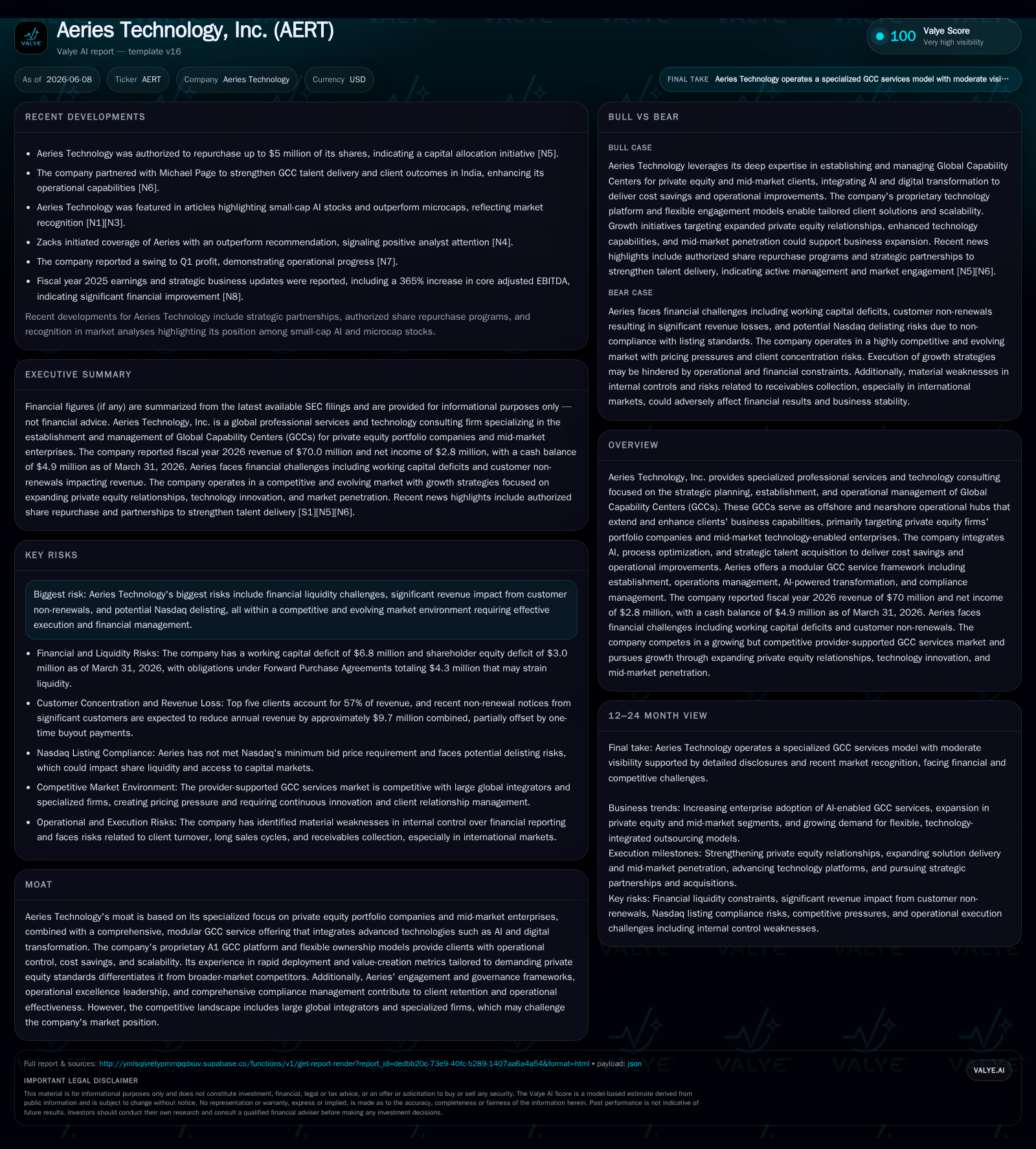
In its June 2026 event and quarterly filings, Aeries Technology reported a modest $4.9 million cash balance and a current ratio below one, signaling near-term liquidity constraints. The company faces significant revenue headwinds from major client non-renewals totaling nearly $6 million annually, offset only partially by buyout payments, which exacerbates financial uncertainty despite net income gains. Aeries continues to specialize in establishing and managing Global Capability Centers (GCCs) for private equity portfolio companies and mid-market tech enterprises, leveraging AI integration and flexible ownership models as key differentiators. However, intense competition from global integrators and sector peers, combined with long sales cycles and customer concentration risks, temper growth prospects. Near-term execution and funding strategies will be critical to preserve operational continuity and capitalize on the expanding demand for AI-enabled offshore innovation hubs.
The June 8, 2026 Form 8-K ([S3]) supplements the February quarter filing revealing a cash balance of $4.9 million as of March 31, 2026, against current liabilities exceeding $30 million ([F1], [S2]). With current assets totaling approximately $23.9 million but current liabilities at roughly $30.7 million, the resulting current ratio stands at a constrained 0.78 ([F1]), signaling tight near-term working capital coverage.
Compounding these challenges is the announced non-renewal of a major customer contract effective June 30, 2026, precipitating an estimated $5.7 million annual revenue hit ([S8]). Although this customer will pay a one-time buyout of about $2.7 million to Aeries, this sum only partially buffers top-line attrition moving forward. This loss follows a prior sizable non-renewal from April 2025 reducing revenue by $4 million annually ([S11]). The cumulative effect heightens concerns over revenue sustainability given the company’s concentrated client base, where three clients contributed nearly 40% of fiscal year 2026 revenues ([S15]).
Meanwhile, despite these headwinds, Aeries reported net income of $2.8 million and operating income of $4.5 million for the fiscal year ended March 31, 2026 ([F1]), demonstrating operational profitability under strain. However, the company also carries substantial legacy debt—approximately $1.8 billion net debt per last available data ([F1])—a figure predating recent quarters but indicative of significant leverage requiring active management.
Market reception remains volatile although shares have climbed approximately 46% year-to-date according to nascent market commentary ([N1]). The positive price movement appears detached from fundamental liquidity constraints flagged in filings but signals some investor optimism about long-term strategic positioning or potential capital raises.
Aerie’s Business Model: Specialized GCC Services Fueled by AI and Flexible Ownership
Aeries Technology operates distinctly as a professional services firm specializing in the design, launch, and management of Global Capability Centers (GCCs). These centers act as offshore or nearshore extensions enhancing clients’ business capabilities through cost-efficient talent deployment and operational governance ([S1]). Target customers are primarily private equity portfolio companies and mid-market technology-enabled enterprises seeking scalable innovation hubs with embedded advanced technologies like AI.
The company’s revenue streams derive mainly from consulting fees tied to strategic GCC planning, establishment project management, ongoing operations oversight, compliance administration including transfer pricing risks mitigation, and technology-enabled transformation services ([S1], [S15]). A notable element is Aeries’ proprietary AI-focused GCC platform which integrates process automation workflows aimed at reducing turnaround times while elevating accuracy across enterprise systems. This digital-first approach is coupled with adaptable ownership structures such as Build-Operate-Transfer (BOT) models allowing clients to calibrate control levels based on evolving requirements.
Crucially, this modular service design enables differentiation in an increasingly commoditized services environment by embedding talent acquisition strategy aligned with artificial intelligence expertise, meeting rising enterprise demands for domain-specific AI skills in GCCs ([S1]). Moreover, governance frameworks ensure clients maintain strategic authority over operations while benefiting from managed service efficiencies.
Industry Dynamics: The Competitive Energies Around Global Capability Centers
The GCC market occupies an evolving space characterized by strong competitive tension between large-scale global systems integrators (GSIs) offering broad outsourcing portfolios and smaller specialized consultancies like Aeries that provide targeted expertise for high-demand niches such as private equity-led transformations ([S1]). While GSIs wield scale advantages enabling competitive pricing power across extensive engagements, they often lack nimbleness in tailoring AI-infused solutions that meet sophisticated PE performance benchmarks.
Switching costs within this arena hinge heavily on operational governance design—clients entrenched in flexible ownership schemes or BOT arrangements face material disruption switching providers due to bespoke integrations involving workforce planning, compliance matrices including transfer pricing audits across jurisdictions like India and Mexico, and embedded digital platforms ([S1], analysis). Thus retention dynamics favor providers able to rapidly deploy tailored AI talent while maintaining transparent value metrics.
Pricing pressure persists as commoditized elements such as routine offshore labor arbitrage saturate market offerings forcing margins downwards; however, firms like Aeries that emphasize workflow reengineering powered by proprietary AI capabilities can command differentiated rates reflective of measurable efficiency gains following transformation initiatives ([S15]).
Growth Ambitions Against Financial Headwinds
Aeries articulates several strategic growth levers designed to capitalize on rising private equity investments into GCCs—particularly those emphasizing digital agility via AI/ML talent deployment frameworks prevalent in regions with cost advantages like India hosting over 250,000 AI/ML professionals across more than 1,200 GCCs ([S1]). Expanding PE relationships through focused marketing efforts and increased salesforce presence in core geographies like North America are key priorities intended to accelerate deal flow despite lengthy selling cycles inherent to major GCC projects ([S15]).
However, recent customer contract terminations introduce acute revenue volatility risking derailed expansion plans without rapid replacement orders or upsell success among existing accounts ([S8], [S11]). Talent acquisition challenges for high-caliber AI professionals further elevate execution risk given industry-wide shortages reducing capacity expansion speed critical to integrating new mandates cruise-speed deployment implied in growth ambitions.
Previous notices of client terminations forecasting multi-million-dollar revenue declines corroborate this risk’s materiality.
Operational hurdles include scaling international operations predominantly in India and Mexico susceptible to regulatory shifts impacting transfer pricing norms or labor policies; compliance failure could induce fines or harm reputation undermining brand cemented among demanding PE clientele seeking partnership stability ([S1], [S4]). Finally limited public company management experience coupled with intense sector rivalry demands flawless execution raising governance scrutiny.
Key Indicators and What to Watch Going Forward
Near-term market watchers should focus sharply on client renewal announcements subsequent to the June 30 contract expiry marking a pivotal test of retention effectiveness or damage mitigation via onboarding replacements ([S3], [N1]). Signs of successful ramp-up in AI platform integration inside active GCC deployments will serve as tangible proof points for innovation led differentiation supporting higher margin capture potential amidst competitive pressure (analysis).
Stock price movement remains a barometer reflecting shifting investor sentiment tied not just to fundamental progress but also external sector momentum influencing appetite for microcap technology services stocks referenced in recent analyst coverage([N2]).
Financial Overview: Current Liquidity Status in Context
The balance sheet depicts material constraint: cash resources of approximately $4.9 million as of March 31, 2026 ([F1]) cover only a fraction of short-term liabilities totaling about $30.7 million ([F1]), leading to a working capital deficit and a current ratio of 0.78 ([F1]). Total debt remains substantial at approximately $1.8 billion net debt as of September 30, 2023 ([F1]), underscoring significant leverage that requires active management.
Management’s proactive tasks emphasize cost rationalization coupled with capital raising yet no assurance exists these will fully offset pressing maturities compressing runway available before possible liquidity challenges arise.
This analysis is based solely on publicly filed documents including Forms 8-K, 10-Q, and Annual Reports filed through June 8th, 2026 alongside contemporaneous market commentary. It does not constitute investment advice but rather aims to illuminate critical operating developments shaping Aeries Technology's strategic horizon amidst sector evolution.
Disclaimer: This is research-only, informational analysis and not investment advice. It may include AI-generated interpretation and general industry context. Always verify important details using primary sources.

Comments