
Graham Corporation Expands Precision Mixing and Foil Bearing Capabilities After Strategic Acquisitions
Recent acquisitions of FlackTek and Xdot reshape Graham’s product scope, supporting a strategic shift into diversified mission-critical markets beyond energy.
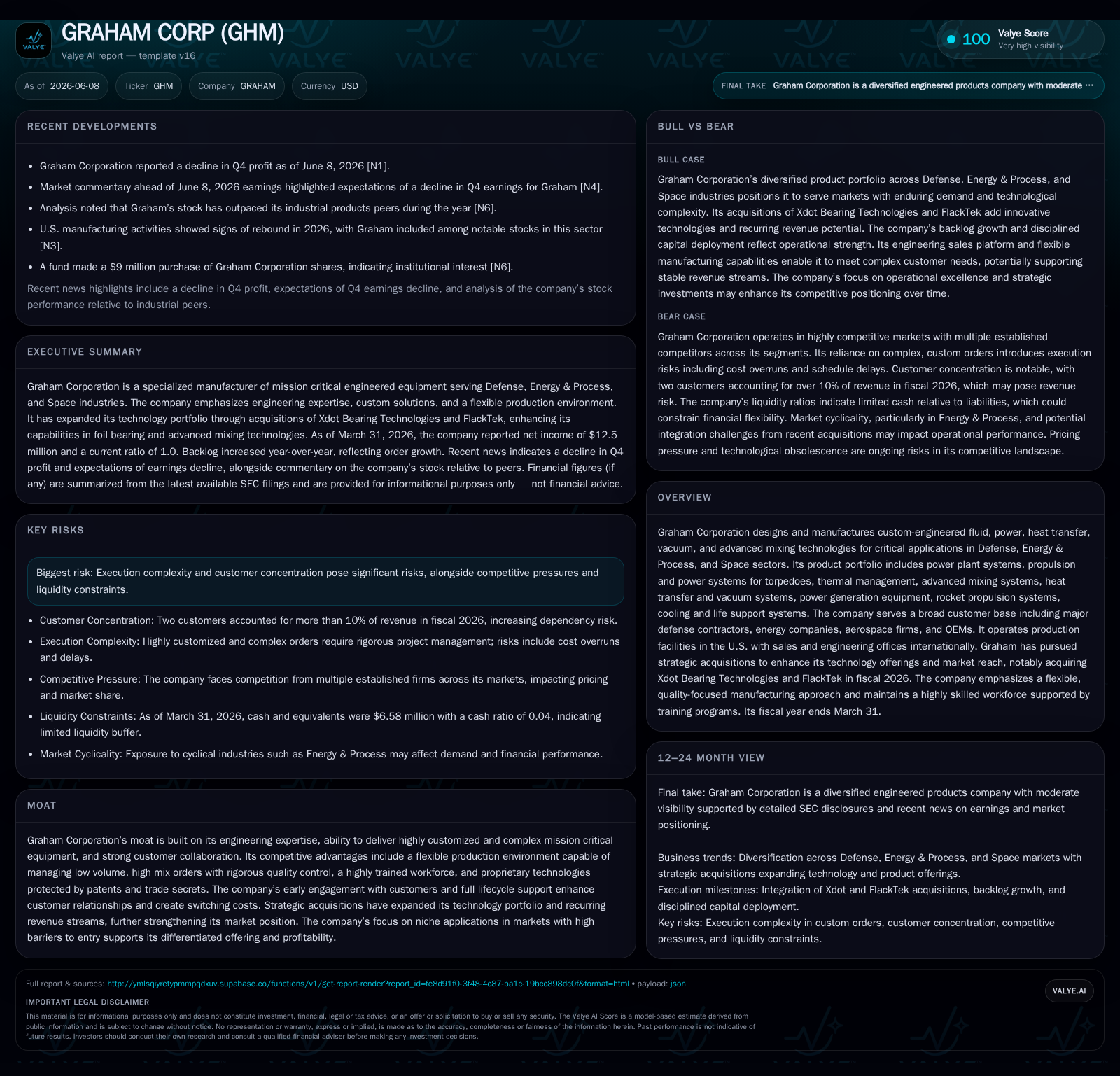
Graham Corporation’s latest quarterly filing highlights its transformative acquisitions of FlackTek and Xdot, expanding its engineering-led portfolio into precision mixing and foil bearing technologies. These moves diversify revenue streams away from the historically cyclical energy sector into defense and space, where high compliance and customization create robust barriers to entry. Backlog growth coupled with recurring consumables revenue positions the company for more stable demand in fiscal 2027. Execution risks around integration and customer concentration remain significant considerations.
Recent Quarterly Update: Acquisitions Reframe Growth Outlook
In Graham Corporation's fiscal 2026 fourth quarter filing [S2] and subsequent event disclosures [S3], the company reported completing two strategic acquisitions that materially reconfigure its market presence. The October 2025 acquisition of Xdot Bearing Technologies—a specialist in foil bearing design—was integrated into Graham’s turbomachinery subsidiary Barber-Nichols (BN), enhancing capabilities in high-speed rotating machines critical for aerospace propulsion markets. Though Xdot’s annual sales are modest (~$1 million), its proprietary technology complements BN’s existing offerings, opening avenues into new applications requiring precision aero engine components [S1], [S5].
In January 2026, Graham acquired FlackTek Manufacturing for $37 million including stock consideration [S1], [S5]. FlackTek’s patented bladeless centrifugal mixers deliver precision mixing with faster cycle times and higher product consistency compared to traditional methods. Its addressable markets span from adhesives to aerospace materials processing. Critically, FlackTek has an installed base generating recurring demand for consumables and service contracts, adding a new dimension to Graham’s revenue profile beyond project-based hardware sales. This move broadens Graham’s industrial processing footprint with technology serving defense laboratories to commercial R&D centers [S1], [S5].
These acquisitions signify a deliberate pivot from Graham’s legacy cyclicality tied to energy sector project flows toward a more balanced exposure emphasizing defense and space segments known for longer cycle times but more stable order patterns.
Business Model: Engineering Complex, High-Compliance Mission Critical Solutions
Graham Corporation operates a specialized engineering platform focused on the design and manufacture of custom fluid flow, power generation, heat transfer, vacuum, and advanced mixing systems for mission-critical uses across Defense, Energy & Process industries, and Space sectors [S1], [S16]. The company derives revenue primarily by delivering highly engineered-to-order equipment that demands deep technical collaboration at project start-up phases.
Central to Graham’s moat is its early engagement approach with customers who require not only fabrication but also integration insights to optimize system performance. This has cultivated sticky relationships amplified by full lifecycle support including training, troubleshooting, upgrades, and consumables supply—especially now expanded through FlackTek’s consumable-driven business model.
Further differentiation arises from Graham's flexible production environment optimized for low volume but technically complex orders with frequent specification changes midstream—a typical scenario in aerospace or naval propulsion programs where rigorous regulatory standards apply [S16]. This agility contrasts with higher volume industrial manufacturing peers lacking such customized depth
Proprietary technologies protected by patents (e.g., FlackTek’s MEGA™ system) preserve pricing power within these niche sectors given the specialized nature of applications involving nuclear submarines or commercial space life-support systems [S24]. This structure positions Graham favorably against commoditized competitors struggling to match its engineering breadth.
Industry Structure and Competitive Position: Navigating Defense, Energy Transition, and Industrial Processing
Graham operates within a fragmented ecosystem dominated by suppliers of engineered components for defense propulsion (competing against PCC, Triumph Aerospace) as well as providers of industrial mixing solutions post-FlackTek acquisition. The competitive basis includes technology sophistication, price/performance balance, delivery reliability, and reputation for compliance under stringent military or aerospace certifications [S6].
This industry is characterized by significant barriers to entry due to the specialized knowledge required for high-tolerance manufacturing, product qualification protocols dictated by end-user specifications (e.g., U.S. Navy or NASA requirements), and long customer qualification cycles fostering relationship stickiness.
Cyclicality risk diminishes as Graham pursues diversification beyond conventional oil refining or power generation projects toward defense contracts such as nuclear submarine propulsion systems—areas benefiting from sustained government spending plans—and space exploration programs encompassing rocket propulsion thermal management where project longevity supports backlog durability ($533 million backlog at March 31, 2026) [S11]
Emerging recurring revenues driven by FlackTek’s consumables portfolio complement project sales and help smooth revenue volatility characteristic of capital equipment cycles within energy markets.
Growth Drivers: Market Diversification, Recurring Revenue Expansion, Strategic Portfolio Enhancements
Growth at Graham is structurally anchored in three pillars:
Market Diversification: A strategic migration from energy-heavy revenues toward Defense (60% of FY26 sales) plus expanding Space segment presence provides resilience through stable government contracts across vessel construction/retrofit programs (CVN aircraft carriers; SSN fast-attack submarines) alongside commercial satellite cooling platforms [S16], [N1].
Recurring Revenue Expansion: Acquisition of FlackTek introduces robust recurring flows tied to accessories and maintenance products servicing an installed base across multiple industries—from battery manufacturers to defense labs—thereby increasing revenue visibility beyond one-time equipment sales [S1], [S5].
Strategic Portfolio Enhancements: The integration of Xdot foil bearing tech strengthens Barber-Nichols’ turbomachinery line enabling penetration into cutting-edge aerospace turbine markets requiring lightweight frictionless bearings ideal for high-speed environments; similarly P3 Technologies’ magnetic pump innovations enrich fluid handling offering [S24].
Integration of acquired entities adds organizational complexity requiring successful cultural assimilation while maintaining quality standards critical for defense certification processes [S2], [F1].
Customer Concentration: With two customers accounting each for more than 10% of revenue in FY26—primarily linked to naval contracts—any disruption or reprioritization poses meaningful revenue volatility 17 [S16]
Liquidity Profile: Corporate cash balances of approximately $6.6 million against net debt near $4.3 million provide moderate cushion, while the current ratio of about 1x indicates working capital is tightly managed amid growth initiatives [F1], [S2].
Sophisticated risk management will be crucial as the company scales its upgraded portfolio.
What to Watch Next: Order Book Trends, Operational Execution Milestones, Earnings Guidance
Investors should monitor several key indicators in the near term:
Updates to funded backlog published alongside supplemental disclosures post FY26 results will indicate whether recent diversification efforts translate into sustainable order wins beyond the energy sector backlog base [S3]
Progress on integrating FlackTek’s recurring revenue model into financial reporting will provide insight into margins expansion potential amid scale economies.
Operational metrics reflecting production efficiency improvements within BN + Xdot synergy initiatives will test management's ability to leverage proprietary technologies into profitable new market segments.
FY27 guidance commentary due from upcoming earnings calls will be critically scrutinized for signs of accelerated revenue ramp or margin pressures associated with acquisitions integration costs or raw material inflation headwinds [N6]
Financial Overview: Stability Amid Transition
Graham reported operating income of approximately $15 million on revenues near $22 million for fiscal 2026 ending March 31st [F1]. Net income stood roughly at $12.5 million illustrating solid profitability amid transition. Cash on hand was about $6.6 million against estimated net debt near $4.3 million using last available debt metrics demonstrating moderate leverage levels supportive of ongoing capital investments yet requiring careful working capital management given the current ratio around one consistent with low volume/high mix operations [F1], [S2].
The financial profile underscores a company balancing solid core earnings while investing strategically in evolving market exposure away from cyclicality inherent in traditional energy infrastructure equipment sales.
This analysis reflects information available as of June 2026. It emphasizes operational developments anchored in SEC filings without investment advice or projections. Graham’s transformation toward diversified high-margin engineered solutions merits attention given current market trends favoring specialized mission critical technologies over commoditized energy sector products.
Disclaimer: This is research-only, informational analysis and not investment advice. It may include AI-generated interpretation and general industry context. Always verify important details using primary sources.

Comments