
Vail Resorts Reports Seasonal Revenue Pressure in Latest Quarter Despite Portfolio Strength
Q3 2026 results highlight the impact of seasonal visitation declines on Vail Resorts’ Mountain and Lodging segments despite diversified operations.
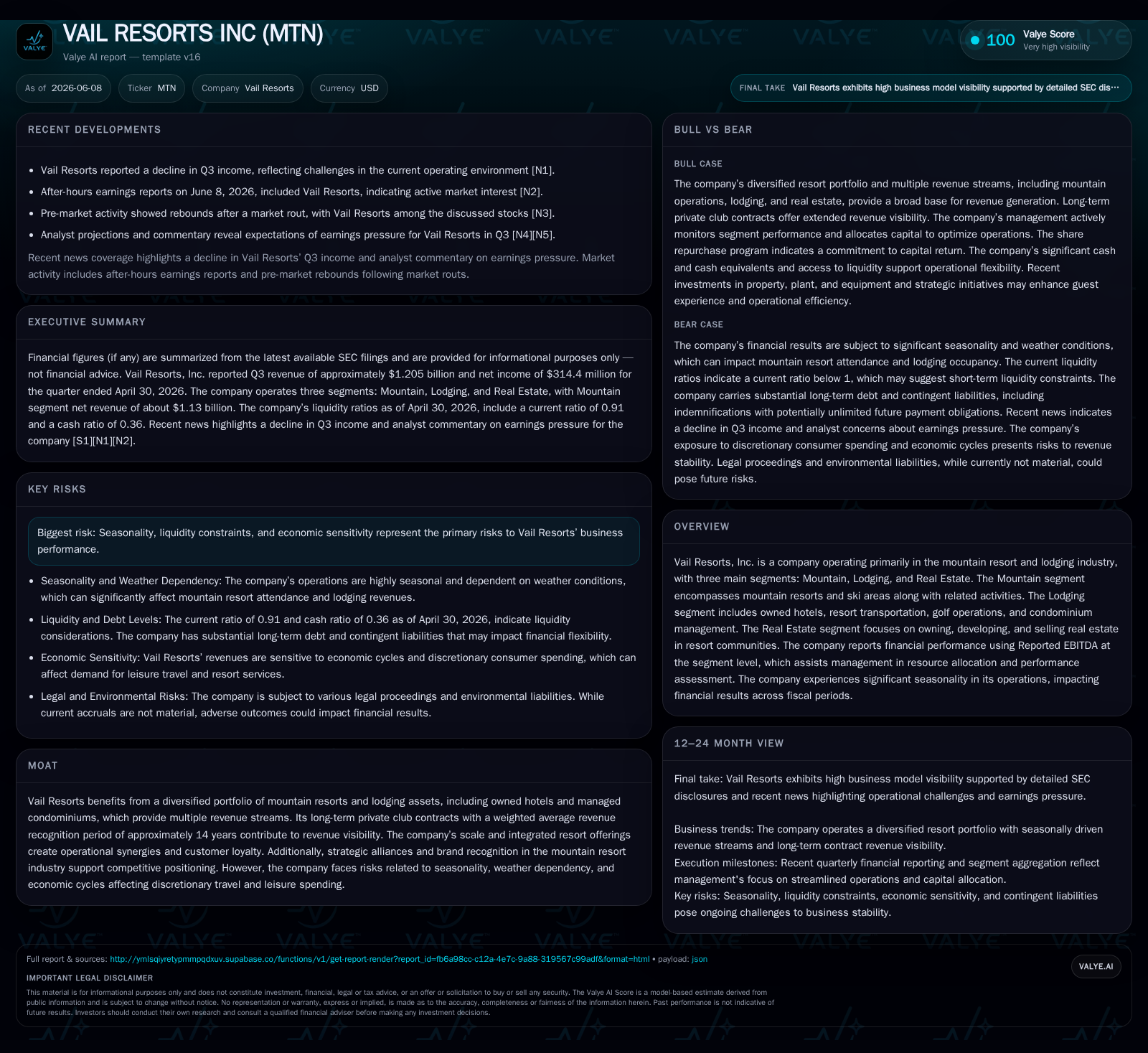
Vail Resorts’ fiscal third quarter ending April 30, 2026, reflects a roughly 7% decline in net revenue with softness concentrated in its core Mountain and Lodging segments amid seasonal visitation drops and discretionary spending headwinds. The company’s multi-segment model—encompassing mountain resorts, upscale lodging assets, and real estate—is structurally resilient but inherently exposed to weather-driven seasonality and economic cycles. While private club contracts and integrated resort offerings provide revenue visibility and customer loyalty, rising leverage and continued sensitivity to macroeconomic factors remain watchpoints. Anticipated winter season results, lodging occupancy trends, and debt maturities will be critical near-term indicators for operational recovery and financial stability.
Latest Quarter Operational Performance Highlights Seasonal Impact
Vail Resorts reported net revenues of $1.205 billion for the fiscal third quarter ended April 30, 2026, reflecting a decline of approximately 7% from $1.296 billion in the prior-year period. This decrease was primarily driven by softness in the Mountain segment services and Lodging operations amid typical off-peak seasonal visitation declines and discretionary leisure spending headwinds [S2]. Specifically, Mountain segment net revenue decreased from $1.213 billion to about $1.13 billion, while Lodging segment revenue fell from $82.9 million to $75.3 million in the quarter [S2]. Retail and dining revenues also declined, dropping from $180 million to $161 million year-over-year, consistent with lower guest volumes [S2].
The seasonal variability inherent in mountain resort operations significantly impacts operating margins due to the fixed-cost nature of resort infrastructure and staffing. Despite these pressures, Vail Resorts’ Board approved a quarterly dividend of $2.22 per share payable July 9, 2026, signaling confidence in underlying cash flow stability despite earnings softness [S2]. These results underscore the company’s reliance on peak winter visitation and discretionary travel demand as critical drivers of annual profitability.
Segmental Revenue Dynamics: Mountain Resorts, Lodging & Real Estate
The Mountain segment remains the core revenue engine, generating income primarily through lift ticket sales, multi-resort season passes, and ancillary spending on retail and dining within resort premises [S25]. Season pass products include private club contracts with extended revenue recognition averaging approximately 14 years, providing multi-year revenue visibility and smoothing cyclical fluctuations [S25]. However, the segment’s performance is highly sensitive to skier visits, which fluctuate with weather conditions and economic cycles.
The Lodging segment diversifies revenue through ownership and management of luxury hotels under the RockResorts brand, concessioner properties such as the Grand Teton Lodge Company, ground transportation services, condominium management fees, and mountain golf operations [S25]. Lodging revenues are closely tied to occupancy rates and average daily rates (ADR), both of which are influenced by discretionary travel demand and broader economic factors. While premium positioning supports higher pricing power relative to typical hotels, occupancy volatility remains a key operating variable.
Real Estate activities, though modest in revenue contribution, strategically complement the portfolio by generating cash flow through property development and sales within resort communities, helping to offset seasonal revenue swings in Mountain and Lodging segments [S2]. Segment EBITDA margins vary, reflecting the distinct operational characteristics and capital intensity of each business line.
Vail’s Business Model: Diversification Against Seasonal Earnings Volatility
Vail Resorts’ integrated business model leverages synergies across mountain resorts, upscale lodging, and real estate to foster customer loyalty and stabilize cash flows across seasonal cycles [S25]. The multi-resort season pass portfolio, including long-term private club contracts, provides upfront cash flow and revenue visibility over extended periods, mitigating some short-term cyclicality
Nonetheless, the company remains exposed to pronounced earnings volatility driven by weather-dependent skier visitation and economic sensitivity affecting discretionary leisure spending. Fixed operating costs related to resort maintenance, staffing, and capital investments create operating leverage that can compress margins during low visitation periods. Customer retention and pricing power hinge on delivering compelling resort experiences and pass flexibility, which help maintain demand resilience across geographic markets.
Industry Positioning: Competitive Set and Pricing Power Considerations
Vail Resorts operates within a competitive landscape characterized by high fixed costs and seasonality, alongside peers such as Aspen Skiing Co. and Alterra Mountain Company, which face similar weather and economic sensitivities [N2][N3]. Vail’s scale advantage through a broad multi-resort network enables it to offer diversified pass products and attract a geographically dispersed customer base, enhancing distribution leverage and upfront season pass cash flows.
Brand strength supports premium pricing elasticity; however, discretionary spending pressures can reduce skier visits and pass utilization rates despite price increases. Lodging assets benefit from luxury positioning, commanding higher ADRs relative to non-resort hotels, but occupancy rates remain closely correlated with winter season health, making short-term pricing power variable. Continuous innovation in pass product design, yield management on lodging inventory, and expansion of ancillary hospitality services are critical to defending competitive positioning under cyclical pressures.
Growth Engines: Expanding Penetration, Innovation & Asset Utilization
Growth strategies focus on deepening market penetration through enhanced pass portfolio innovation, including multi-mountain access and tailored offerings that increase guest engagement and loyalty [S2]. Operational improvements target margin expansion via cost optimization and dynamic pricing aligned with real-time demand signals.
Lodging growth initiatives emphasize increasing occupancy and ADR through targeted marketing to affluent demographics less sensitive to economic cycles, supported by the RockResorts brand’s premium appeal. Asset utilization extends beyond winter with golf and summer outdoor activities, diversifying revenue streams and reducing reliance on ski season performance.
Selective real estate development within high-demand resort communities continues to provide incremental cash flow diversification, balancing expansion with prudent leverage management given the capital-intensive nature of property development.
Key Risks: Weather Dependency, Economic Cyclicality, Balance Sheet Leverage
Vail Resorts’ operational performance is inherently exposed to unpredictable weather patterns that can sharply reduce skier visits, directly impacting lift ticket sales—the highest-margin Mountain segment revenue component—and related ancillary spending [S2]. Economic downturns further exacerbate risks by curbing discretionary leisure budgets, affecting both Mountain and Lodging demand.
Financially, the company reported net debt of approximately $2.58 billion as of April 30, 2026, with total debt near $3 billion and cash and equivalents of about $371 million, yielding a current ratio of 0.91x, indicative of tight working capital management requirements [F1][S2]. This leverage level necessitates vigilant liquidity and covenant compliance oversight, especially amid potential interest rate volatility and refinancing risk. Seasonality also challenges steady cash flow generation, requiring effective capital expenditure planning for lift infrastructure and resort maintenance to sustain competitive positioning.
What To Watch: Upcoming Seasons, Revenue Forecasts & Debt Maturities
Key near-term indicators include winter season skier day counts across flagship resorts, which will reflect snowfall conditions relative to prior years and influence top-line revenue trends [S2][S26]. Lodging occupancy rates and achieved ADRs will provide insight into demand recovery and pricing power amid ongoing consumer budget constraints.
Debt maturity profiles, particularly term loans and senior notes maturing around 2030, require monitoring for refinancing conditions and cost of capital implications [S26]. Interest rate floors linked to SOFR and variable spreads tied to EBITDA ratios will affect financing costs and leverage sustainability
Innovation in pass products, expansion into new markets, or enhanced ancillary offerings could serve as catalysts for growth, though these are moderated by prevailing macroeconomic uncertainties.
Brief Financial Snapshot: Cash Flow Profile and Capital Structure
For the nine months ended April 30, 2026, Vail Resorts reported net income of approximately $370 million, down from $486 million in the prior-year period, reflecting margin pressures from volume softness [S2]. Operating cash flows remain solid, supported by non-cash depreciation and amortization charges exceeding $220 million, underpinning ongoing capital investment capacity.
Liquidity metrics show a current ratio near 0.91x, reflecting seasonal working capital deployment typical for the business cycle stage, while total debt of roughly $3 billion positions the company within investment-grade covenants but with limited flexibility absent operational improvements or deleveraging [F1][S26]. The declared dividend of $2.22 per share underscores management’s commitment to capital returns balanced against prudent financial risk management [S2].
This analysis synthesizes Vail Resorts Inc.’s latest SEC filings through June 8, 2026, contextualizing operational and financial performance within the mountain resort sector’s seasonal and economic dynamics without offering investment advice.
Disclaimer: This is research-only, informational analysis and not investment advice. It may include AI-generated interpretation and general industry context. Always verify important details using primary sources.

Comments