
Enviri Corp Transitions to New Enviri Post-Clean Earth Sale
Following the divestiture of its Clean Earth business, Enviri redefines its operational and financial identity through the standalone New Enviri entity.
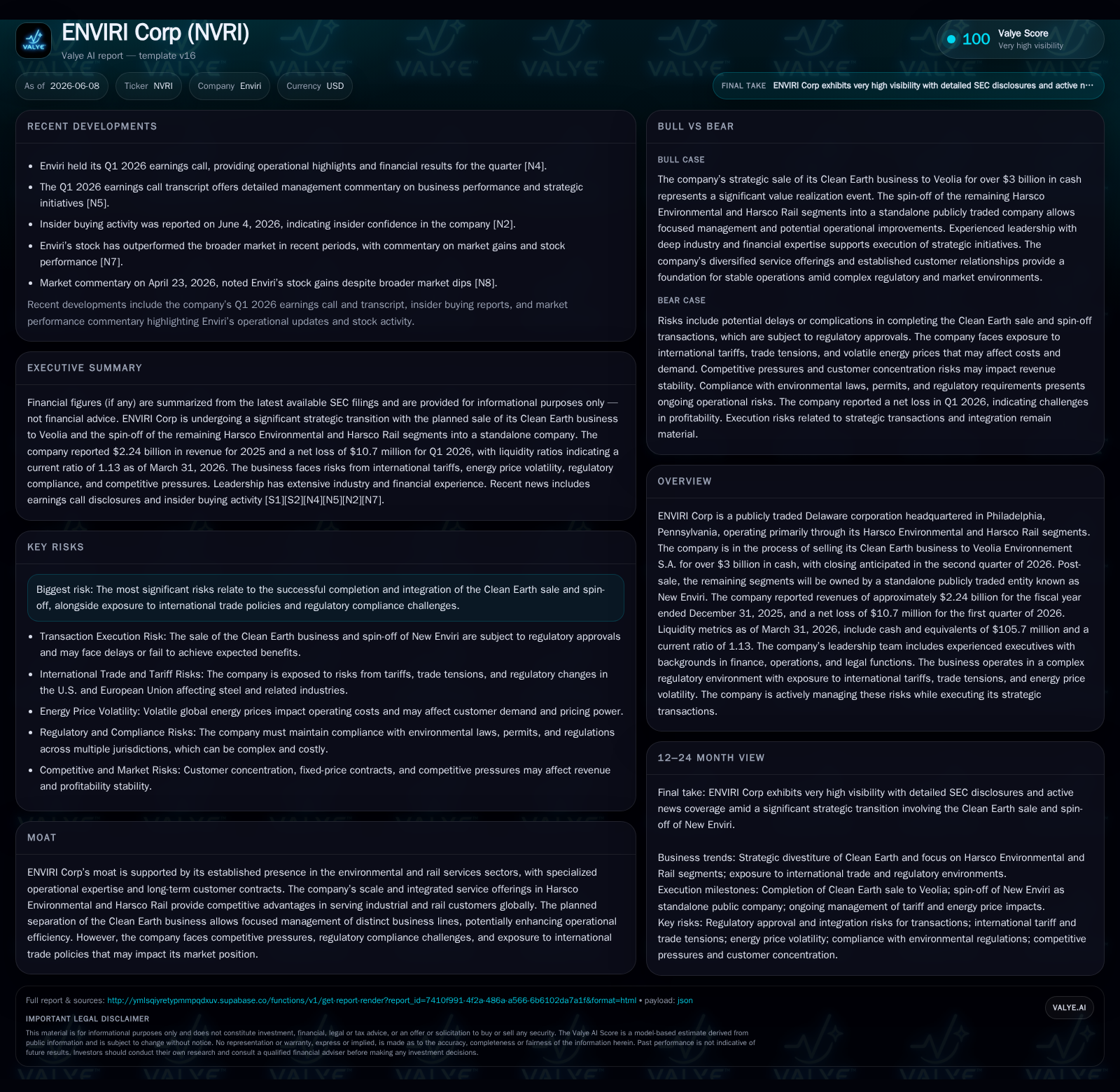
In Q1 2026 and the June 1, 2026 closing, Enviri Corp completed the $3 billion sale of its Clean Earth segment to Veolia, simultaneously spinning off the remaining Harsco Environmental and Rail businesses as a new publicly traded entity called New Enviri. This marked a transformational shift from a diversified environmental services platform toward a more focused business model emphasizing industrial environmental services and rail maintenance. The transaction reshapes revenue streams, cash flow characteristics, and operational priorities, while introducing new execution risks around integration and regulatory challenges. Financially, New Enviri entered this phase with moderate liquidity and elevated leverage that will require careful management amid sector-specific demand drivers and cost pressures.
Latest Quarterly Update Highlights Post-Transaction Changes
Enviri Corp's Q1 2026 filing (dated May 11, 2026) outlined a pivotal restructuring culminating in the June 1, 2026 closing of the $3 billion sale of its Clean Earth business to Veolia Environnement S.A. [S2][S3]. Concurrently, the company spun off its Harsco Environmental and Rail segments into a new standalone publicly traded entity, New Enviri, marking a strategic shift from a diversified environmental services platform to a more focused industrial environmental and rail services operator [S1][S3].
Operationally, Q1 results reflected continuity amid transition, with revenue mix shifting away from waste management toward industrial environmental solutions and rail infrastructure maintenance services [S2]. Liquidity remained stable as of March 31, 2026, with cash and equivalents of approximately $105.7 million against current liabilities of $640.7 million, yielding a current ratio of 1.13, indicative of moderate short-term liquidity buffers [F1]. The company also retired its receivables purchase facility and redeemed $475 million of senior notes concurrent with the transaction close, enhancing capital structure flexibility and reducing refinancing risk [S3].
Business Model Reconstruction After Divestiture
New Enviri’s business model centers on two core segments: Harsco Environmental, which delivers engineered industrial environmental solutions including waste treatment and remediation services tailored to heavy industry; and Harsco Rail, which provides specialized railcar and track maintenance services critical to rail network lifecycle management [S1]. Both segments operate predominantly under long-term, fixed-price or cost-plus contracts with industrial and rail customers, providing revenue visibility and aligning with regulatory compliance cycles.
The divestiture of Clean Earth removes exposure to municipal and hazardous waste processing, concentrating New Enviri’s portfolio on industrial process environmental services and rail infrastructure support. Key operating metrics now emphasize contract backlog, renewal rates, service volumes tied to steel production throughput, and maintenance cycle frequency [S2]. Pricing structures combine fixed fees with variable components linked to energy and raw material costs, exposing margins to input cost volatility amid recent geopolitical energy price fluctuations
Competitive Positioning in Environmental and Rail Services
New Enviri competes in niche markets against specialized industrial environmental contractors and dedicated rail maintenance providers. Its competitive advantage lies in the integrated service offering that bundles environmental remediation with rail infrastructure maintenance, enabling operational synergies and cross-selling opportunities that are less accessible to single-focus peers [S1]. However, the company faces pricing pressure in regulated markets where baseline contract rates are constrained, and incremental pricing power depends on demonstrated operational efficiencies and technological innovation.
Regulatory and trade policy risks are salient. The U.S. government’s steel import tariffs and the European Union’s proposed reductions in steel import quotas and anti-dumping duties introduce cost and demand uncertainties for New Enviri’s steel-related customers, potentially affecting service volumes and contract pricing [S2][N3]. Additionally, compliance with evolving environmental and safety regulations across multiple jurisdictions imposes variable cost burdens, influencing operating margins and contract competitiveness.
Growth Opportunities in the New Enviri Framework
Growth drivers include increased infrastructure investment in rail networks aimed at modernization and sustainability, as well as tightening industrial environmental regulations that elevate demand for engineered remediation and compliance solutions. New Enviri’s focus on long-term contracts with industrial customers provides backlog visibility and recurring revenue streams, while its engineering capabilities position it to capitalize on decarbonization and pollution control trends.
Cross-segment innovation and service integration offer avenues for margin expansion and differentiation. Monitoring contract renewal rates, backlog growth, and new contract awards in forthcoming earnings reports will be critical to assessing the realization of these growth opportunities [N1][N2]. The strategic pivot toward higher-value engineered services over commoditized waste processing suggests potential for improved revenue quality, albeit with execution risks inherent in the transition.
Risks and Potential Constraints Facing New Enviri
Key risks include the complexity of post-divestiture integration and operational realignment, which may disrupt service delivery or delay realization of anticipated synergies [S2]. Energy price volatility remains a margin risk due to partial pass-through limitations in fixed-price contracts, compounded by geopolitical instability affecting global energy markets.
International trade tensions and tariff policies pose demand and cost risks for steel-dependent customers, potentially impacting contract volumes and pricing [S2]. Customer credit quality is a concern given fixed-price contract exposure, especially if macroeconomic conditions weaken industrial end markets. Labor relations and workforce retention challenges persist in skilled trades critical to rail and environmental services, with union negotiations potentially affecting cost structures and operational continuity.
Insurance claims and uninsurable loss exposures also represent operational risks, necessitating vigilant risk management [S2]. Regulatory compliance costs and permitting delays remain ongoing challenges, particularly in international markets with evolving environmental standards.
What to Monitor Next: Milestones and Performance Indicators
Critical indicators include contract renewal rates and backlog development in both Environmental and Rail segments, which signal commercial momentum post-spin-off [N1][N2]. Regulatory approval progress for operational permits and environmental compliance will affect capacity and service delivery.
Management commentary on pricing strategies amid inflationary pressures, energy cost pass-through effectiveness, and labor negotiations will provide insight into margin trajectory. Market reception of New Enviri shares post-spin-off, reflected in trading volumes and price trends, will also offer sentiment cues.
Upcoming earnings calls are expected to clarify guidance and operational priorities, with adjusted EBITDA margins by segment serving as key metrics for credit and investment community assessments [N1][N2]
Financial Profile Update - Liquidity, Leverage, and Cash Flow
As of March 31, 2026, Enviri held $105.7 million in cash and equivalents against current liabilities of $640.7 million, yielding a current ratio of 1.13, reflecting adequate but tight working capital typical of capital-intensive industrial service operations [F1]. Total debt stood near $1.57 billion at year-end 2025, with net debt approximating $1.46 billion after accounting for cash reserves, indicating elevated leverage that will require disciplined deleveraging as New Enviri matures [F1].
The retirement of the receivables purchase facility and redemption of $475 million in senior notes concurrent with the Clean Earth sale improved capital structure flexibility and reduced near-term refinancing risks [S3]. Going forward, free cash flow generation will depend on volume growth in Harsco Environmental and Rail segments, effective cost management, and capital expenditure discipline.
Maintaining covenant compliance and improving adjusted EBITDA margins will be pivotal for sustaining creditworthiness and funding strategic initiatives [S2][S13]. Transparent segment-level financial disclosures will be essential for stakeholders to assess operational health and financial resilience.
This analysis is based exclusively on publicly available SEC filings through June 8, 2026, and recent earnings call disclosures without offering investment guidance or price forecasts.
Disclaimer: This is research-only, informational analysis and not investment advice. It may include AI-generated interpretation and general industry context. Always verify important details using primary sources.

Comments