
ServiceTitan's Q1 2027 Results Show Momentum in AI-Powered Platform Expansion
ServiceTitan reports solid Q1 growth driven by AI integration and FinTech expansion amid continued net losses and investment in growth.
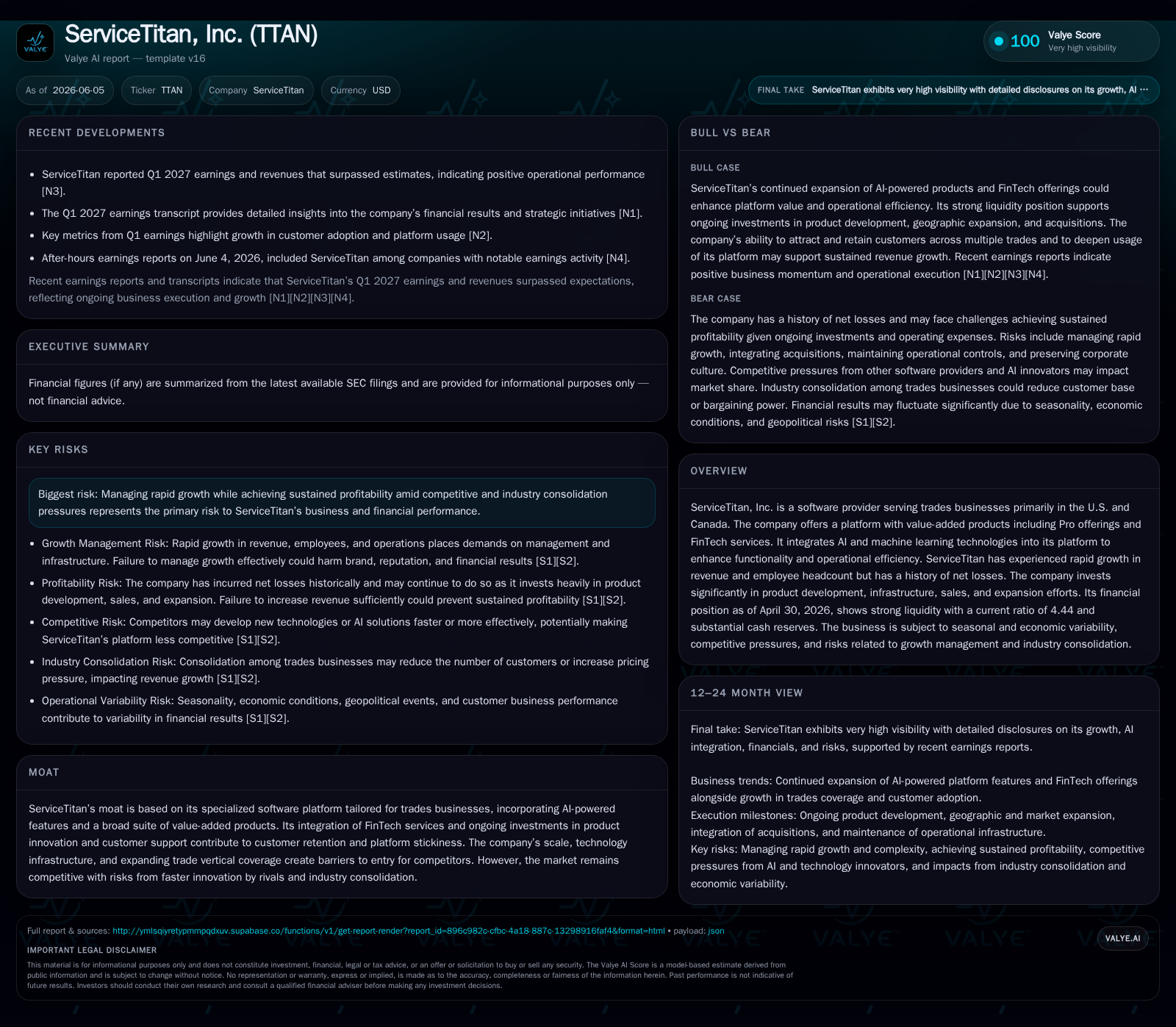
In its latest quarterly filing, ServiceTitan highlighted sustained revenue growth supported by enhancements to its AI-powered trades software platform and expanding FinTech offerings. While revenue momentum remains strong, the company continues to operate at a net loss as it invests heavily in product development and scaling operations. ServiceTitan’s strong liquidity position and elevated current ratio alleviate near-term financial pressure but competitive dynamics and execution risk persist. The platform’s specialized SaaS model focused on trades businesses underpins sticky customer relationships, with growth fueled by both new client acquisition and upsell of integrated Pro and payment products.
Q1 Operating Highlights and What They Mean Now
ServiceTitan’s Q1 2027 results filed on June 5, 2026 [S2] show encouraging signs of operational momentum centered on its AI-driven platform expansion. Revenue topped consensus estimates through enhanced uptake of its core SaaS offering integrated with newly launched AI-powered features that optimize scheduling, diagnostics, and inventory management for trades contractors [N1][N3]. Concurrently, the company reported increased monetization from FinTech services including payment processing and consumer financing partnerships embedded within the workflow software.
Despite these top-line gains, ServiceTitan continues to report net losses supplemented by elevated investments in product development and sales efforts [S2]. This reflects a strategic choice to prioritize long-term platform value creation over near-term profitability. The firm’s commentary underscores a commitment to innovation-led differentiation while scaling customer onboarding support necessary to maintain high retention rates in a competitive software environment.
Inside ServiceTitan’s Business Model: From Core SaaS to FinTech Integration
ServiceTitan generates recurring revenues primarily via a subscription-based SaaS platform tailored specifically for small to mid-sized trades businesses across the U.S. and Canada. This platform facilitates operational workflows—dispatching, invoicing, job tracking—and analytics customized for sectors like plumbing, HVAC, electrical, and roofing [S1].
Revenue is supplemented by sales of Pro product offerings that add functionality such as workforce management and advanced reporting tools [S1][S2]. Additionally, the firm embeds FinTech capabilities permitting contractors to offer consumer financing options seamlessly during sales cycles; referral fees from these third-party financial partners contribute incremental income
This diversified revenue mechanics model enhances customer stickiness: trades businesses integrate deeply with ServiceTitan’s ecosystem not just for software licensing but also for payment facilitation—creating switching costs difficult to replicate by generalist competitors.
Competitive Positioning Within the Trades Software Ecosystem
ServiceTitan’s moat is anchored in its specialized vertical focus combined with a rich suite of integrated features enhanced continually through AI/ML investments [S1]. Its scale advantage enables ongoing infrastructure improvements that smaller players find challenging to match.
The company faces competition from other trades-focused SaaS providers that may attempt faster feature rollouts or aggressive pricing strategies; however, ServiceTitan’s combination of platform breadth—including enterprise-grade scheduling complexities—and embedded financial services fosters strong net retention rates [N2]. Sales cycles remain nuanced given SMB trades adoption patterns but have been streamlined through dedicated onboarding processes prioritizing contractor technician buy-in.
Ongoing threats emerge from potential industry consolidation among customers (contractor mergers) that could depress total addressable market or consolidate bargaining power.
Growth Drivers: AI Product Evolution and Market Expansion
ServiceTitan’s growth thesis rests on expanding ARR driven by innovation in AI-enabled operational efficiencies—automated job dispatching predictions, demand forecasting, technician productivity analytics—and broadening trade vertical coverage [S2][N1]. These enhancements promise productivity gains for customers leading to deeper usage and upsell opportunities.
Geographic expansion outside existing core markets combined with partnerships extending access to complementary financial services increase total contract value per customer. The escalation of FinTech integration is particularly notable; referral fees from consumer financing provide a scalable revenue stream less sensitive to churn.
Customer acquisition is supported by sector specialization which allows tailoring messaging uniquely addressing trade pain points unlike more generic field service management platforms.
Risks and Constraints: Growth Management amid Rising Competition
Rapid scaling brings typical organizational challenges including talent recruitment/retention especially in technology roles building sophisticated AI features [S1][S2]. Ongoing investment intensity weighs on near-term profitability requiring careful capital allocation balancing R&D spend versus market penetration efficiency.
External risks include economic downturns influencing discretionary repair/maintenance spends by homeowners/businesses served by trades contractors. Furthermore, competitive pressures persist from newer entrants innovating rapidly or incumbents bundling adjacent services that potentially erode ServiceTitan’s market share.
Regulatory compliance related to financial service offerings adds complexity with evolving data privacy laws affecting consumer financing products embedded within the platform.
Looking Ahead: Milestones and Execution to Track
Investors should monitor key performance indicators such as net revenue retention rates reflecting success in expanding per-customer wallet share through Pro product adoption. Tracking ARR growth will provide insight into subscription velocity fueled by new client additions versus churn.
Execution of upcoming AI feature releases and evidence of tangible productivity benefits will be telling regarding innovation-driven differentiation. Expansion into additional North American regions or new trades will test sales scalability.
Guidance updates will reveal management’s view on trading conditions amid macroeconomic factors impacting the trades sector’s capital spending cycles.
Financial Snapshot: Balance Sheet Strength and Profitability Dynamics
As of April 30, 2026, ServiceTitan reported robust liquidity with cash & equivalents totaling approximately $421.5 million alongside current assets of $600.9 million against current liabilities of $135.4 million—a current ratio of 4.44 indicating strong short-term financial flexibility [F1][S2]. Total debt stood modestly at about $106 million (as of October 2025), translating into a substantial net cash position given the significant cash reserves [F1].
The firm operates at a net loss reflecting significant reinvestment into growth initiatives; however, positive free cash flow generation trends from prior periods suggest improving operating leverage potential as scale rises [S1]. Continued cost control alongside revenue expansion will be critical for moving towards sustained profitability without sacrificing innovation capacity.
This analysis synthesizes publicly filed SEC disclosures as of June 5, 2026 ([S1], [S2], [S3]) alongside reported news transcripts ([N1], [N2], [N3]) without conjecture beyond documented facts. It aims to provide an informed industry perspective on ServiceTitan's positioning within the growing yet competitive trades SaaS ecosystem driven increasingly by AI-enhanced workflow automation coupled with embedded financial technology services.
Disclaimer: This is research-only, informational analysis and not investment advice. It may include AI-generated interpretation and general industry context. Always verify important details using primary sources.

Comments