
Best Buy’s Strategic Reset and Omnichannel Strength Fuel Q1 Momentum
Best Buy completes key restructuring steps while leveraging its integrated retail ecosystem to drive early fiscal 2027 growth.
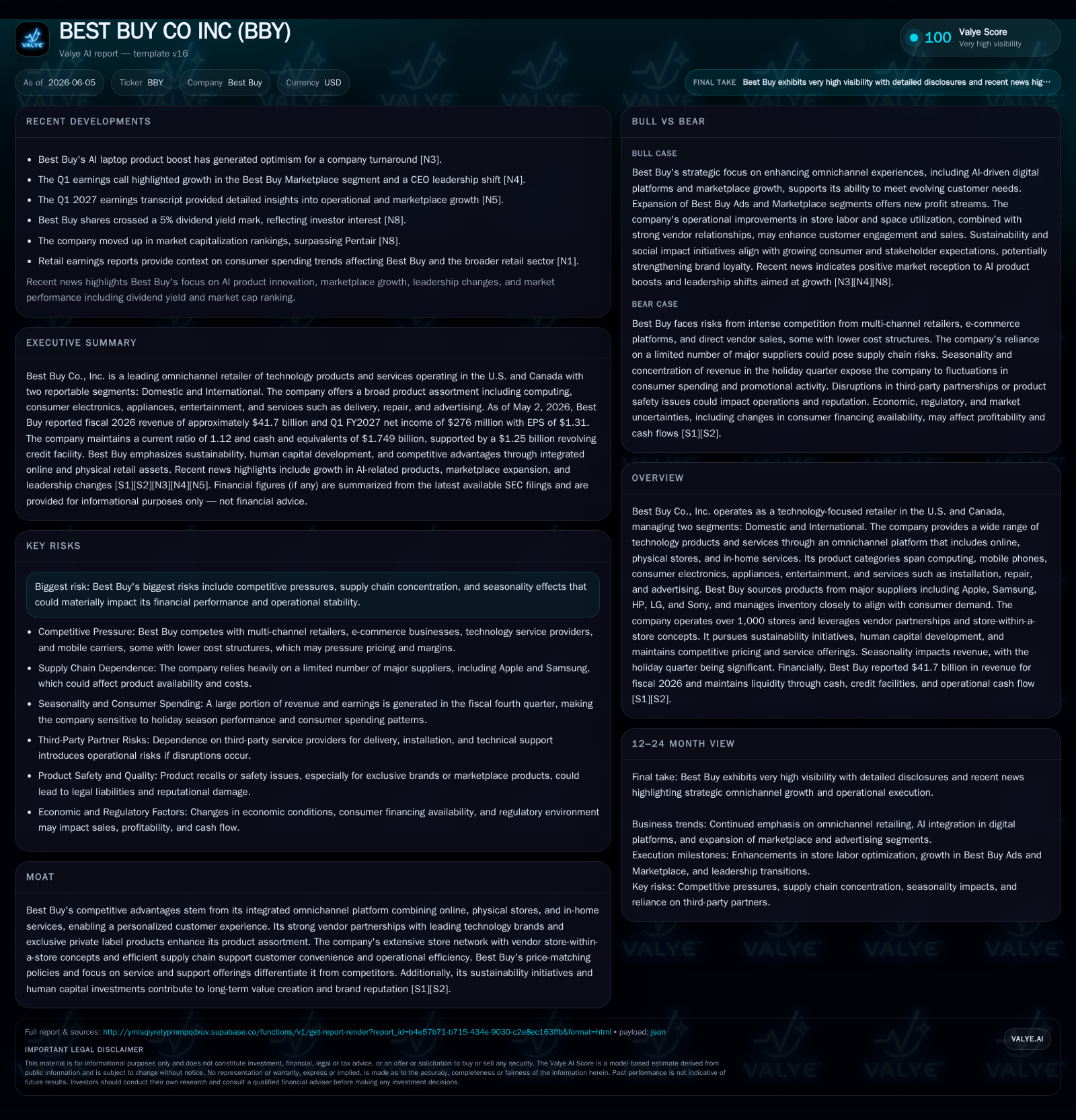
In its latest 10-Q for the first quarter of fiscal 2027, Best Buy reported the effective completion of its fiscal 2024 labor and store optimization restructuring initiative with no new charges expected, signaling progress in aligning resources with evolving consumer shopping preferences. The company’s omnichannel platform—spanning physical stores, ecommerce, marketplace commissions, and value-added services like Geek Squad—continues to facilitate modest comparable sales growth amid a challenging retail environment. Notably, emerging product cycles related to AI-enhanced laptops and growing membership subscriptions support incremental marketplace expansion, positioning Best Buy for a measured recovery. However, risks from seasonal volatility, supply-chain pressures tied to global trade uncertainties, and intense competition remain present headwinds.
Quarterly Operating Update: Restructuring Completion and Customer Realignment
Best Buy’s first quarter filing for fiscal 2027 reveals the successful conclusion of its fiscal 2024 enterprise-wide restructuring initiative focused on labor force optimization aligned with shifting consumer shopping behavior [S2]. This effort primarily targeted the redeployment of field workforce resources across stores and online channels to better match where customers prefer to shop while simultaneously redirecting corporate functions to strategic priorities. Crucially, management reported no restructuring expenses incurred in the first quarter and does not anticipate further material costs related to this program moving forward
This development suggests that the company has transitioned into an operational phase where leaner staffing complements its omnichannel strategy without near-term restructuring headwinds. The timing coincides with broader efforts to refine customer experience through targeted store layouts and digital tooling enhancements.
Omnichannel Model and Product-Services Mix Driving Revenue Streams
Best Buy continues to operate a robust omnichannel retail platform integrating over 1,000 physical stores in the U.S. and Canada with a sophisticated ecommerce operation and marketplace offerings. Its revenue mix spans several primary categories: computing and mobile phones; consumer electronics; appliances; entertainment products; plus services including Geek Squad installation/repair and advertising revenue derived from its Best Buy Ads segment [S1]
The company’s marketplace model increasingly contributes via commission revenues from third-party sellers enabled by its web infrastructure—a trend positively highlighted during recent earnings calls [N1,S2]. Alongside direct product sales, subscription-based memberships such as My Best Buy Plus provide a semi-recurring revenue cushion through benefits like price matching, extended warranties, and service discounts.
Key vendor relationships with Apple, Samsung, HP, LG and Sony strengthen Best Buy’s assortment exclusivity through store-within-a-store shop-in-shop models that augment customer choice while deepening brand affinity. The combination of private label product lines (e.g., Insignia) alongside curated premium offerings aids product mix improvements favoring mid-to-higher margin tiers [S1]
Competitive Positioning: Vendor Partnerships and Service Differentiation
Best Buy's integrated approach confers meaningful competitive moats relative to both brick-and-mortar peers and purely digital disruptors. The company leverages extensive geographic footprint permitting localized inventory fulfillment combined with its digital storefronts offering convenience and broad product selection.
Price matching policies mitigate risk of losing customers on price sensitivity while Geek Squad services encompass unique support capabilities that create switching costs beyond simple hardware transactions. Vertically integrated financial offerings—including branded credit cards—add incremental profit-share income enhancing overall unit economics.
Despite aggressive competition from Amazon and other e-tailers exerting pricing pressure especially on commoditized product categories, Best Buy’s blend of physical-digital synergy coupled with differentiated service ecosystems sustains market relevance within North America’s consumer electronics landscape [S1,S2]
Supply Chain Dynamics amid Geopolitical and Inflationary Pressures
Although direct imports represent only a small fraction (~1%-3%) of Best Buy’s overall assortment due to reliance on vendor-managed supply chains from China, Mexico, and Southeast Asia, ongoing complexities in global trade policy impose cost uncertainty risks that mandate close supplier coordination. Nonrecurring impairments associated with the Best Buy Health optimization effort and China sourcing initiative were recorded recently but not expected to recur materially [S2].
Inflationary effects coupled with tariff-related volatility could stress gross margins if cost increases cannot be fully passed through despite price-matching commitments. Inventory markdown discipline is critical for minimizing write-offs amid volatile demand signals reflective of economic conditions impacting discretionary tech purchases [S1,S22].
Growth Drivers: Marketplace Expansion, AI Enhancements, and Memberships
Recent quarters have evidenced encouraging signs of marketplace commission revenue acceleration as Best Buy capitalizes on network effects inherent to its expanding seller ecosystem [N1]. Simultaneously, an uptick in demand for AI-enhanced laptops has provided an important product cycle tailwind fueling tech-savvy consumer interest—a dynamic spotlighted in market commentary as a potential catalyst for improved near-term performance [N5].
Membership programs continue gaining traction with customers who value bundled benefits, thereby enhancing net retention metrics that underpin recurring revenue stability amidst fluctuating purchase frequency patterns [S1]. These streams help offset cyclicality tied to core hardware sales concentrated ahead of holiday seasons.
Risks to Watch: Seasonal Volatility, Cost Pressures, and Industry Competition
Fiscal concentration remains a notable risk factor for Best Buy given that a disproportionate share of revenue and operating profits accrues in the Q4 holiday season—a period susceptible to unpredictable consumer behavior shifts or promotional dynamics [S1]
Additionally, macroeconomic headwinds including inflation-driven cost pressures weigh on margin flexibility especially when coupled with aggressive pricing strategies adopted by online pure plays seeking market share gains. Supply chain disruptions related to geopolitical trade tensions add another risk layer warranting close monitoring.
The competitive landscape dictates ongoing investment in service differentiation initiatives which incur costs that could compress short-term profitability if volumes do not meet expectations.
Looking Ahead: Execution Milestones and Demand Signals
Key operational indicators meriting investor attention comprise same-store sales growth segmented by channel (stores vs digital), efficacy of workforce alignment post-restructuring in improving labor productivity metrics, continued marketplace GMV expansion rates supported by new seller onboarding levels, plus success trajectory of the AI laptop product surge during upcoming quarters [N3,S2]
Execution on these fronts will signal whether Best Buy can translate strategic resets into sustainable topline momentum while counterbalancing sector-wide headwinds.
Financial Profile: Capital Allocation Discipline Supporting Stability
Best Buy maintains a solid liquidity position evidenced by approximately $1.75 billion in cash & equivalents against total debt near $1.16 billion as of May 2, 2026—yielding net cash status (negative net debt) around $591 million consistent with an investment-grade credit profile [F1,S2]
The firm pursues a balanced capital return policy prioritizing operational funding followed by returning surplus cash via dividends—which remained steady at $0.96 per share quarterly—and opportunistic share repurchases which were paused during Q1 reflecting caution amid macro uncertainties [S2]. This prudent calibration ensures resilience facilitating continued investments in growth such as ecommerce platform enhancements alongside shareholder remuneration commitments.
Disclaimer: This analysis is based solely on publicly available filings as of June 5, 2026, including SEC disclosures and supplemental market commentary. It does not constitute investment advice or research views but aims to provide an informed industry perspective grounded in disclosed operational data.
Disclaimer: This is research-only, informational analysis and not investment advice. It may include AI-generated interpretation and general industry context. Always verify important details using primary sources.

Comments