
ABM Industries Q2 2026 Report: Acquisition Impact and Operational Dynamics
ABM’s recent acquisition and financial maneuvers in Q2 2026 reveal both growth potential and elevated leverage challenges within integrated facility services.
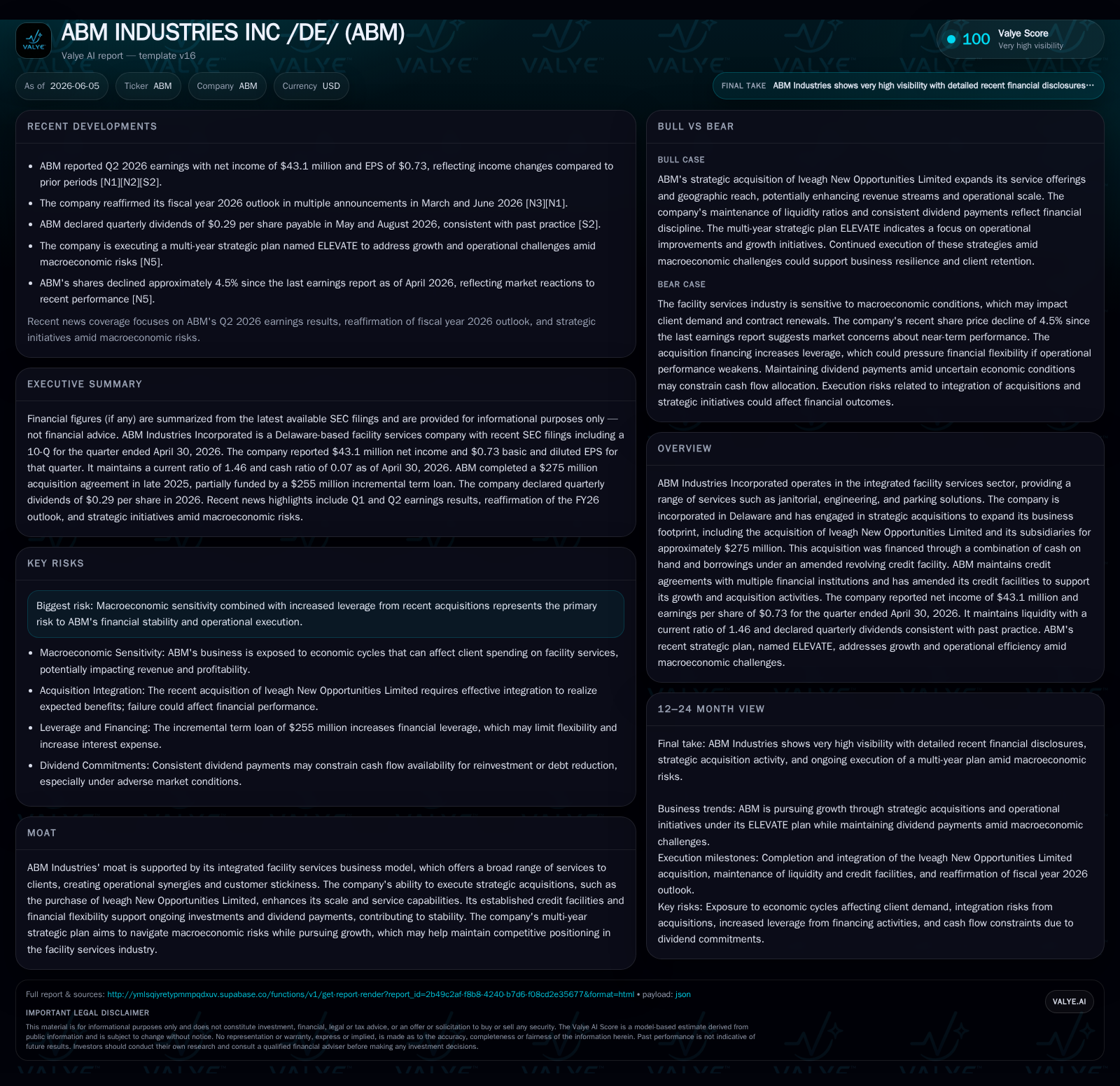
In Q2 2026, ABM Industries closed its $275 million acquisition of Iveagh New Opportunities Limited, financing this primarily through borrowings under an amended revolving credit facility. The quarter delivered net income of $43.1 million with a dividend reaffirmed at $0.29 per share, reflecting operational resilience despite increased leverage. ABM’s integrated facility services model—with bundled janitorial, engineering, and parking solutions—continues to drive customer stickiness and margin stability. However, elevated net debt nearing $1.9 billion raises near-term leverage management risks amid a macro-sensitive environment. Monitoring synergy realization from acquisitions and disciplined liquidity management will be key execution milestones for FY26.
Q2 Operating Update: Acquisition Closure and Earnings Overview
ABM Industries’ second quarter ended April 30, 2026 marked a pivotal operational period highlighted by the completion of its strategic acquisition of Iveagh New Opportunities Limited ("WGNSTAR") for approximately $275 million in cash [S2][S3]. This transaction extends ABM’s footprint internationally while broadening its portfolio within integrated facility services. The acquisition was primarily financed through cash on hand combined with $255 million borrowed under an amended revolving credit facility executed earlier in February 2026 [S21].
Financially, the quarter recorded net income of $43.1 million (EPS of $0.73) along with a consistent quarterly dividend declaration of $0.29 per share payable in August 2026 [S3][N6]. Maintaining the dividend level amidst increased leverage signals confidence in cash flow generation capability despite elevated debt post-acquisition.
Integrated Facility Services Business Model Explained
ABM’s business revolves around delivering bundled facility solutions that include janitorial cleaning, engineering maintenance, parking management, and other specialty outsourced services [S1]. This integrated approach creates significant operational synergies—cross-selling multiple solutions to the same clients enhances customer stickiness and drives margin stability by locking in recurring revenue streams.
Such diversification across service lines mitigates exposure to single-service cyclicality and end-market volatility. ABM’s multi-year strategic plan focuses on harnessing these synergies while expanding geographically through accretive acquisitions like Iveagh, amplifying scale effects that improve pricing power and operational leverage.
Competitive Positioning: Scale, Service Mix, and Pricing Power
The Iveagh acquisition strategically bolsters ABM’s competitive scale in the European market segment—a region where competition ranges from local niche providers to large global players [S1][S2]. By increasing service mix breadth through this deal, ABM enhances its margin profile; integrated offerings generally command better pricing compared to standalone service competitors given the convenience and consolidation benefits to clients.
Pricing power appears durable due to high switching costs embedded in multi-contract relationships and the operational complexity associated with integrating disparate facilities services internally at client sites. This positions ABM favorably relative to smaller peers who often compete primarily on price alone.
Growth Drivers: Strategic Acquisitions and Multi-Service Client Synergies
Acquisitions remain a central lever for ABM’s top-line expansion strategy—here evidenced by the sizable transaction to acquire Iveagh subsidiaries adding incremental revenue streams and geographical reach [S4][S8]. The use of amended credit facilities to finance this deal aligns with typical industry practice where scale consolidation enables margin improvements post-integration.
Beyond expansion via M&A, ABM drives growth organically through enhancing penetration within existing accounts by bundling multiple service lines—generate higher wallet share per client while locking renewal cycles behind bundled contracts acts as a reliable demand stabilizer even amid macroeconomic fluctuations.
Risks and Constraints: Leverage Management and Macroeconomic Sensitivity
While acquisition-fueled growth provides scale advantages, it comes with elevated leverage carrying potential execution risks. As of April 30, 2026, total debt stood around $2 billion against a cash balance just shy of $95 million resulting in net debt close to $1.9 billion [F1]
Macroeconomic sensitivity remains material given ABM’s exposure to corporate real estate demand cycles influencing client budgets for outsourcing services [S18]. Any sustained economic weakness or tightening cost controls among customers could pressure revenue volumes or delay contract renewals—exacerbating stress on cash flows needed for debt servicing.
Looking Ahead: Guidance and Execution Benchmarks for FY26
Despite missing some analyst earnings estimates this quarter [N2], ABM reaffirmed its full-year 2026 outlook emphasizing confidence in demand recovery supported by ongoing delivery against its multi-year plan [N5][S3]. Key execution points will involve successful integration of Iveagh assets with measurable synergy capture milestones—including cost optimization and cross-selling uplifts—and continual monitoring of customer retention rates within multi-service agreements.
Additionally, maintaining discipline around working capital management alongside prudent covenant compliance will be critical for navigating external uncertainties while sustaining shareholder returns via dividends.
Financial Snapshot: Liquidity and Leverage Assessment Post-Acquisition
ABM’s balance sheet as of quarter-end shows cash & equivalents at $94.9 million juxtaposed against total debt approximating $2 billion generating net debt near $1.9 billion [F1]. This elevated leverage reflects borrowings used for the recent acquisition plus existing funding structures.
The company’s current ratio of 1.46 demonstrates reasonable short-term liquidity which supports operational needs including dividend payments declared consistently at $0.29 per quarter since late 2025 despite higher debt levels [S3][F1]. The amended revolving credit facility includes provisions allowing incremental term loans supporting capital strategies while accommodating regular shareholder distributions [S21].
Continuous attention to managing leverage ratios amid market sensitivities represents an important watchpoint for assessing ABM’s financial flexibility going forward.
This analysis synthesizes publicly disclosed filings up to June 5, 2026, without providing investment research views or speculative forecasts. It aims to provide a fact-based evaluation of ABM Industries’ current operating dynamics driven by recent strategic moves within the integrated facility services sector.
Financial position in context
As of 2026-04-30, companyfacts shows $95mm in cash and equivalents and $2.0bn of total debt [F1]. The same snapshot implies net debt of roughly $1.9bn, keeping balance-sheet context relevant but secondary to the operating story [F1]. Current assets of $2.0bn and current liabilities of $1.39bn imply a current ratio near 1.46x for 2026-04-30 [F1].
Disclaimer: This is research-only, informational analysis and not investment advice. It may include AI-generated interpretation and general industry context. Always verify important details using primary sources.

Comments