
NetApp's Q4 Momentum: AI Integration and Cloud Strategy Execution
NetApp’s latest quarter underscores AI-driven demand strength and cloud-centric growth reinforcing its Intelligent Data Infrastructure leadership.
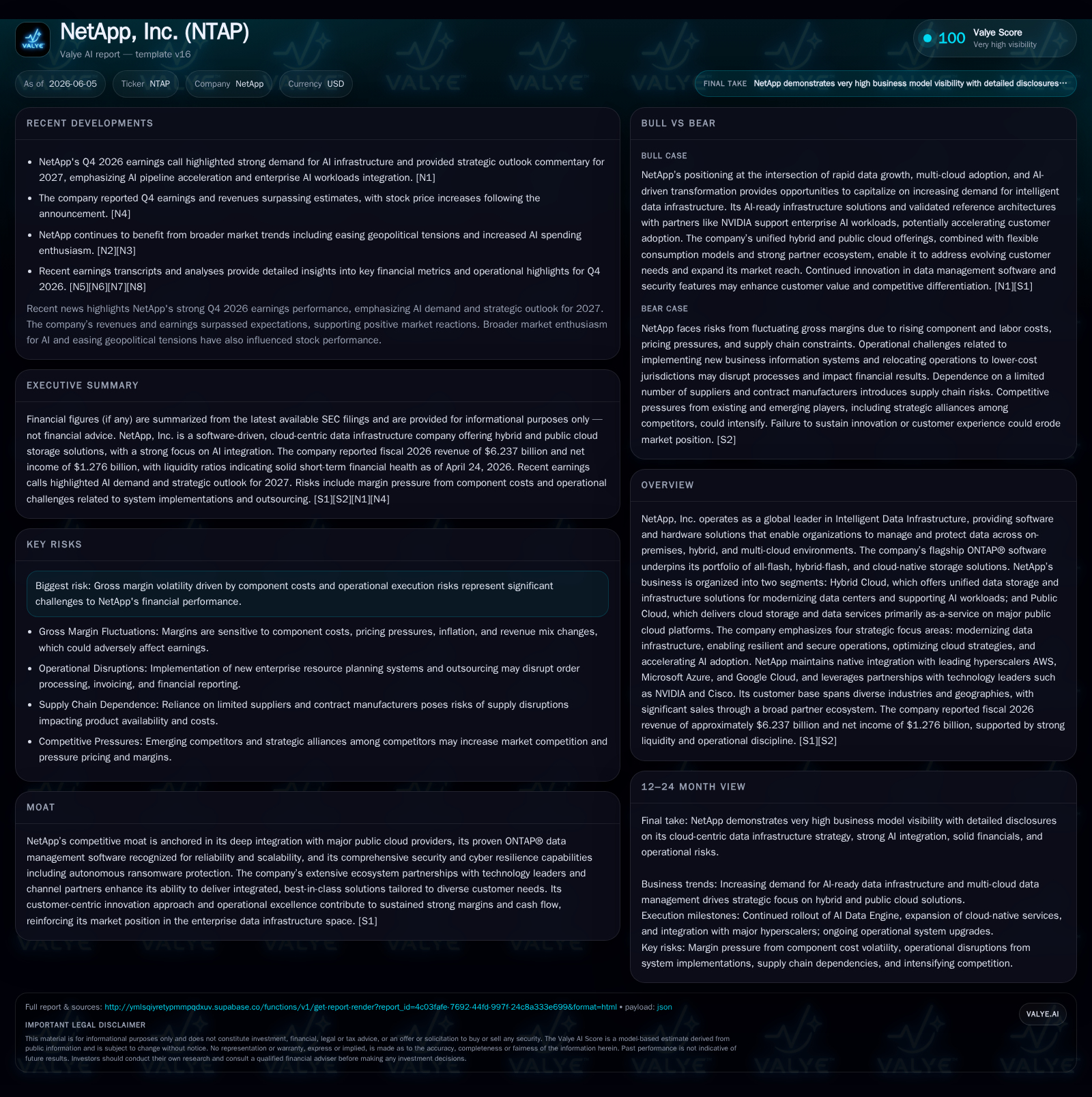
In Q4 2026, NetApp reported revenues surpassing estimates driven primarily by surging AI workloads and continued expansion of its hybrid and public cloud segments. The company’s software-led approach, centered on its ONTAP® platform, enables seamless data management across multi-cloud environments, strengthening its competitive moat through deep hyperscaler integration and cyber resilience features. While component cost pressures present margin volatility risks, NetApp’s robust balance sheet supports ongoing R&D investments to fuel innovation and capitalize on AI adoption trends.
Latest Quarterly Operating Update: AI Demand Drives Results
NetApp’s fiscal Q4 ended April 24, 2026, revealed a stronger-than-anticipated revenue performance fueled by heightened demand for AI-centric data infrastructure solutions. Total net revenues reached approximately $6.93 billion, marking an acceleration over the prior year’s $6.57 billion figure [S2]. The surge was notably powered by the Hybrid Cloud business whose product offerings—anchored in the ONTAP® software platform—are optimized for demanding AI workloads requiring high-performance hybrid flash storage coupled with seamless data mobility across clouds. Public Cloud services also contributed solidly as NetApp continues to expand its footprints as-a-service on major hyperscalers [N1][N3][S3]. Management emphasized that AI workloads have materially changed customer procurement patterns toward integrated cloud/on-premises solutions featuring resilient data management.
Margins reflected industry-wide component cost inflation and supply chain complexities; however, operating income remained robust at $1.67 billion for the fiscal year ending April 2026 [F1], underscoring effective cost management despite pressures. Operational resilience efforts including autonomous ransomware protections helped maintain customer trust amid rising cyber threats—an increasingly essential value proposition.
Business Model in Transition: Software-Led Data Infrastructure and Hybrid Cloud Growth
NetApp has strategically evolved from a traditional hardware vendor to a predominantly software-driven Intelligent Data Infrastructure provider. Its flagship ONTAP® software serves as the foundation for delivering scalable all-flash and hybrid-flash storage solutions as well as cloud-native storage deployments that address complex enterprise needs across on-premises, hybrid cloud, and multiple public clouds [S1].
Revenue streams bifurcate into two core segments: Hybrid Cloud—which bundles unified storage arrays tailored for modernizing legacy data centers while supporting compute-intensive applications like AI—and Public Cloud—which focuses on native integrations that enable NetApp-branded data services deployed natively on AWS, Azure, and Google Cloud platforms delivered predominantly via subscription or consumption models [S1]. This segmentation illustrates a deliberate shift toward recurring revenue models combining product sales with growing services intake.
The software-led transition enhances stickiness due to ONTAP®’s recognized reliability and scalability alongside seamless interoperability with multiple cloud ecosystems—a competitive edge that fosters strong customer retention and opportunity for usage expansion.
Competitive Positioning Within Enterprise Data Infrastructure Ecosystem
NetApp’s moat is multifaceted. The company is uniquely positioned as the sole enterprise data infrastructure provider with native integrations across the three major public cloud hyperscalers: Amazon Web Services, Microsoft Azure, and Google Cloud Platform. This level of partnership facilitates customers’ multi-cloud strategies while offering integrated management tools that simplify operations [S1].
Moreover, NetApp’s autonomous cyber resilience capabilities—including advanced ransomware detection and recovery—address increasingly stringent security demands pervasive in enterprise IT operations. This proactive security stance differentiates NetApp in a market where data protection is paramount.
Its extensive ecosystem partnerships with channel resellers, technology vendors, and hyperscaler alliances strengthen distribution reach while enabling co-engineered solutions which enhance tailor-fit customer experiences. In sum, NetApp competes strongly against traditional storage providers transitioning to cloud as well as emerging pure-play cloud-native competitors.
Hybrid Cloud Versus Public Cloud Segment Dynamics
The Hybrid Cloud segment represents the core of NetApp’s strategic transformation ambitions. It supplies unified flash storage appliances powered by ONTAP®, optimized for AI workload performance Headroom combined with agility to move data fluidly between on-premises infrastructure and public clouds—crucial amid edge computing proliferation [S1]. Customers seek these on-prem architectures for latency-sensitive or compliance-bound applications while leveraging public clouds for elasticity.
Conversely, the Public Cloud segment capitalizes on SaaS-like consumption models delivering NetApp-managed data services directly within hyperscaler environments. This includes capabilities such as database-as-a-service or backup-as-a-service constructed atop native cloud infrastructure [S1]. This division monetizes increasing enterprise reliance on cloud platforms through predictable subscription economics reflecting usage elasticity and scaling efficiencies.
Together these segments represent complementary growth engines addressing different corners of evolving corporate data strategies: modernization of existing assets alongside cloud-first new deployments.
Strategic Growth Drivers Around AI Integration and Cloud Optimization
Several mega-trends underpin NetApp’s growth trajectory: explosive data volume growth triggered by IoT proliferation; accelerating multi-cloud adoption driven by the need for flexibility; and surging artificial intelligence workloads demanding ultra-low latency storage performance combined with robust cyber resilience features.
NetApp leverages sector KPIs such as net retention rates boosted from seat expansions via usage-based licensing plus enhanced subscription uptake in its Public Cloud unit reported during Q4 earnings discussion [N5]. Moreover, steady capex directed toward R&D—particularly focused on evolving ONTAP®’s abilities to optimize for AI workflows and enable autonomous operations—reinforces innovation leadership crucial in this competitive landscape [S1].
Customer feedback points to improved lifecycle management efficiencies enabled by integrated offerings spanning edge-to-cloud spectrum which enhance switching costs while reducing total cost of ownership—a key decision driver especially in large enterprises undertaking digital transformations.
Key Risks: Margin Volatility and Talent Retention Challenges
Despite momentum, NetApp faces material execution risks documented explicitly in recent filings. Component scarcity and inflationary cost pressures impact gross margins—a volatile factor given hardware remains a significant portion of total revenues despite growing software influence [S2]. Additionally, periodic workforce restructuring initiatives over recent years signal challenges retaining critical engineering talent amid fierce industry competition which could impair product development pace or sales effectiveness [S1].
Cybersecurity complexities also remain a risk vector even though they present an innovation opportunity; failure to anticipate evolving threat landscapes could damage reputation or lead to costly incidents.
Finally, reliance on key distributor customers accounting collectively for over 40% of revenues creates some concentration risk that needs monitoring given their negotiating leverage [S22].
What to Watch Next: Milestones in Product Innovation and Guidance Signals
Investors should monitor forthcoming product releases focusing on enhancements in AI workload support capabilities including accelerated inference processing integration within ONTAP®, strengthened cyber resilience automation features expected later in FY27, alongside expanded availability of Public Cloud data services which could drive incremental recurring revenue growth [N1][S3]
Key demand indicators will include renewal rates in Hybrid Cloud segments reflecting enterprise digital infrastructure refresh cycles along with uptake velocity of new usages stemming from advanced analytics or machine learning projects.
Management guidance clarity post Q4 earnings calls will be critical to assess sustainability of higher demand levels amid macroeconomic uncertainties. Partnerships expansion announcements or bolt-on acquisitions targeting adjacent technology domains could also materially influence strategic positioning going forward.
Financial Snapshot: Capital Structure Supports Strategic Investments
NetApp maintains a robust liquidity profile with cash plus equivalents totaling approximately $2.07 billion at fiscal year-end April 2026 balanced against total debt near $2.49 billion resulting in net debt around $417 million (debt less cash) [F1]
This capital structure supports ongoing investments in research & development—highlighted by near-$1 billion annual R&D spend—to maintain product leadership amidst intensifying competition while sustaining shareholder returns through dividends and share repurchases under active authorization programs [S16]
Disclaimer: This report is an independent corporate analysis grounded exclusively in publicly available SEC filings and news disclosures without offering investment advice or research views.
Disclaimer: This is research-only, informational analysis and not investment advice. It may include AI-generated interpretation and general industry context. Always verify important details using primary sources.

Comments