
Hurco Companies Q2 Update: Managing Cyclicality Through Technology and Geographic Diversity
Hurco’s Q2 2026 operational update highlights revenue growth amid industry cyclicality, leveraging its proprietary CNC software and diversified global footprint.
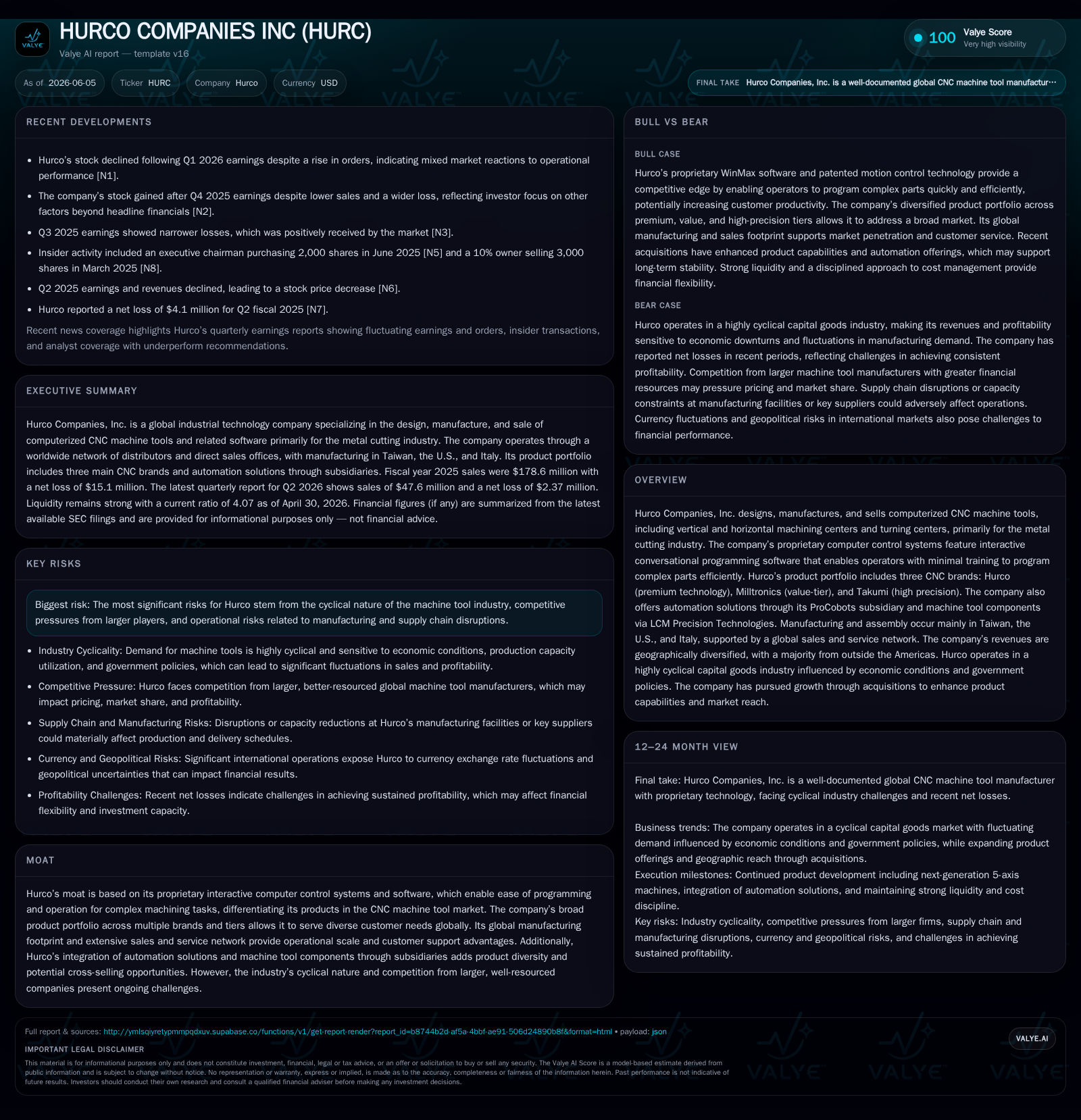
In its latest 10-Q filing dated June 5, 2026, Hurco Companies, Inc. reported a year-over-year increase in sales and service fees for Q2, reflecting resilience in a historically cyclical machine tool market. The company’s multi-brand CNC portfolio—anchored by proprietary interactive conversational programming—and broad geographic exposure underpin its ability to adapt to regional demand fluctuations and pricing pressures. While operational discipline and inventory management remain priorities amid modest volume growth, Hurco continues to invest in advanced automation solutions through subsidiaries like ProCobots and strategic product enhancements. The company’s strong liquidity position with no debt further supports its long-term technology development and market expansion strategy.
Second Quarter Operating Highlights
Hurco’s Q2 fiscal results published on June 5, 2026 show total sales and service fees of approximately $47.6 million, up from $40.9 million in the same quarter last year [S2]. This roughly 16% increase signals a positive near-term trajectory despite prevailing challenges in the capital equipment sector characterized by strong cyclicality. The company notes that ancillary service revenues such as maintenance contract fees are recognized on a prorated deferred basis over the contract term, reflecting a measured but stable recurring revenue component. Freight and training services occasionally provided remain immaterial relative to total contract values but form part of comprehensive customer support activities. Additionally, Hurco employs foreign currency forward contracts to manage inter-company exposure without hedging designation under FASB guidance; gains or losses flow through other income accordingly [S2]. Inventory levels remain actively managed to optimize turnover without compromising readiness for order variability inherent to the industry.
Hurco’s approach evidences operational discipline designed to maintain operating income stability while investing selectively in R&D and capacity enhancement initiatives in light of lower overall machine tool sales volumes globally.
Comprehensive Product Portfolio with Proprietary CNC Software Advantage
Central to Hurco’s business model is its patented interactive conversational programming software embedded in most CNC machines across its three brands: Hurco (premium technology), Milltronics (value-tier), and Takumi (high precision) [S1]. This software differentiates the offering by enabling both skilled machinists and less experienced operators to rapidly program complex parts directly from blueprints or CAD files without extensive coding knowledge. The rapid programming cycle times enabled can reduce overall manufacturing lead times—a critical advantage in short-run job shops or complex aerospace components requiring precision surface finishes.
The multi-brand portfolio serves distinct customer segments allowing Hurco to capture broader market share across different price points and application needs. While Hurco-branded controls emphasize cutting edge features with a focus on high productivity and profitability gains for customers, Milltronics machines target those needing robust but easy-to-use systems at more accessible prices. Takumi targets sectors such as die & mold, aerospace, or medical industries where ultra-high speed machining is essential; these machines employ industry-standard controls rather than proprietary software.
Beyond machine tools, subsidiaries like ProCobots extend Hurco’s revenue streams through automation integration equipment that complements machine tending processes—an important growth lever as manufacturing increasingly adopts robotics for labor efficiency. LCM Precision Technologies supplies high-value components enhancing vertical integration benefits.
Global Market Exposure and Competitive Positioning in the Machine Tool Industry
Hurco operates an international sales network comprising roughly 160 independent agents supported by direct sales organizations in key geographies including China, Europe (France, Germany, UK), India, Taiwan, Italy, and the U.S. This extensive footprint allows the company to tailor product offerings according to regional industrial dynamics [S1]. About 62% of revenues come from outside the Americas; notably around half of total revenue is generated from Europe where higher-end VMX series machines command stronger pricing due to greater precision demands amongst aerospace and defense manufacturers. Conversely, Asia Pacific customers exert more pricing pressure reflecting a more cost-sensitive market environment.
Manufacturing is concentrated across Taiwan (assembly), U.S., and Italy—a geographically diversified footprint that mitigates tariff shocks or supply chain disruptions prevalent amid global trade uncertainties. Key components are sourced globally but multiple suppliers are maintained per part specification further supporting operational flexibility [S1], [S22].
Competitive pressure arises primarily from large multinational CNC machinery manufacturers with deeper pockets for R&D investment; however, Hurco’s proprietary controls software provides a competitive moat that competitors using standard industry hardware/software cannot easily replicate. The company leverages this alongside its multi-brand strategy to maintain market relevance despite scale differences.
Growth Catalysts: Market Expansion and Automation Integration
Hurco has been proactive in acquisitions since 2013 aimed at elevating machine accuracy and broadening production capabilities—particularly enhancing precision vital for medical device or aerospace applications where tolerances are tightest [S1]. These strategic moves also introduced automation solutions via ProCobots positioning Hurco within an expanding addressable market encompassing robotic machine tending setups.
Geographic expansion targets emerging regions where industrialization spurs demand for flexible machining solutions not met fully by incumbent heavyweights. Additionally, adding non-Hurco branded products such as laser cutting machines or Swiss lathes further diversifies revenue streams beyond core CNC mills/turns.
Inventory management emerges as a tactical lever enabling cash flow efficiency—holding sufficient stock buffers yet avoiding excess capital tied up during cyclical downturns [S1]
Risk Factors and Cyclical Challenges Impacting Performance
Cyclicality remains the foremost risk directly influencing demand elasticity for capital-intensive equipment like CNC machine tools; sudden shifts in end-customer capital expenditure plans can significantly fluctuate order flows impacting quarterly results unpredictably [S1]. Macro uncertainties—geopolitical tensions causing tariff volatility—and ongoing global economic stress extend lead times or defer purchase commitments depressing near-term sales momentum.
Supply chain risks related to international manufacturing networks could strain production schedules if single points of failure emerge among suppliers or factory disruptions occur. Competition imposes margins compression threats particularly against financially stronger multinational incumbents willing to underprice smaller players temporarily.
Nonetheless, Hurco addresses these risks through cost containment efforts initiated since fiscal years 2024-25 combined with balance sheet conservatism reducing financial leverage exposure ensuring flexibility during rough cycles.
What to Monitor Next: Order Trends, Margin Developments, and Innovation Pipeline
Investors should focus on upcoming quarterly disclosures detailing order backlog evolution which will signal whether demand strength sustains or softens further given macro headwinds [S2],[S3]. Progression of new product rollouts including control system upgrades or automation integration options will provide insight into the success of innovation efforts grounded in proprietary software advantage.
Margin trajectories will reflect both raw material cost pass-through efficacy plus operational efficiencies realized from leaner overhead structures implemented during recent periods. Management commentary around capital expenditure plans or acquisition targets will be indicative of forward-looking growth ambitions balanced against current cyclical pressures.
Concise Financial Overview Supporting Operational Insights
As of April 30, 2026, Hurco holds approximately $50 million in cash and equivalents with no outstanding debt reported—a net cash position that offers substantial liquidity cushion amid fluctuating working capital needs [F1], [S2].
Maintenance contract-related deferred revenues contribute marginal recurring fee streams albeit service fees remain immaterial compared to product sales volume—the senior management explicitly incorporates rigorous discounting policies maintaining revenue recognition integrity without inflating top-line metrics artificially [S2]. Share-based compensation granularity reveals controlled equity grant activities supporting employee retention aligned with long-term performance goals.
Overall financial posture underscores prudent stewardship enabling Hurco to persistently fund technology advancements strengthening product differentiation despite cyclicality-induced margin compression risks.
DISCLAIMER: This analysis is based solely on public filings dated through June 5, 2026 without any investment research view implied or expressed.
Disclaimer: This is research-only, informational analysis and not investment advice. It may include AI-generated interpretation and general industry context. Always verify important details using primary sources.

Comments