
GSI Technology Advances Edge AI Revenue Forecast Amid Strategic Review
Latest filings reveal GSI balancing legacy SRAM sales with emerging associative compute investments amid strategic alternatives exploration.
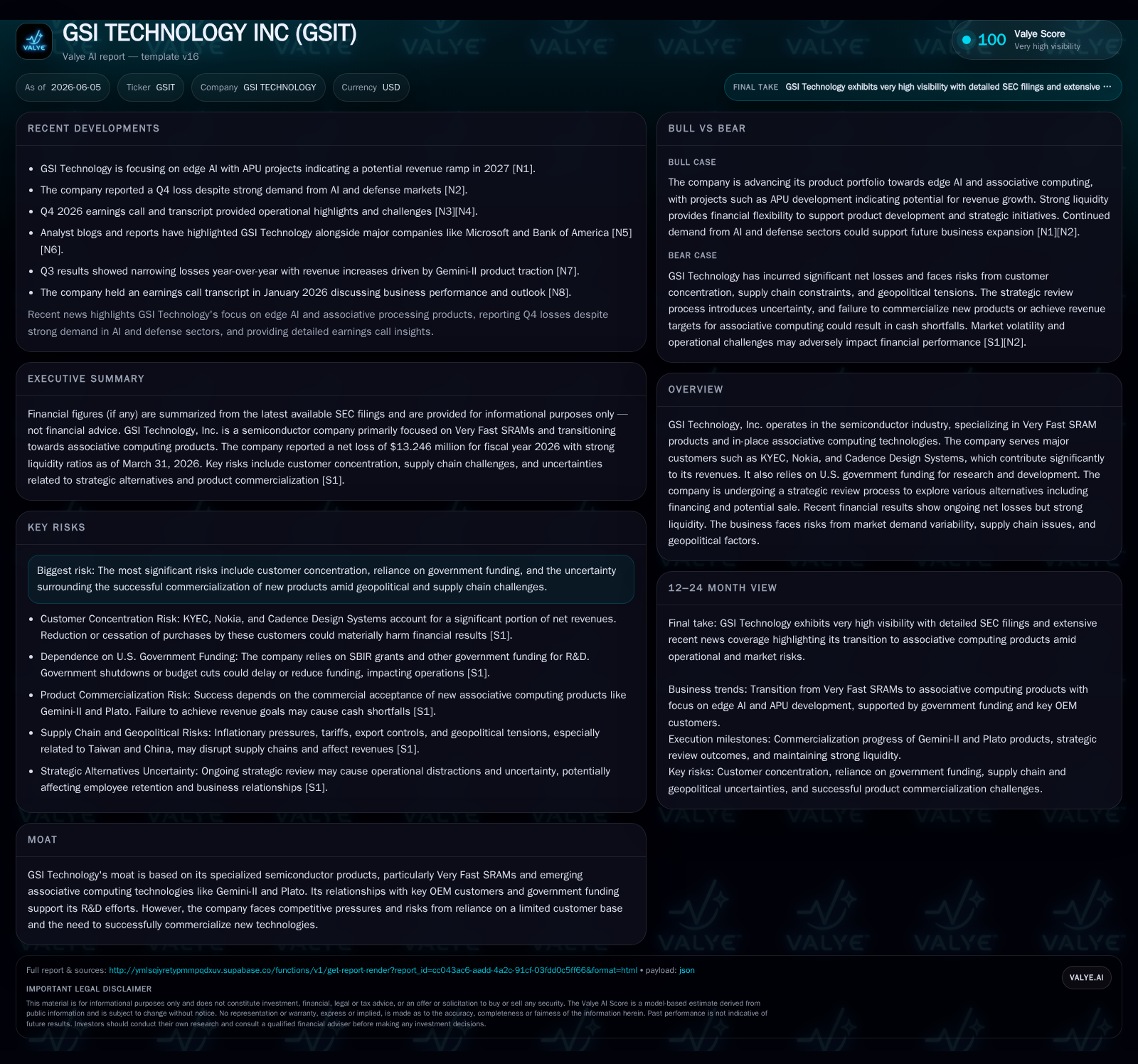
GSI Technology’s Q3 2026 10-Q underscores continued net losses offset by solid cash reserves, driven by legacy Very Fast SRAM sales to major OEMs. Concurrently, executive compensation ties unveiled in an 8-K highlight management’s focus on ramping revenues from its novel Associative Processing Unit (APU) technology targeting edge AI markets. The semiconductor firm's strategic review announced in early 2026 signals potential structural shifts as it navigates challenges including customer concentration risk and complex product commercialization dynamics.
Latest Quarterly Update: Operational Highlights from Q3 2026 Filing
GSI Technology’s latest Form 10-Q filed on February 6, 2026, paints a picture of a company balancing its established legacy SRAM business with an ambitious push into associative computing innovation [S2]. Despite sustained operating losses exceeding $13 million for the fiscal year ending March 31, 2026 [F1], GSI maintains robust liquidity with over $67 million in cash and equivalents and a strong current ratio of approximately 8.6 [F1]. This financial strength provides runway while the firm navigates fluctuating demand patterns from customers such as KYEC, Nokia, and Cadence Design Systems—its three largest contributors to revenues that together constitute a material portion of total sales [S2][S4].
Alongside these operating results is an ongoing strategic evaluation initiated earlier in the year that contemplates various futures including financing options or even sale [S18]. Management commentary tied to these developments surfaced in a May 2026 compensation filing revealing a new Variable Compensation Plan linking executive bonuses directly to net revenues from both legacy SRAM products and the emerging Associative Processing Unit (APU) lines as well as R&D offsets [S3]. This innovative incentive structure highlights the company's dual commercial thrusts—from sustaining dependable SRAM revenue streams to accelerating near-term monetization of its compute-in-memory edge AI architectures.
Business Model Deep Dive: SRAM Revenues Anchor While APU Emerges
GSI's business model is distinctly two-pronged. Its cornerstone remains Very Fast synchronous Static Random Access Memory (SRAM) chips, which generate most current revenues by serving high-performance applications across test & measurement instrumentation, telecommunications infrastructure, and aerospace/defense sectors [S1]. The firm claims to offer one of the broadest portfolios of high-density synchronous SRAM products available—a competitive advantage given these devices’ critical roles where ultra-low latency and reliability define purchasing decisions. These mature products are sold primarily to contract manufacturers and distributors who supply leading OEMs such as KYEC and Nokia [S4], accounting for significant line-item revenue stability despite some downside risks from evolving OEM internal strategies.
Concurrently, GSI invests heavily in developing an innovative range of Associative Processing Units (APUs), a compute-in-memory architecture optimized for edge AI workloads requiring rapid contextual analysis with minimal power use [S1][N1]. The Gemini series APUs (Gemini-I fully produced; Gemini-II pre-production) emphasize time-to-first-token speed advantages pivotal for multi-modal vision-language models in real-time physical AI scenarios [S21]. Although revenue from APUs remains nascent thus far [S1][S21], their successful commercialization promises transformational growth potentially reshaping GSI’s addressable market exposure beyond traditional memory components.
Customer and Market Concentrations: Risks Embedded in Major OEM Dependencies
A dominant feature underpinning GSI’s operational landscape is its heavy customer concentration risk. Three major customers—KYEC, Nokia, and Cadence Design Systems—cumulatively contributed approximately one-third or more of total revenues recently [S4][S23][S24], creating material volatility susceptibilities. KYEC alone accounted for roughly 14% of net revenues in fiscal 2026 but demonstrated significant prior fluctuations (up to 23% in fiscal 2025) attributed partly to channel inventory variability [S24]. Similarly, Nokia's contribution has been sharply declining over recent years—from roughly 21% down to below 6%—reflecting its internal transition toward alternate memory solutions displacing GSI's products [S24]. These dynamics underscore inherent unpredictability impacting GSI’s quarterly revenue recognition and overall financial performance.
The firm sells mostly through distributors (comprising over 90% of sales), whose purchase decisions are influenced by OEM requirements and supply chain conditions [S4]. This adds complexity to forecasting demand amidst end-customer shifts and external headwinds such as macroeconomic cycles or geopolitical trade constraints. Such concentration contrasts against larger semiconductor peers with more diversified customer bases and product mixes but is somewhat typical among specialized component suppliers catering to niche military or telecommunications segments.
Industry Position: Specialized SRAM Market Dynamics and Compute-in-Memory Innovation
Within the semiconductor ecosystem, GSI operates at the intersection of highly specialized SRAM manufacturing and pioneering associative computing innovation. Its longstanding presence delivering Very Fast synchronous SRAMs gives it credence among defense-related customers who value radiation-hardened variants—a segment characterized by high barriers due to rigorous qualification requirements and limited direct competition [S11]. While this niche ensures some insulation against commoditization forces seen elsewhere in memory markets, the scale remains relatively modest compared to mainstream DRAM or flash vendors.
On the other hand, GSI’s APU technology stakes claim to transformative potential within edge AI hardware—an arena attracting significant investment across GPU-accelerated platforms (NVIDIA), FPGA suppliers (Xilinx/AMD), and emergent compute-in-memory startups. The APU’s architectural advantage lies in reducing data movement costs by embedding compute capabilities directly within memory arrays—a structural efficiency critical for size-, weight-, and power-constrained edge deployments [S1]. Yet commercialization hurdles persist given incumbent dominance by CPU/GPU/FPGA incumbents with massive ecosystems plus supply chain scale advantages.
Growth Catalysts: Edge AI Demand and Strategic Incentives Align with Product Roadmap
Looking ahead, several growth drivers position GSI at an inflection point. Market analyst estimates suggest the Serviceable Available Market for associative processing units in edge AI could grow at a CAGR near 20% through 2030 from a $7 billion base in 2025—a trajectory underpinning management’s accelerated commercialization efforts [S21]. The Gemini-II APU's pre-production shipments along with first smart city deployments mark early execution milestones validating real-world application potential [S21][N1].
Strengthened alignment between strategic goals and executive pay through the new Variable Compensation Plan enacted May 2026 serves as an operational lever ensuring leadership focus on hitting tangible revenue thresholds from both SRAM legacy products and evolving APUs plus optimizing R&D funding utilization [S3]. Such KPI-linked compensation is uncommon at smaller fabless firms but reflects seriousness about measured progress amidst technological transformation.
Risks to Monitor: Product Commercialization, Customer Concentration, and Geopolitical Factors
Despite promising avenues, key risks warrant close attention. The primary challenge lies in successfully scaling APU revenues beyond proof-of-concept phases given entrenched competition and long sales cycles compounded by technological risks inherent in disruptive architectures [S15]. Persistent reliance on U.S. government funding for R&D heightens vulnerability to policy uncertainty or appropriations lapses that may delay project timelines or increase cost burdens [S15].
Moreover, customer concentration issues expose GSI to order volatility risks; contract manufacturers can also shift supplier preferences rapidly based on price or technological fit considerations outside GSI’s control. Geopolitical tensions—including export controls on dual-use technologies—add layers of compliance complexity impacting product availability across global markets especially relevant given industry-wide wafer supply dependencies on TSMC foundries [S15]. Inflationary pressures affecting wafer costs and assembly add moderate margin pressure risking delayed profitability improvements.
Outlook and Next Milestones: Guidance Signals and Execution Watchpoints
Stakeholders should closely track upcoming quarterly revenue disclosures for signs of meaningful ramping APU sales starting calendar year 2027 aligned with initial production orders referenced earlier [N1][N2][N3][S21]. Additional Department of Defense contract milestones under Small Business Innovation Research programs may offer timely validation points along with commercial traction announcements from smart city projects underway [S21].
Strategic review outcomes expected within the coming months could materially affect capital structure or ownership status reflecting management’s openness to financing or transactional alternatives hinted at since March 2026 [S18], underscoring execution risk during this critical pivot period.
Brief Financial Profile: Liquidity Strength vs. Continued Operating Losses
As of March 31, 2026, GSI maintained $67.2 million in cash and equivalents supporting operations against modest current liabilities totaling $9.2 million—a current ratio of about 8.6 indicating comfortable short-term liquidity coverage [F1]. Despite this balance sheet cushion, operating income remained negative near -$17.5 million while net losses totaled -$13.2 million for fiscal year ended March 2026 reflecting continued investment load primarily into APU development alongside ongoing fixed cost absorption inherent at this stage [F1]. The absence of reported debt further anchors liquidity but underscores dependency on either organic cash generation improvement or external capital injections going forward.
In summary, GSI Technology stands at a juncture defined by leveraging its entrenched SRAM expertise while pushing frontier compute-in-memory innovations into promising but commercially uncertain edge AI markets. Sharp customer concentration risk combined with complex geopolitical landscapes forms notable headwinds requiring careful execution management supported by aligned leadership incentives revealed recently. Continued monitoring of quarterly results against stated performance criteria will be essential to assess if GSI successfully transitions toward sustainable growth engines amid ongoing strategic review processes.
This analysis is based solely on publicly available data cited herein up to June 5, 2026. It does not constitute investment advice.
Disclaimer: This is research-only, informational analysis and not investment advice. It may include AI-generated interpretation and general industry context. Always verify important details using primary sources.

Comments