
Ooma's Subscription Surge: Profitability and Integration Drive Growth in Fiscal 2026
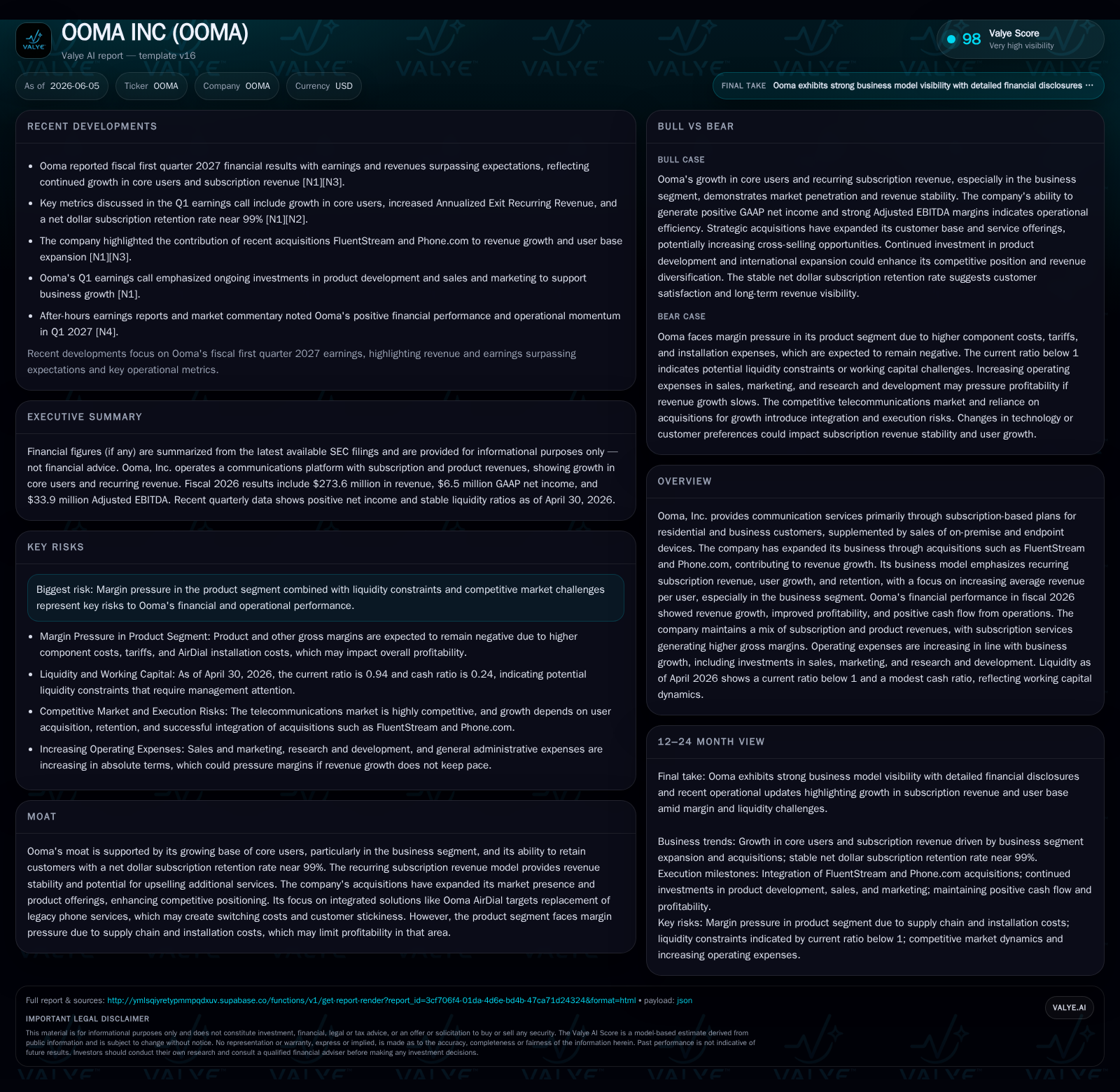
Ooma’s fiscal Q1 2027 results highlight accelerating subscription revenue growth fueled by acquisitions and user expansion, amid persistent product segment margin pressure.
Ooma Inc reported strong momentum in its subscription-based business during fiscal Q1 2027, driven notably by organic growth in its Ooma Business user base and integration of recently acquired FluentStream and Phone.com. This expansion underpins improving profitability as subscription revenues, which carry higher gross margins, increasingly dominate the mix. However, persistent cost pressures in the hardware device segment weigh on overall margin gains. Going forward, the company’s ability to deepen customer wallet share and manage product-related costs alongside sustaining its near-99% net dollar retention rate will be crucial to maintaining growth and financial health.
Q1 Fiscal 2027 Results: Acquisition Impact and User Growth Momentum
Ooma’s latest quarterly filing for the period ended April 30, 2026 [S2] reveals a continuation of its strategic momentum toward subscription-driven growth. The first quarter saw a tangible uplift attributable to both organic expansion of its core Ooma Business users and integration benefits from late-2025 acquisitions FluentStream and Phone.com [S1]. These acquisitions contributed approximately $6.1 million in revenue in fiscal 2026, boosting total revenue past $273 million for the year with a 7% YoY rise largely concentrated within the business subscription segment.
The company's earnings release highlighted positive cash flow from operations amounting to $27.7 million in fiscal 2026, underscoring healthy underlying cash conversion despite ongoing investment for growth [S1],[S3]. The infusion of new users and services supports a narrative of strengthening market traction particularly within small- and medium-sized business customers.
Subscription-Centric Business Model Driving Revenue Quality
At the core of Ooma’s model is a subscription service framework that generates stable, recurring revenue streams [S1]. Fiscal year data shows that subscription revenue from Ooma Business increased by about 10%, reflecting robust user additions combined with upselling efforts enhancing average revenue per user (ARPU). This recurring subscription focus is critical; it delivers higher gross margins relative to hardware product sales—61% total gross margin maintained through fiscal 2026 attests to this structure [S1].
A key competitive moat lies in Ooma’s net dollar retention rate near 99%, which signals an ability not only to keep customers but also expand their spending over time via additional services and features [S1]. Although hardware device sales add valuable revenue streams, they operate under tighter margins due to component costs and installation expenses.
Industry Positioning: Competing Amid Legacy Replacement and Cloud Trends
Ooma strategically positions itself as an integrated communications solution that targets replacement of legacy analog phone systems — an area where legacy telcos have traditionally dominated [S1],[N12]. Its flagship offering, Ooma AirDial, exemplifies this approach by bundling cloud-communication flexibility with endpoint device support, aiming to create switching costs and elevated customer stickiness.
However, competitive pricing pressures loom as legacy providers pivot toward VoIP offerings themselves while more pure-play cloud SaaS communication platforms compete on feature breadth and ecosystem integration. Ooma’s hybrid model balances these forces but requires continued innovation to differentiate [S1],[N12].
Growth Drivers: Upselling, Retention, and Market Expansion via Acquisitions
Growth engines appear multifaceted. Organic user base expansion remains vital — the Ooma Business segment’s consistent core user additions fuel baseline subscription revenue increases [S3]. Concurrently, management emphasizes incremental revenue from upselling premium features that enhance ARPU. The recent acquisitions of FluentStream and Phone.com broaden geographic reach and client verticals served, creating cross-selling opportunities.
Investment in R&D alongside sales and marketing targets further new service introductions enhancing value proposition for business customers [S1],[S3]. Maintaining low churn rates amidst market competition also protects these revenues.
Margin Pressure in Product Segment: Supply Chain and Cost Challenges
Product segment challenges persist as component supply chain constraints inflate procurement costs while field installations add operational complexity [S1]. These factors compress product gross margins despite growing device sales revenues. Given that product revenues command lower margins than subscriptions, the overall profitability could face caps unless efficiency gains or price adjustments are realized.
This dynamic underscores a structural headwind for overall margin improvement despite promising top-line trends.
Risks and Watchpoints: Churn, Competitive Pricing, and Liquidity Constraints
While customer churn remains low especially in business subscriptions—a major strength—any uptick could materially impact financial outcomes given the subscription model dependency [S1],[S2]. Competitive pricing pressures from both traditional telecoms transitioning to VoIP services and emerging SaaS communication providers also threaten margin expansion.
Notably, at quarter-end April 30, 2026 the company shows a current ratio below unity (0.94) owing to higher current liabilities relative to assets [F1], suggesting working capital tightness that calls for monitoring though no immediate solvency concerns are evident due to cash reserves exceeding $17 million [F1]. Maintaining efficient liquidity management will be crucial as operating expenses scale.
Looking Ahead: Monitoring Demand Signals and Execution Milestones
Key metrics to watch include core user additions next quarter, shifts in ARPU reflecting upsell effectiveness, gross margin stability amid product cost pressures, and execution progress integrating recent acquisitions [S3],[N1,N2,N3].
R&D returns delivering innovative services targeting SMB clients would support sustained growth beyond basic voice replacement. Success lowering churn further or expanding into adjacent industry verticals can visibly enhance the company’s market footprint.
Brief Financial Snapshot: Cash Position, Debt, and Profitability
The latest financial data show Ooma holding approximately $17.2 million in cash as of April 30, 2026 with nominal debt near $0.6 million — resulting in a net cash position supportive of ongoing operations [F1]. Fiscal year ending January 31, 2026 reflected a positive GAAP net income of $6.5 million compared to prior year losses. Adjusted EBITDA reached $33.9 million representing about 12% margin performance [S1].
This capital structure supports measured investments into R&D and marketing while managing margin headwinds associated with hardware products. Continued cash flow from operations above $27 million signals solid underlying business health at present.
This analysis is based solely on information contained in publicly filed SEC documents along with verified news sources through June 5th, 2026. It does not constitute investment advice or a research view regarding securities of Ooma Inc or any other entity.
Disclaimer: This is research-only, informational analysis and not investment advice. It may include AI-generated interpretation and general industry context. Always verify important details using primary sources.

Comments