
Enact Holdings’ Strategic Balance of Risk and Capital in Mortgage Insurance
An analysis of how Enact Holdings leverages underwriting discipline, proprietary risk models, and capital strategies to sustain growth and optimize returns in the U.S. mortgage insurance market.
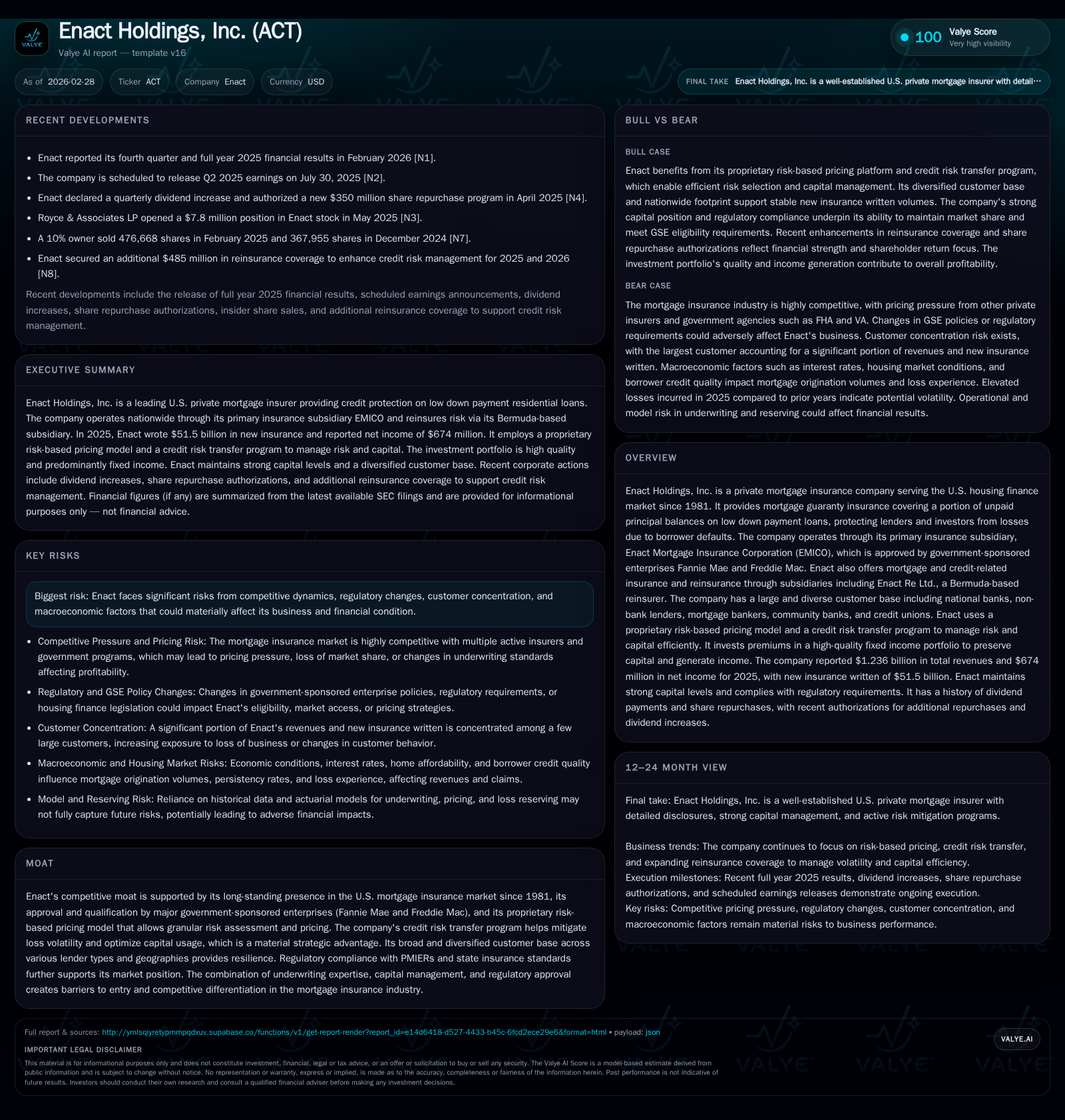
Enact Holdings, a leading private mortgage insurer since 1981, has maintained steady revenue growth and profitability by focusing on granular risk-based pricing and innovative credit risk transfer (CRT) programs. Its large and diverse customer base, combined with regulatory compliance and a well-capitalized balance sheet, underpin resilience amid evolving housing finance dynamics. Key drivers include disciplined underwriting, investment portfolio management, and opportunistic capital returns via dividends and share repurchases.
Track Record of Growth and Profitability in a Competitive Market
Since its founding in 1981, Enact Holdings has established itself as a key player in the U.S. private mortgage insurance (PMI) sector by providing credit protection on low down payment loans. The company reported new insurance written (NIW) of approximately $51.5 billion for fiscal year 2025—a figure consistent with $51.0 billion in 2024 and $53.1 billion in 2023 [N1][S14]. This volume stability is supported by a broad customer base of about 1,600 mortgage lenders ranging from national banks to community credit unions.
Revenues increased steadily from $1.095 billion in 2022 to $1.236 billion in 2025, reflecting a compound annual growth rate near 2.8% [F1]. Net income rose to $674 million in 2025 from $546 million in 2021, with a notable year-over-year increase of approximately 23% compared to 2024 [F1]. Operating cash flow also expanded to $724 million in 2025, underscoring strong cash generation from core operations [F1]. These financial outcomes align with Enact’s disciplined premium pricing strategies coupled with stringent underwriting controls.
Adjusted operating income reached $688 million for fiscal year 2025 [N1], illustrating operational resilience amid shifting mortgage market conditions.
Historical performance (annual)
| FY | Rev ($mm) | CFO ($mm) | Rev YoY |
|---|---|---|---|
| 2025 | 1236 | 725 | +2.8% |
| 2024 | 1202 | 686 | +4.2% |
| 2023 | 1154 | 632 | +5.4% |
| 2022 | 1095 | 561 |
Source: SEC companyfacts cache [F1].
Capital returns and efficiency (annual)
| FY | Div ($mm) | Buybacks ($mm) |
|---|---|---|
| 2025 | 121 | 382 |
| 2024 | 112 | 244 |
| 2023 | 213 | 88 |
| 2022 | 251 | 2 |
Source: SEC companyfacts cache [F1].
Note: Fiscal years correspond to calendar years ended December.
Evolving Underwriting Model and Proprietary Risk-Based Pricing
Enact’s underwriting is distinguished by a proprietary risk-based pricing model that evaluates borrower credit quality on a granular loan-level basis [S1][S7]. This methodology allows premium rates to closely reflect the specific risk profiles of individual mortgages rather than relying on broad rate cards common among competitors.
The model incorporates decades of historical loan performance data enabling dynamic adjustments based on delinquency trends or claim severity while maintaining alignment with government-sponsored enterprise (GSE) requirements such as those from Fannie Mae and Freddie Mac [S14]. This sophisticated approach supports effective pricing across purchase versus refinance business segments and geographic regions while prudently managing loss exposure.
Customers receive visible but confidential rate schedules—often through advanced technology platforms—balancing competitive pricing pressures with protective capital management.
Credit Risk Transfer Program: A Cornerstone of Capital Optimization
A key element of Enact’s capital management strategy is its comprehensive credit risk transfer (CRT) program [S1][S7]. This program includes excess-of-loss reinsurance agreements that cap losses beyond specified thresholds, quota share treaties sharing premiums and losses proportionally with reinsurers, and Issuer Loan Notes (ILNs) transferring risk exposure to third-party investors via collateralized structures.
The CRT framework mitigates earnings volatility caused by spikes in mortgage defaults by transferring substantial loss layers off Enact’s statutory balance sheet while providing regulatory capital relief under PMIERs standards.
This risk transfer enhances return on equity through efficient capital use without compromising underwriting discipline or claims reserve adequacy—critical advantages given economic cyclicality.
As of December 31, 2025, Enact maintains protections against severe downside scenarios through exposure spread among high-credit-quality counterparties backed by collateral pools exceeding $336 million [S22].
Investment Portfolio Strategy Supporting Liquidity and Returns
At year-end 2025, Enact’s investment portfolio was valued at approximately $6.05 billion consisting primarily of investment-grade fixed maturity securities rated predominantly AA or above [S11][S1]. The portfolio duration extended modestly to about 4.7 years with a pre-tax yield near 4.4%, reflecting prudent positioning amid rising interest rates.
The company employs a buy-and-hold philosophy matching asset maturities against expected liabilities while prioritizing liquidity preservation [S1]. Genworth acts as the primary external manager for insurance subsidiary assets under defined mandates governing issuer concentration, sector diversification, and credit quality.
Regular stress testing ensures liquidity sufficiency under multiple adverse scenarios protecting claims payment capacity during periods of elevated defaults or market stress.
Critical Milestones and Regulatory Compliance Ahead
Enact’s operations depend on strict adherence to regulatory frameworks including Private Mortgage Insurer Eligibility Requirements (PMIERs), state insurance laws, and approvals from GSEs like Fannie Mae and Freddie Mac [S20][S14].
PMIERs impose rigorous capital adequacy standards requiring minimum surplus relative to insured risk-in-force (RIF). Enact manages leverage within an RIF-to-capital ceiling enforced by GSEs.
Potential changes from FHFA or shifts in GSE underwriting policies could materially affect permissible risk levels or capital requirements possibly limiting new insurance writing capacity; thus regulatory developments are key milestones for ongoing monitoring.
Maintaining compliance strengthens Enact’s competitive moat given the high barriers for entrants needing similar approvals alongside established counterparty trust.
Capital Deployment: Dividends, Buybacks, and Future Allocation Choices
Supported by strong balance sheet metrics and operating cash flow exceeding $724 million for FY2025 [F1], Enact pursues balanced shareholder returns through dividends alongside opportunistic share repurchases [S5].
Dividend payments totaled approximately $121 million in FY2025 compared to higher historic levels such as $251 million in FY2022—reflecting prudent capital conservation amid macroeconomic uncertainty [F1]. Buybacks increased significantly to about $382 million in FY2025 demonstrating management's commitment to efficient equity allocation while maintaining alignment with principal shareholder Genworth [F1][S5].
An approximate return on equity of 12.6% for FY2025 underscores disciplined capital deployment balancing growth ambitions against prudent capitalization [F1].
Future capital returns will remain flexible depending on evolving market conditions together with ongoing PMIERs compliance demands [S5].
Navigating Macroeconomic Headwinds and Competitive Pressures
Despite resilient fundamentals buoyed by underwriting rigor and CRT buffers, Enact faces external risks detailed extensively within its disclosures [S20]. Key challenges include fluctuations in mortgage origination volumes tied closely to interest rates affecting refinancing activity; potential increases in delinquencies impacting claim frequency; and intensifying competition driven by automated lender selection tools emphasizing price.
Regulatory uncertainty around possible reforms affecting GSE charters or enhanced capital frameworks may impose tighter operational constraints reducing market access or increasing reserve requirements.
Monitoring normalized claim severities alongside persistency rates will be essential for early detection of trends influencing earnings volatility despite CRT mitigants. Enact's diverse customer mix across multiple channels helps mitigate localized economic downturns but systemic residential mortgage credit risks remain inherent.
Disclaimer: This analysis is based solely on information available as of February 28, 2026—including public SEC filings ([F1], [S#]) and verified news sources ([N#]). It is intended as an informational overview without providing any form of investment advice or recommendation regarding securities of Enact Holdings, Inc.
Disclaimer: This is research-only, informational analysis and not investment advice. It may include AI-generated interpretation and general industry context. Always verify important details using primary sources.

Comments