
Contineum Therapeutics Stakes Claim in Neuroinflammation with PIPE-791 and PIPE-307 Advancements
Clinical-stage Contineum advances dual small molecule candidates in IPF, CNS disorders while managing increasing R&D costs and strategic partnership dynamics.
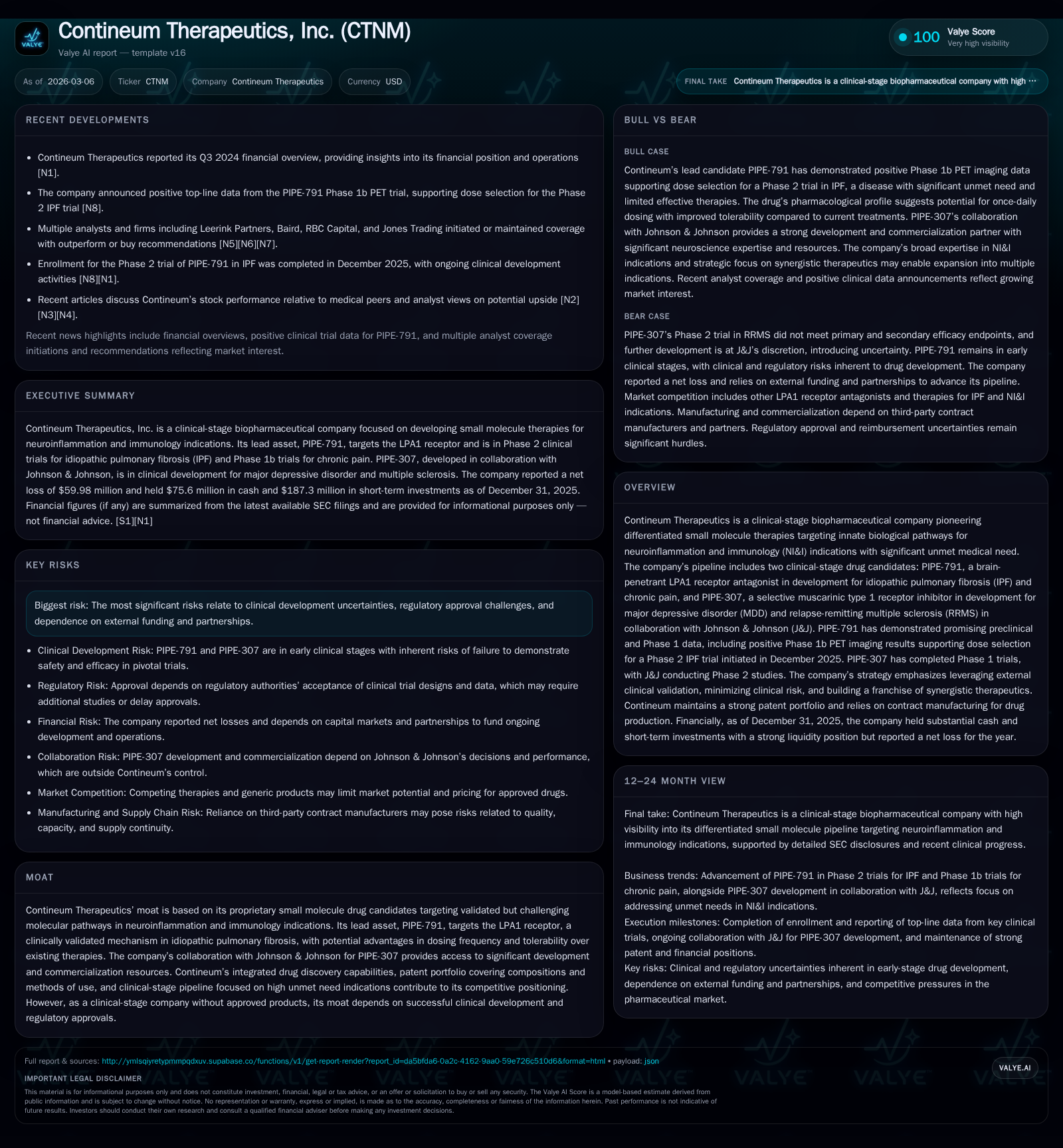
Contineum Therapeutics is progressing its clinical-stage pipeline targeting innate neuroinflammatory and immunological pathways through two lead small molecule candidates: PIPE-791 for idiopathic pulmonary fibrosis (IPF) and chronic pain, and PIPE-307 for major depressive disorder (MDD) and relapse-remitting multiple sclerosis (RRMS) in collaboration with Johnson & Johnson. The company’s FY2025 financials reflect deepening operating losses driven by intensified clinical activities, with operating income declining 33.7% and net loss widening by 41.9% year-over-year amid cash flow pressures. PIPE-791 has advanced into a Phase 2 IPF trial following positive Phase 1b PET receptor occupancy data, whereas PIPE-307’s RRMS Phase 2 trial failed to meet efficacy endpoints, leaving further development contingent on J&J's strategic discretion. Near-term catalysts include mid-2026 chronic pain data from PIPE-791’s Phase 1b study and ongoing Phase 2 enrollment for MDD indications. Contineum’s robust liquidity position supports continued R&D investment; however, regulatory, clinical, and funding risks remain prominent.
From Discovery to Trials: Tracking Contineum's Growth Journey
Contineum Therapeutics has evolved as a focused clinical-stage biopharmaceutical player concentrated on novel small molecule therapies addressing neuroinflammatory and immunological pathways implicated in diseases with high unmet medical need. Historically, the company has escalated R&D expenditures commensurate with its advancement from discovery into early and mid-stage clinical trials across two primary assets, resulting in magnified operating losses.
Fiscal year 2025 underscores this trajectory with operating losses expanding substantially to $68.06 million compared to $50.89 million in FY2024 — a worsening of roughly one-third year-over-year [F1]. The net loss accelerated even more acutely by nearly 42% to $59.98 million over the same period, reflecting both intensifying program costs and associated general corporate expenses. Operating cash flow suffered a steeper contraction of over two-thirds, down to negative $55.31 million from negative $32.85 million, signaling increased cash consumption typical for clinical-stage biotechs heavily investing ahead of pivotal data readouts [F1]. Capital expenditure remained tightly controlled at $0.23 million for FY2025, down over half from FY2024 levels, consistent with focus on agile clinical funding rather than fixed asset expansion [F1]. Notably, strong balance sheet fundamentals persist; equity grew to nearly $261 million while the current ratio soared above 27x—a substantial buffer illustrating solid short-term liquidity management amid costly trials [F1]. The following table summarizes key annual financial metrics:
Historical performance (annual)
| FY | Net ($mm) | CFO ($mm) | OpInc ($mm) | Capex ($) | Net YoY |
|---|---|---|---|---|---|
| 2025 | -60 | -55 | -68 | 231000 | -41.9% |
| 2024 | -42 | -33 | -51 | 514000 |
Source: SEC companyfacts cache [F1].
Capital returns and efficiency (annual)
| FY | FCF ($mm) | ROE% |
|---|---|---|
| 2025 | -56 | -23.0 |
| 2024 | -33 | -21.3 |
Source: SEC companyfacts cache [F1].
Data sourced from company XBRL filings [F1]
PIPE-791: Advancing LPA1R Antagonism in Pulmonary Fibrosis and Chronic Pain
PIPE-791 represents Contineum's wholly-owned lead candidate designed as a brain penetrant lysophosphatidic acid receptor subtype 1 (LPA1R) antagonist — a clinically validated target implicated in idiopathic pulmonary fibrosis (IPF). The compound exhibits favorable pharmacokinetics characterized by high bioavailability, selectivity, low plasma protein binding, and extended receptor residence time supporting potential advantages over existing therapeutics through improved dosing frequency and tolerability profiles [S1].
In September 2025, Phase 1b PET imaging data illuminated clear receptor occupancy at planned doses—an industry gold standard biomarker confirming target engagement critical for dose optimization ahead of efficacy studies [S1]. This enabled Contineum to advance PIPE-791 into an active Phase 2 IPF trial initiated December 2025—a significant regulatory milestone given IPF's progressive fibrotic nature and limited therapeutic options.
Further extending its portfolio expansion strategy, Contineum completed enrollment in Q4 2025 of a randomized, double-blind placebo-controlled Phase 1b crossover study probing safety and preliminary efficacy signals of oral PIPE-791 in chronic osteoarthritic pain (COAP) and chronic low back pain (CLBP). These indications broaden potential market applicability while leveraging neuroinflammatory mechanisms analogous to pulmonary fibrosis [S1]. Top-line outputs from this trial are slated for release by mid-2026 ([N1], [S1]).
From a development standpoint, leveraging receptor occupancy measured via PET imaging optimizes dose selection paramount to accelerating development timelines within the highly competitive LPA1R antagonist niche where balancing central nervous system penetration without off-target effects remains challenging.
Navigating PIPE-307 Development with Johnson & Johnson Partnership
PIPE-307 is Contineum's selective muscarinic type 1 receptor inhibitor targeting neuropsychiatric indications such as major depressive disorder (MDD) and relapse-remitting multiple sclerosis (RRMS). Unlike PIPE-791, this asset benefits from an exclusive worldwide licensing agreement with Johnson & Johnson that encompasses development rights including manufacturing and commercialization capabilities—a strategic alliance providing significant resource leverage yet also ceding considerable operational control [S1].
Clinical advances include successful completion of two Phase 1 studies in healthy volunteers preceding initiation of J&J-led Phase 2 trials:
- The Moonlight-1 proof-of-concept study for MDD commenced recruiting approximately 124 adults as of December 2024 focusing on monotherapy efficacy evaluations [S1].
- VISTA trial targeting RRMS patients reported topline results in November 2025 showcasing acceptable safety at investigated doses but failing to meet primary or secondary efficacy endpoints—highlighting challenges underscored by rigorous disease heterogeneity [S1].
The absence of efficacy signals places future PIPE-307 development squarely under J&J’s discretion per their licensing terms which could influence subsequent investment or termination decisions [S1]. This arrangement exemplifies risk sharing but also dependency intrinsic to pharma collaborations wherein milestone payments hinge upon progression milestones.
Clinical Trial Outcomes and Future Milestones
Contineum’s recent clinical disclosures reveal divergent trajectories across its dual asset platform:
PIPE-791 enjoyed favorable early phase biomarker validation permitting initiation of pivotal Phase 2 studies for IPF while expanding indication reach into chronic pain syndromes pending upcoming data readouts anticipated Q2 2026 ([N1], [S1]). Positive receptor occupancy findings foster confidence in appropriate dosing strategies essential for demonstrating therapeutic benefit within fibrotic lung disease.
Conversely, PIPE-307's mixed outcomes—with safety established but efficacy unproven in RRMS—highlight typical biologic complexity encountered when developing CNS-disorders therapeutics ([N3], [S1]). Investment focus currently shifts toward MDD evaluation where ongoing randomized placebo-controlled trials may clarify clinicians' appetite for mechanism-based novel agents.
Upcoming milestones include:
- Mid-year expectation for COAP/CLBP data from PIPE-791 testing dosing rationale extension into neuropathic pain;
- Patient recruitment progress or interim analyses updates from the J&J-led Moonlight-1 MDD study;
- Any formal developments regarding J&J’s strategic decision-making post-RRMS failure will materially affect investor perception on commercial viability ([N2]).
Monitoring these catalysts alongside regulatory communications will provide critical visibility into Contineum's advancing value proposition within a crowded neuroimmunomodulation therapeutic marketplace.
Financial Health Check: Underlying Metrics and Capital Deployment
The fiscal profile portrays Contineum sustaining expected losses inherent to firms prioritizing clinical innovation absent generating product revenues:
Operating cash flow plunged nearly seven-tenths YoY to negative $55.31 million reflective of ramped expenditures directed principally at advancing both pipelines forward ([F1]). Free cash flow approximates negative $55.54 million considering minimal capital expenditure below $0.25 million signaling deliberate cost containment over infrastructure spending typical among asset-centric drug developers ([F1]).
Equity grew robustly from just under $198 million to around $261 million during fiscal year ending December 2025 underscoring capital raises that augment runway adequacy essential for navigating pivotal readouts ([F1]). Liquidity metrics such as soaring current ratios nearing an uncommon level of ~27x underscore conservative working capital policies safeguarding against near-term funding disruptions—especially valuable given intensified developmental risks ([F1]).
Consistent with its clinical stage status, Contineum maintains zero dividend payouts or share repurchase programs reflecting reinvestment mandate aligned with biotechnology R&D norms ([F1], [S3]). To summarize:
• Sustained negative returns on equity (~–23%) driven by net losses; • Heavy operational cash burn aligned squarely with pipeline advancement priorities; • Capital allocation concentrated on drug development versus fixed asset expansion; • Strong liquidity position buffering potential volatility tied to costly trials.
Risk Profile: Regulatory and Development Hurdles
Contineum explicitly acknowledges material risks common among early stage biopharma entities deploying novel molecular therapies:
• Dependence on successful clinical progression of PIPE-791 and PIPE-307; failure could severely harm prospects ([S4]); • Evolving FDA regulatory frameworks increase uncertainty including judicial reinterpretations potentially prolonging review processes ([S4]); • Product liability exposure with rising insurance costs may affect commercial viability (); • Complex healthcare laws covering anti-kickback statutes, false claims acts, pricing transparency introduce compliance challenges that could result in penalties or operational restrictions (); • Drug pricing reforms such as Inflation Reduction Act negotiations may reduce future revenue despite innovation premiums ([S7]); • Intellectual property litigation risks threaten freedom-to-operate or require costly redesigns ([S9]); • Heavy reliance on partnership dynamics notably J&J's discretionary rights over PIPE-307 introduces external dependencies impacting development timelines ([S1]).
Robust compliance programs aligned with evolving legal landscapes alongside contractual safeguards remain critical mitigants.
What Investors Should Monitor Next: Catalysts & Potential Barriers
Key near-term inflection points shaping valuation perceptions include:
• Q2 CY2026 release of COAP/CLBP data from PIPE-791 potentially extending indication scope beyond IPF; • Ongoing enrollment updates or interim analyses from J&J-led Moonlight-1 MDD trial given prior RRMS setbacks; • Any milestone announcements affecting contingent revenue streams under collaborative agreements; • Continued strong liquidity supporting funding runway amidst expensive late-phase research; • Regulatory communications clarifying accelerated approval pathways or labeling impacting commercial launch strategies; • External macro factors such as reimbursement policy shifts or drug pricing reforms altering commercial dynamics profoundly.
Balancing optimism around mechanistically differentiated pipeline assets supported by solid capital flexibility against inherent binary outcomes embedded within early-stage clinical development coupled with partnership option risks remains paramount.
Disclaimer: This report is prepared solely for informational purposes based on publicly available information combined with sector expertise; it does not constitute investment advice or recommendation regarding Contineum Therapeutics’ securities or business prospects.
Disclaimer: This is research-only, informational analysis and not investment advice. It may include AI-generated interpretation and general industry context. Always verify important details using primary sources.

Comments