
EyePoint Advances Sustained Retinal Therapies with Pivotal Phase 3 Milestones
Clinical progress of DURAVYU™ and proprietary Durasert E™ technology drive near-term focus amid capital and regulatory complexities.
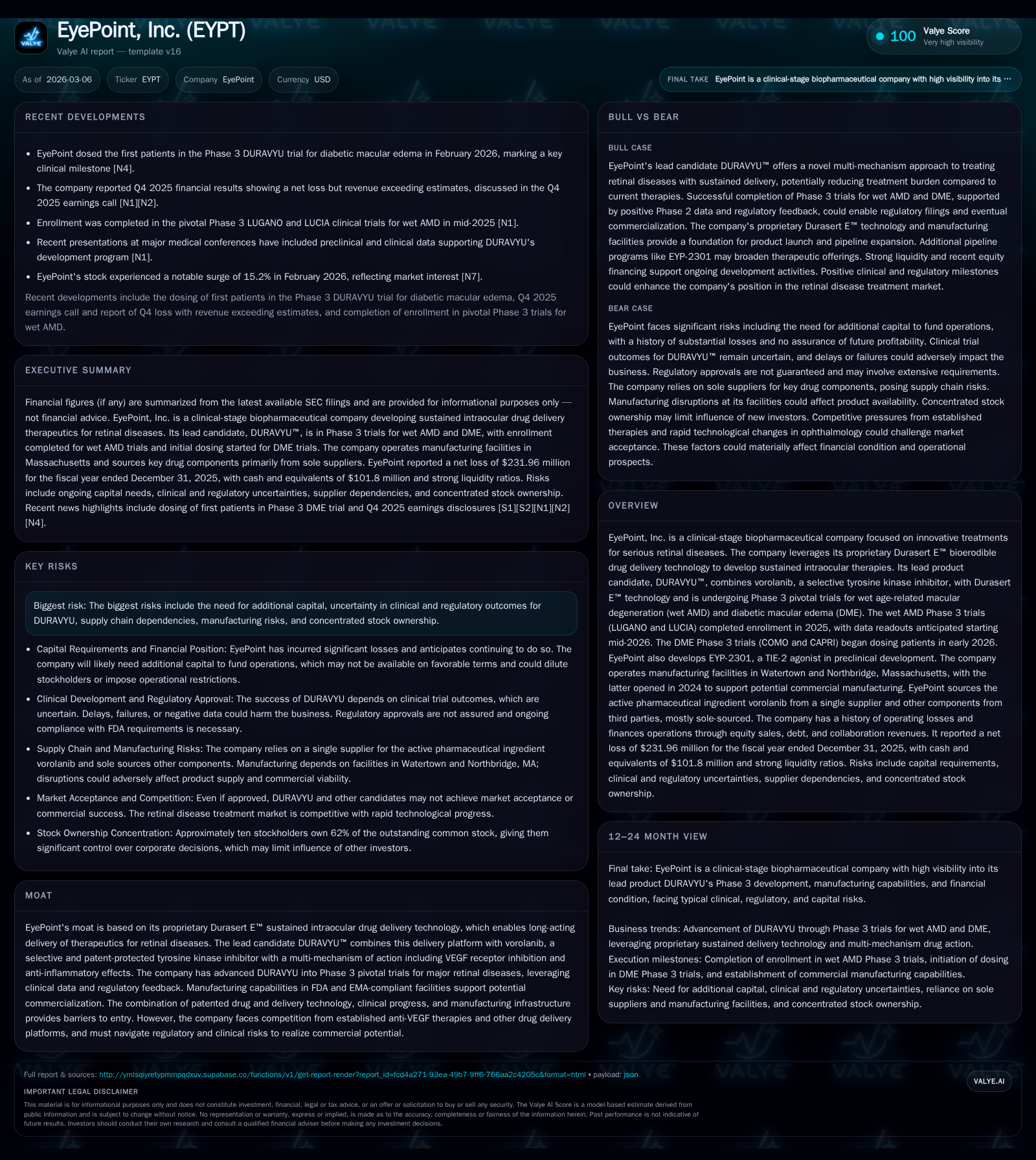
EyePoint, Inc. continues to build on its proprietary sustained intraocular drug delivery platform, Durasert E™, aiming to transform retinal disease treatment with its lead candidate DURAVYU™, currently in pivotal Phase 3 trials for wet AMD and diabetic macular edema. Despite significant revenue growth and increasing R&D investment driving widening operating losses, the company maintains a strong liquidity position but signals a need for additional capital. Regulatory risks—including ongoing DOJ investigations—and competition from established anti-VEGF therapies remain critical headwinds as the company approaches key data readouts expected mid-2026 that will crucially influence its commercial outlook.
Historical Growth Driven by Proprietary Drug Delivery Platform
EyePoint’s financial history reflects a developing biotech profile with minimal early revenues followed by substantial investment in research and development. Revenue increased from $304,000 in FY2016 to $701,000 in FY2017 [F1]. While revenues remain modest relative to expenses, this growth aligns with advancing proprietary technology development.
Operating income has deteriorated sharply over recent years—from an operating loss of approximately -$75 million in FY2023 to -$243 million in FY2025—correlating with increased clinical development and manufacturing investments centered on EyePoint's Durasert E™ sustained intraocular delivery platform [F1]. Net income similarly declined from -$70.8 million in FY2023 to -$232 million by FY2025 [F1].
Operating cash flow has been deeply negative recently (-$240 million in FY2025), reflecting heavy cash burn associated with late-stage clinical trials and operational scaling [F1]. Capital expenditures remained relatively low at $3.3 million in FY2025, focused primarily on facility improvements for regulatory compliance [F1].
Historical performance (annual)
| FY | Net ($mm) | CFO ($mm) | OpInc ($mm) | Capex ($mm) | Net YoY |
|---|---|---|---|---|---|
| 2025 | -232 | -240 | -243 | 3 | -77.2% |
| 2024 | -131 | -126 | -146 | 4 | -84.9% |
| 2023 | -71 | 2 | -75 | 3 | +30.8% |
| 2022 | -102 | -65 | -100 | 2 |
Source: SEC companyfacts cache [F1].
Capital returns and efficiency (annual)
| FY | FCF ($mm) | ROE% |
|---|---|---|
| 2025 | -243 | -75.8 |
| 2024 | -130 | -38.9 |
| 2023 | -2 | -26.6 |
| 2022 | -67 | -106.1 |
Source: SEC companyfacts cache [F1].
*Note: Revenue figures unavailable for recent years; all other figures sourced from SEC filings and XBRL data [F1].
Clinical Development Progress: DURAVYU Trials and Pipeline Updates
EyePoint’s lead candidate DURAVYU™ combines vorolanib—a selective tyrosine kinase inhibitor targeting VEGFR—with the Durasert E™ sustained-release platform designed for intraocular administration [N1][N5][S1]. This dual-action approach aims to improve treatment durability for retinal diseases such as wet age-related macular degeneration (wet AMD) and diabetic macular edema (DME).
By late 2025, EyePoint completed enrollment in pivotal Phase 3 LUGANO and LUCIA studies evaluating DURAVYU for wet AMD [N1]. Early patient data readouts are expected mid-2026. Concurrently, Phase 3 COMO and CAPRI studies for DME initiated dosing in early 2026 [N5], representing important pipeline expansion.
Sustained-release technology like Durasert E™ offers potential advantages over frequent intravitreal injections typical of current anti-VEGF therapies by improving patient adherence and possibly enabling differentiated market positioning contingent on clinical outcomes [S1][N1].
Capital Structure and Financial Health Amid Heavy R&D Investment
At December 31, 2025 EyePoint reported cash and cash equivalents of approximately $101.8 million alongside current assets of $328.7 million versus current liabilities of $37 million—yielding a strong current ratio near 8.9—indicating solid short-term liquidity despite significant cash burn [F1].
Operating cash flow was substantially negative at around $240 million reflecting escalating clinical trial expenses and general administrative costs associated with late-stage development and manufacturing scale-up [F1][S1][N2]. Capital expenditures remained moderate at roughly $3.3 million focused on facility enhancements aligned with FDA/EMA compliance requirements [F1].
The company acknowledges the likely need to raise additional capital given ongoing negative cash flows through advanced clinical stages; such financings may entail dilution or operational restrictions per disclosures [S1]. Equity stood near $306 million at year-end but declined from prior periods due to accumulated net losses; return on equity was approximately -75.8% reflecting continued investment without profitability [F1].
Regulatory Landscape and Potential Judicial Outcomes
EyePoint faces ongoing regulatory scrutiny including a Department of Justice investigation related to historical sales and promotional activities concerning DEXYCU®, which it previously commercialized until recently [S4][S5][S12]. Agreements in principle reached with DOJ and the Department of Health & Human Services Office of Inspector General contemplate settlement payments around $4.7 million plus interest along with commitments to enter corporate integrity agreements aimed at ensuring future compliance.
Finalization of these settlements is expected during the first half of 2026; failure to comply could result in penalties including exclusion from federal healthcare programs such as Medicare and Medicaid or substantial fines negatively impacting the company’s financial condition [S5][S12].
Broader healthcare regulatory risks include evolving enforcement of fraud statutes such as the False Claims Act and Anti-Kickback Statute; pricing pressures under legislation like the Inflation Reduction Act; complex Medicaid rebate reporting obligations; as well as stringent privacy laws including HIPAA requirements—all imposing ongoing operational challenges and cost burdens typical for biopharma companies at this stage [S4–S11][S16–S23].
Forward-Looking Milestones and Industry Positioning
Key upcoming milestones include pivotal Phase 3 top-line data releases for DURAVYU’s wet AMD indication anticipated mid-2026 which will critically influence regulatory review pathways and commercial viability assessments [N1][N5].
Manufacturing capabilities anchored at Watertown and Northbridge facilities remain positioned to meet FDA/EMA quality standards supporting potential rapid scale-up following approval [N1][F1]. The company’s sustained-release platform aims to differentiate against entrenched anti-VEGF therapies that require frequent injections by offering extended dosing intervals coupled with multi-mechanism efficacy.
No specific updated commercial guidance was provided post-readout; however monitoring FDA interactions and competitive dynamics remains essential given the high stakes of late-stage clinical success or failure [N1][F1].
Key Risks: Financing Needs, Regulatory Compliance & Competitive Environment
Primary risks include reliance on external capital markets to fund costly late-stage trials where failure or delays could force operational cutbacks or strategic shifts impacting shareholder value [S1]. Clinical trial outcomes remain uncertain despite prior encouraging phases.
Regulatory risks persist due to DOJ investigations with attendant reputational harm potential even after settlements conclude alongside complex compliance demands from evolving healthcare laws affecting pricing transparency and reimbursement landscapes [S4][S5][S12].
Competition from established anti-VEGF biologics benefits from prescriber familiarity despite frequent injection burdens; emerging alternative delivery platforms backed by larger pharmaceutical firms also present threats necessitating clear differentiation based on safety and efficacy durability profiles.
Operational execution risks relate primarily to manufacturing scale-up while maintaining quality standards requisite for commercialization success.
Disclaimer: This analysis summarizes EyePoint’s financials and pipeline progress based on publicly available data as of March 2026 without providing investment advice or recommendations.
Disclaimer: This is research-only, informational analysis and not investment advice. It may include AI-generated interpretation and general industry context. Always verify important details using primary sources.

Comments