
Grove Collaborative Faces Revenue Declines and Operational Challenges While Pivoting Toward Sustainable Growth
The company navigates shifting consumer demand and strategic platform focus amidst ongoing losses and tightening liquidity.
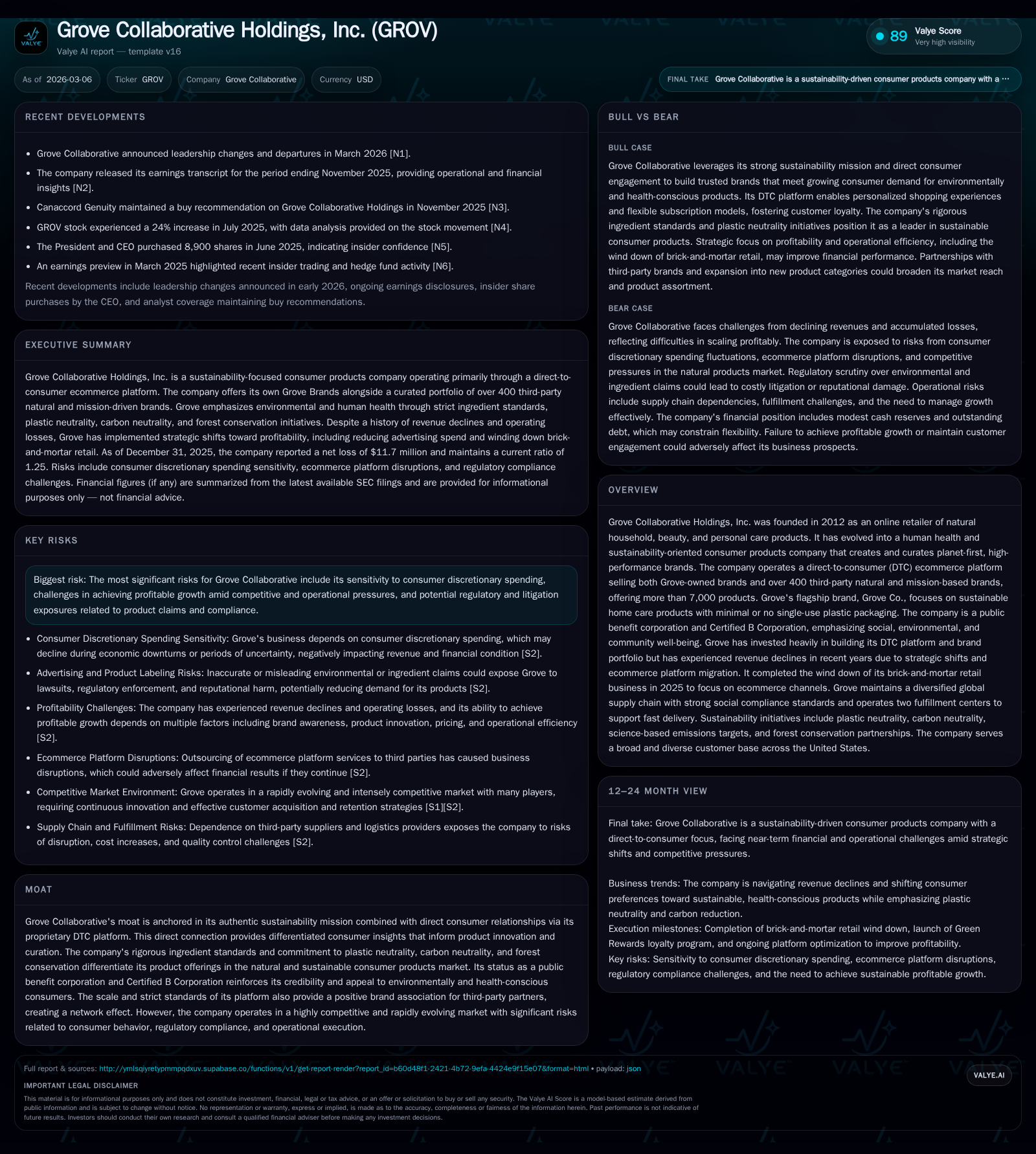
Founded in 2012 as an online natural products retailer, Grove Collaborative has evolved into a sustainability-driven consumer products company relying heavily on direct-to-consumer (DTC) ecommerce. Despite its strong mission and brand differentiators, Grove has experienced consecutive annual revenue declines due to reduced advertising spend, marketplace dynamics, and an exit from brick-and-mortar retail. The firm reported narrowing but still significant net losses in 2025 with negative operating cash flow, reflecting ongoing investment in product innovation and platform capabilities. Its liquidity remains constrained but sufficient for the near term owing to a revolving credit facility and equity injections. Future growth hinges on expanding non-homecare product categories, optimizing customer acquisition costs, and leveraging its sustainability credentials to deepen consumer engagement.
Company Overview and Historical Performance
Grove Collaborative Holdings, Inc., established in 2012 originally as ePantry, has transformed from a third-party natural goods online retailer into a vertically integrated consumer products company focused on sustainability and human health. Operating primarily through its proprietary direct-to-consumer (DTC) ecommerce platform, Grove sells both its own Grove Brands and over 400 curated third-party natural and mission-aligned brands offering more than 7,000 products. The flagship Grove Co. brand emphasizes sustainable home care solutions with minimal plastic packaging.
Since going public via a business combination with Virgin Group Acquisition Corp II in June 2022 [S1][S2], Grove has been balancing investment in brand portfolio expansion and customer acquisition against mounting losses and evolving market dynamics.
Financially, Grove’s top-line results have been pressured; net revenues declined by approximately 15% in fiscal 2025 following a steeper 22% decrease in 2024. This contraction primarily stems from intentional reductions in advertising spend to improve profitability as well as an exit from brick-and-mortar retail sales by end-2025—a channel that historically contributed modestly to revenue but reduced margins [F1][S2][S6]. The company’s shift toward intensified focus on its DTC platform aligns with its strategy to engage consumers directly with sustainability narratives while optimizing cost structure.
Revenue and Product Mix
Revenue generation by segment shows that roughly 41% of net sales in fiscal 2025 originated from Grove Brands, with about three-quarters of this attributable to home care categories such as cleaning agents which embody the company’s sustainability ethos through carbon neutrality and plastic-offset initiatives [S6][S16]. While home care remains the cornerstone category, Grove has articulated plans to increase penetration into expanding health & wellness, beauty, and personal care sectors within its DTC ecosystem.
Profitability Trends
Despite continuous operation at losses since founding—with an accumulated deficit surpassing $660 million—Grove reported marked improvement in profitability metrics during 2025. Net loss narrowed by approximately 57%, reaching -$11.7 million compared to -$27.4 million the prior year [F1]. Operating income similarly improved by nearly half year-over-year to -$11.3 million.
This progress owes partly to rigorous expense management initiatives, including scaled-back advertising outlays aimed at enhancing customer acquisition efficiency and lower fulfillment costs driven by decreased sales volumes [F1][S18][S19]. Still, the absence of positive operating income indicates that Grove remains some distance from sustainable profitability.
Cash Flow and Capital Expenditure
Operational cash flow continued negative at -$7.0 million for fiscal 2025 but reflected a nearly 29% improvement relative to prior year levels indicating tighter working capital management alongside reduced operating expenses [F1]. Capital expenditures also declined sharply by over one-third year-over-year to approximately $1.16 million as the firm shifted toward leaner capital investment consistent with scaling back physical retail operations and warehouse automation projects.
Liquidity Position and Capital Structure
As of December 31, 2025, Grove held roughly $8.5 million in unrestricted cash plus restricted cash totaling $3.3 million across various collateral accounts primarily for letters of credit related to leases [F1][S10]. The company's primary debt instrument is a $35 million revolving credit facility ("Siena Revolver") secured against inventory, accounts receivable, and certain cash balances with an outstanding balance of $7.5 million maturing April 10, 2028 [F1][S4][S7][S20]. Interest rates on borrowings float based on Prime Rate or Term SOFR plus respective spreads up to around eight percent effective rate currently.
Additionally, Grove raised equity capital through issuance of Series A Redeemable Convertible Preferred Stock in August 2023 ($10 million) and again in September 2024 ($15 million), augmenting financial flexibility but diluting shareholders accordingly [S11]. Management asserts current resources are sufficient for operational needs over at least the next twelve months though cautions additional capital may be required should strategic investments or unanticipated contingencies arise [S7][S9].
Strategic Initiatives and Operational Adjustments
Grove has executed several operational streamlining measures including workforce reductions announced November 2025 designed to lower fixed costs amid softened demand trends [N1][S18]. Concurrently the company fully exited brick-and-mortar retail channels during calendar year 2025 deeming that concentrated efforts on DTC offer higher returns alongside preservation of sustainability positioning exclusivity.
December of last year saw introduction of "Green Rewards," a customer loyalty program aimed at driving repeat purchases through rewards accrued on product purchases or other activities redeemable against future orders—a critical lever as Grove grapples with cost-effective customer retention amid competitive pressure [S17].
Market Positioning and Moat Considerations
Grove’s differentiated value proposition derives from authentic commitment to sustainability rigorously embedded through its public benefit corporation status and Certified B Corporation certification which align with consumer values for environmental stewardship combined with human health concerns [S6]. Its proprietary DTC platform facilitates enhanced data-driven personalization capabilities allowing real-time consumer feedback translation into new product innovation cycles faster than traditional brick-and-mortar channels.
However, this moat faces challenges given the crowded nature of the natural products market space where competition spans established CPG giants marketing green lines alongside emerging digitally native brands aggressively targeting similar eco-conscious cohorts.
Risk Profile and Regulatory Environment
Key risks center on dependency on discretionary consumer spending which may fluctuate due to macroeconomic conditions affecting household budgets for premium-priced natural products [S23]. The firm is also under investigation by California regulators concerning automatic subscription renewal practices mandating adjustments that could impact recurring revenue streams or impose compliance costs [S23]. Meanwhile product liability claims linked to ingredient transparency or environmental assertions pose litigation risk potentially detrimental both financially and reputationally.
Furthermore, ongoing competitive intensity requires sustained innovation push while prudently managing customer acquisition costs; failure may erode market share or elongate the pathway to profitability.
Outlook: Drivers and Constraints for Growth
Looking ahead, Grove’s growth trajectory depends largely on expanding healthy contributions from adjacent categories (wellness, beauty) beyond core home care which accounted for nearly three quarters of its branded revenue mix in recent periods [S6]. Success also hinges on maximizing lifetime value of customers through programs like Green Rewards while balancing promotional discounting against margin preservation.
New product launches emphasizing performance parity or superiority relative to conventional CPG offerings combined with clear sustainability credentials represent avenues for driving incremental wallet share among environmentally motivated consumers. Evolving digital marketing strategies calibrated toward more efficient CAC (customer acquisition cost) will be crucial given recent pullbacks in advertising spend impacting topline yet vital to avoid stagnation.
Monitoring how the company navigates regulatory developments around subscription practices will provide signals about ongoing stability of its subscriber base revenue streams.
Annual Financial Summary (USD thousands)
Historical performance (annual)
| FY | Net ($mm) | CFO ($mm) | OpInc ($mm) | Capex ($mm) | Net YoY |
|---|---|---|---|---|---|
| 2025 | -12 | -7 | -11 | 1 | +57.3% |
| 2024 | -27 | -10 | -23 | 2 | +36.6% |
| 2023 | -43 | -8 | -35 | 3 | +50.7% |
| 2022 | -88 | -96 | -141 | 4 |
Source: SEC companyfacts cache [F1].
Capital returns and efficiency (annual)
| FY | FCF ($mm) | ROE% |
|---|---|---|
| 2025 | -8 | 68.9 |
| 2024 | -12 | 320.8 |
| 2023 | -11 | -532.3 |
| 2022 | -100 | -330.6 |
Source: SEC companyfacts cache [F1]. Operating income improved almost fivefold from huge loss level seen in FY22 but remains negative illustrating gradual stabilization. Cash equivalents nearly halved from FY24 reflecting burn rate; current ratio approx.1.25 suggests manageable short-term liquidity. Capex declining steadily highlighting shift toward cost containment.
Conclusion
Grove Collaborative remains emblematic of mission-driven natural CPG disruptors wrestling with scaling economics while preserving brand authenticity amid market headwinds. Its progress toward narrowing losses coupled with strategic refocus on DTC strength represents steps forward but structural challenges remain including sustained unprofitability alongside heightened regulatory scrutiny risks. Successful expansion into new categories coupled with disciplined cost control measures will be critical levers alongside optimized customer engagement programs for cultivating durable profitable growth. Stakeholders should monitor regulatory developments impacting subscriptions alongside quarterly guidance issued around revenue trends given historically volatile top-line influenced by marketing spend variations.
This analysis is prepared solely for informational purposes without any investment recommendation or assurance regarding future company performance. Readers should independently verify all data including regulatory filings before making decisions.
Disclaimer: This is research-only, informational analysis and not investment advice. It may include AI-generated interpretation and general industry context. Always verify important details using primary sources.

Comments